
Researchers outline a bold strategy to scale neuromorphic computing, aiming to match human brain functionality with minimal energy use.
This involves developing advanced neuromorphic chips and fostering strong industry-academic partnerships, potentially transforming AI and healthcare through improved efficiency and capability.
Scaling Up Neuromorphic Computing
Neuromorphic computing, which applies neuroscience principles to create computer systems that function like the human brain, must scale up to compete with traditional computing methods. A recent review published on January 22 in the journal Nature outlines a roadmap for achieving this goal. The paper, authored by 23 researchers — including two from the University of California San Diego — provides practical insights into developing computing systems that match the brain’s cognitive abilities while maintaining a similar size and power efficiency.
“We do not anticipate that there will be a one-size-fits-all solution for neuromorphic systems at scale but rather a range of neuromorphic hardware solutions with different characteristics based on application needs,” the authors write.
Credit: David Baillot/University of California San Diego
Potential Applications and Benefits
Applications for neuromorphic computing include scientific computing, artificial intelligence, augmented and virtual reality, wearables, smart farming, smart cities, and more. Neuromorphic chips have the potential to outpace traditional computers in energy and space efficiency, as well as performance. This could present substantial advantages across various domains, including AI, health care, and robotics. As the electricity consumption of AI is projected to double by 2026, neuromorphic computing emerges as a promising solution.
“Neuromorphic computing is particularly relevant today, when we are witnessing the untenable scaling of power- and resource-hungry AI systems,” said Gert Cauwenberghs, a Distinguished Professor in the UC San Diego Shu Chien-Gene Lay Department of Bioengineering and one of the paper’s co-authors.

Building New Architectures
Neuromorphic computing is at a pivotal moment, said Dhireesha Kudithipudi, the Robert F. McDermott Endowed Chair at the University of Texas San Antonio and the paper’s corresponding author. “We are now at a point where there is a tremendous opportunity to build new architectures and open frameworks that can be deployed in commercial applications,” she said. “I strongly believe that fostering tight collaboration between industry and academia is the key to shaping the future of this field. This collaboration is reflected in our team of co-authors.”
Last year, Cauwenberghs and Kudithipudi secured a $4 million grant from the National Science Foundation to launch THOR: The Neuromorphic Commons, a first-of-its-kind research network providing access to open neuromorphic computing hardware and tools in support of interdisciplinary and collaborative research.
NeuRRAM Chip Developments
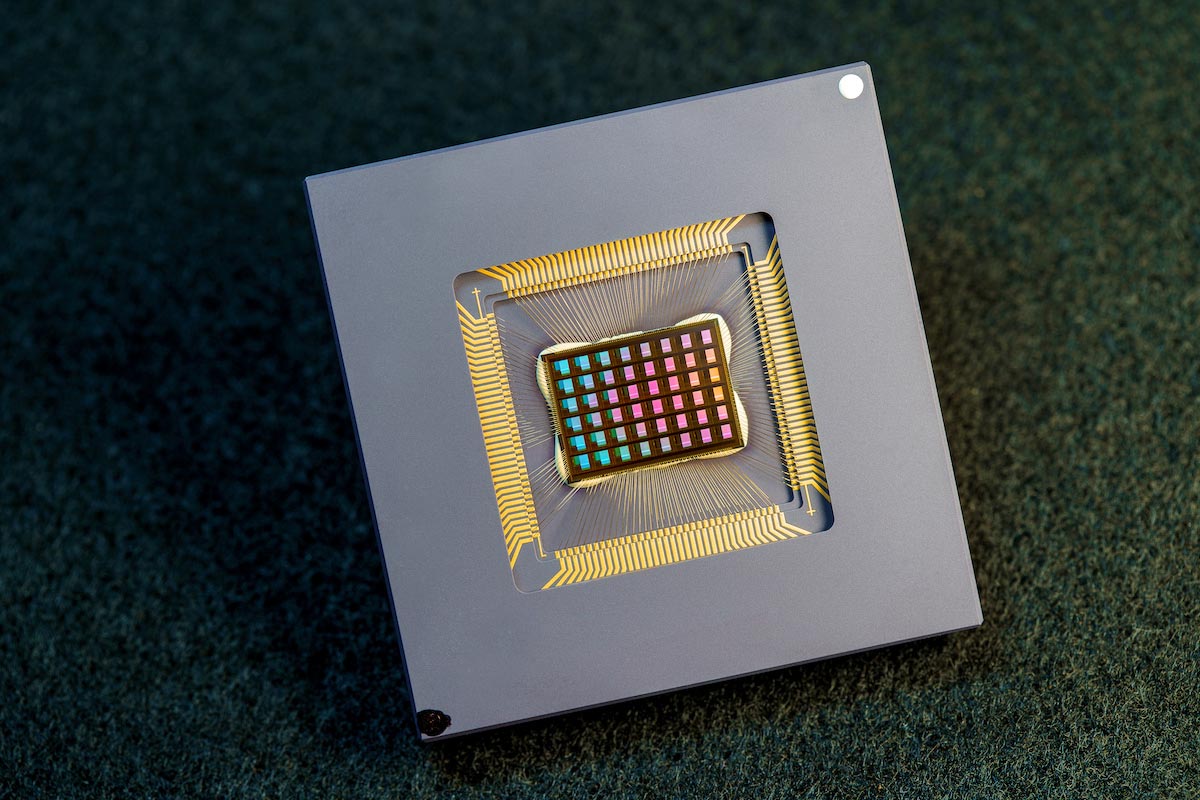
In 2022, a neuromorphic chip designed by a team led by Cauwenberghs showed that these chips could be highly dynamic and versatile, without compromising accuracy and efficiency. The NeuRRAM chip runs computations directly in memory and can run a wide variety of AI applications—all at a fraction of the energy consumed by computing platforms for general-purpose AI computing. “Our Nature review article offers a perspective on further extensions of neuromorphic AI systems in silicon and emerging chip technologies to approach both the massive scale and the extreme efficiency of self-learning capacity in the mammalian brain,” said Cauwenberghs.
To achieve scale in neuromorphic computing, the authors propose several key features that must be optimized, including sparsity, a defining feature of the human brain. The brain develops by forming numerous neural connections (densification) before selectively pruning most of them. This strategy optimizes spatial efficiency while retaining information at high fidelity. If successfully emulated, this feature could enable neuromorphic systems that are significantly more energy-efficient and compact.
Future Directions and Collaborative Potential
“The expandable scalability and superior efficiency derive from massive parallelism and hierarchical structure in neural representation, combining dense local synaptic connectivity within neurosynaptic cores modeled after the brain’s gray matter with sparse global connectivity in neural communication across cores modeling the brain’s white matter, facilitated through high-bandwidth reconfigurable interconnects on-chip and hierarchically structured interconnects across chips,” said Cauwenberghs.
“This publication shows tremendous potential toward the use of neuromorphic computing at scale for real-life applications. At the San Diego Supercomputer Center, we bring new computing architectures to the national user community, and this collaborative work paves the path for bringing a neuromorphic resource for the national user community,” said Amitava Majumdar, director of the division of Data-Enabled Scientific Computing at SDSC here on the UC San Diego campus, and one of the paper’s co-authors.
Enhancing Accessibility and Collaboration
The authors also emphasize the need for stronger collaboration within academia and between academia and industry. They advocate for the development of more user-friendly programming languages to make the field more accessible. They believe these efforts will encourage greater interdisciplinary and industry-wide cooperation.
Reference: “Neuromorphic computing at scale” by Dhireesha Kudithipudi, Catherine Schuman, Craig M. Vineyard, Tej Pandit, Cory Merkel, Rajkumar Kubendran, James B. Aimone, Garrick Orchard, Christian Mayr, Ryad Benosman, Joe Hays, Cliff Young, Chiara Bartolozzi, Amitava Majumdar, Suma George Cardwell, Melika Payvand, Sonia Buckley, Shruti Kulkarni, Hector A. Gonzalez, Gert Cauwenberghs, Chetan Singh Thakur, Anand Subramoney and Steve Furber, 22 January 2025, Nature.
DOI: 10.1038/s41586-024-08253-8
Never miss a breakthrough: Join the SciTechDaily newsletter.
Follow us on Google and Google News.
2 Comments
“Neuromorphic computing, which applies neuroscience principles to create computer systems that function like the human brain…”
—-
We can’t design a computer in the image of our brains since, despite centuries of study, we still do not know how the brain stores information, nor how to access such information.
I’m past 70 YO but I can immediately retrieve memories of experiences and people from 65 years ago from a 3lb grouping of cells that is powered by eating and digesting simple foods!
Why can’t we figure out how data is being stored in the brain and how to read it?
What are hundreds of thousands of brain researchers DOING with their their 40-60 hour weeks?
Exactly, well stated. I will add that the linked article published in Nature is not open access, even though the authors are funded by taxpayer dollars. Like nuclear fusion, the progress of the neuromorphic computing field toward the goal of replicating the human (or any animal) brain is always always decades away. The primary problem is the repeated use of conventional approaches that don’t work, inorganic hardware among them.