
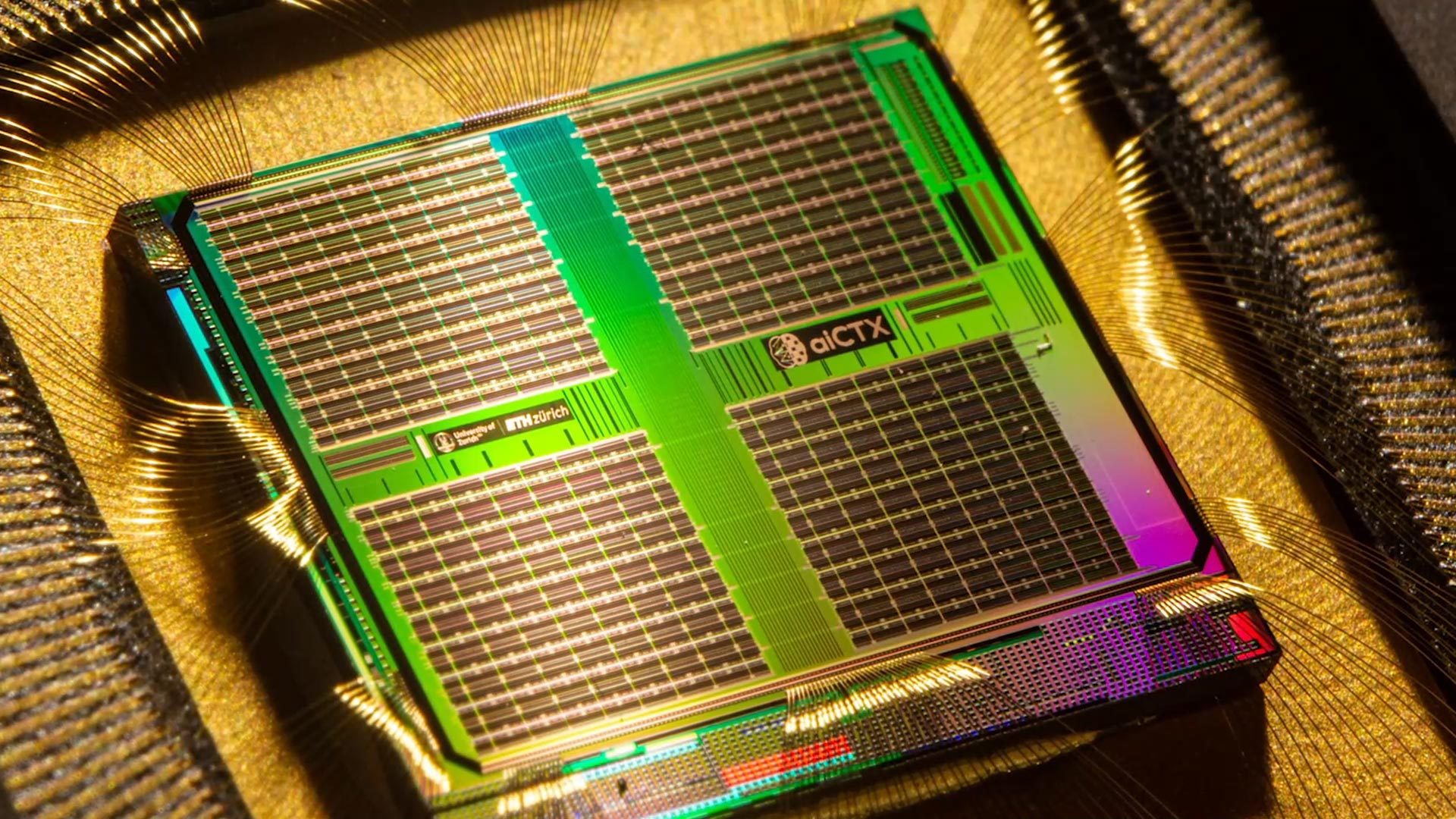
Zurich scientists have created a neuromorphic chip that identifies seizure-related brainwaves in real time.
Researchers from Zurich have developed a compact, energy-efficient device made from artificial neurons that is capable of decoding brainwaves. The chip uses data recorded from the brainwaves of epilepsy patients to identify which regions of the brain cause epileptic seizures. This opens up new perspectives for treatment.
Current neural network algorithms produce impressive results that help solve an incredible number of problems. However, the electronic devices used to run these algorithms still require too much processing power. These artificial intelligence (AI) systems simply cannot compete with an actual brain when it comes to processing sensory information or interactions with the environment in real time.
Neuromorphic Chip Detects High-Frequency Oscillations
Neuromorphic engineering is a promising new approach that bridges the gap between artificial and natural intelligence. An interdisciplinary research team at the University of Zurich, the ETH Zurich, and the UniversityHospital Zurich has used this approach to develop a chip based on neuromorphic technology that reliably and accurately recognizes complex biosignals. The scientists were able to use this technology to successfully detect previously recorded high-frequency oscillations (HFOs). These specific waves, measured using an intracranial electroencephalogram (iEEG), have proven to be promising biomarkers for identifying the brain tissue that causes epileptic seizures.
Complex, Compact, and Energy Efficient
The researchers first designed an algorithm that detects HFOs by simulating the brain’s natural neural network: a tiny so-called spiking neural network (SNN). The second step involved implementing the SNN in a fingernail-sized piece of hardware that receives neural signals by means of electrodes and which, unlike conventional computers, is massively energy efficient. This makes calculations with a very high temporal resolution possible, without relying on the internet or cloud computing. “Our design allows us to recognize spatiotemporal patterns in biological signals in real time,” says Giacomo Indiveri, professor at the Institute for Neuroinformatics of UZH and ETH Zurich.
Measuring HFOs in Operating Theaters and Outside of Hospitals
The researchers are now planning to use their findings to create an electronic system that reliably recognizes and monitors HFOs in real time. When used as an additional diagnostic tool in operating theaters, the system could improve the outcome of neurosurgical interventions.
However, this is not the only field where HFO recognition can play an important role. The team’s long-term target is to develop a device for monitoring epilepsy that could be used outside of the hospital and that would make it possible to analyze signals from a large number of electrodes over several weeks or months. “We want to integrate low-energy, wireless data communications in the design – to connect it to a cellphone, for example,” says Indiveri. Johannes Sarnthein, a neurophysiologist at University Hospital Zurich, elaborates: “A portable or implantable chip such as this could identify periods with a higher or lower rate of incidence of seizures, which would enable us to deliver personalized medicine.” This research on epilepsy is being conducted at the Zurich Center of Epileptology and Epilepsy Surgery, which is run as part of a partnership between University Hospital Zurich, the Swiss Epilepsy Clinic and the University Children’s Hospital Zurich.
Reference: “An electronic neuromorphic system for real-time detection of high frequency oscillations (HFO) in intracranial EEG” by Mohammadali Sharifshazileh, Karla Burelo, Johannes Sarnthein and Giacomo Indiveri, 25 May 2021, Nature Communications.
DOI: 10.1038/s41467-021-23342-2
Never miss a breakthrough: Join the SciTechDaily newsletter.
Follow us on Google and Google News.