
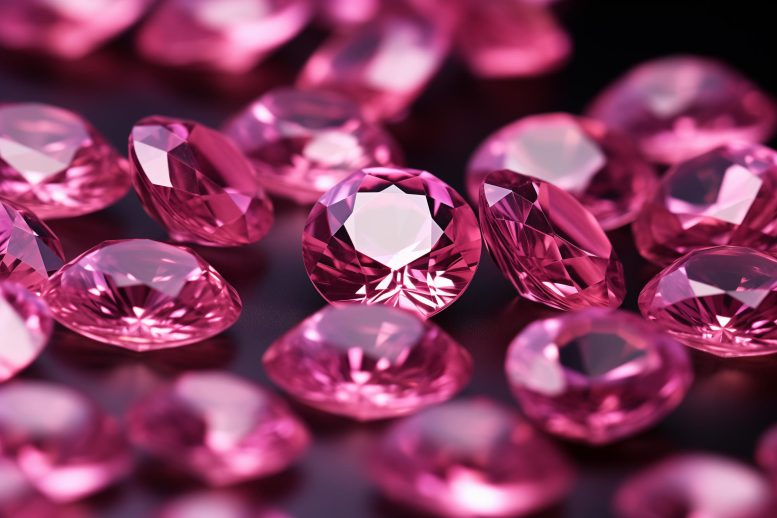
Curtin University researchers studying diamond-rich rocks from Western Australia’s Argyle volcano have identified the missing third key ingredient needed to bring valuable pink diamonds to the Earth’s surface where they can be mined, which could greatly help in the global hunt for new deposits.
Role of ‘Stretching’ in Diamond Emergence
While it is known that for diamonds to form there needs to be carbon deep in the Earth, and for these diamonds to turn pink they must be subjected to forces from colliding tectonic plates, the new study has found the third ingredient needed for the presence of pink diamonds at surface level, which is continents that were ‘stretched’ during continental break-up hundreds of millions of years ago.
Lead researcher Dr Hugo Olierook, from Curtin’s John de Laeter Centre, said the ‘stretching’ of landmasses created gaps in the Earth’s crust through which diamond-carrying magma could rise to the surface.
“By using laser beams smaller than the width of a human hair on rocks supplied by Rio Tinto, we found Argyle to be 1.3 billion years old, which is 100 million years older than previously thought, meaning it would likely have formed as a result of an ancient supercontinent breaking apart,” Dr. Olierook said.
“Argyle is located at the point where the Kimberley region and the rest of northern Australia smashed together many years prior, and that sort of collision creates a damaged area or ‘scar’ in the land that will never fully heal.
“While the continent that would become Australia didn’t break up, the area where Argyle is situated was stretched, including along the scar, which created gaps in the Earth’s crust for magma to shoot up through to the surface, bringing with it pink diamonds.
“As long as these three ingredients are present – deep carbon, continental collision, and then stretching – then we think it will be possible to find the ‘next Argyle’, which was once the world’s largest source of natural diamonds.”
Argyle’s Significance in the Diamond World
Dr Olierook said even with the knowledge of these three ingredients, finding another trove of pink diamonds will not be without its challenges.
“Most diamond deposits have been found in the middle of ancient continents because their host volcanoes tend to be exposed at the surface for explorers to find,” Dr Olierook said.
“Argyle is at the suture of two of these ancient continents, and these edges are often covered by sand and soil, leaving the possibility that similar pink diamond-bearing volcanoes still sit undiscovered, including in Australia.”
Co-author and principal geologist Murray Rayner, from Rio Tinto, said the Argyle volcano has produced more than 90 percent of the world’s pink diamonds, making it an unparalleled source of these rare and coveted gems.
“Knowing the Argyle volcano’s age, at 1.3 billion years old, and situated where some of Earth’s earliest continents fragmented, we have significant further insights into the formation of these diamonds,” Rayner said.
Reference: “Emplacement of the Argyle diamond deposit into an ancient rift zone triggered by supercontinent breakup” by Hugo K. H. Olierook, Denis Fougerouse, Luc S. Doucet, Yebo Liu, Murray J. Rayner, Martin Danišík, Daniel J. Condon, Brent I. A. McInnes, A. Lynton Jaques, Noreen J. Evans, Bradley J. McDonald, Zheng-Xiang Li, Christopher L. Kirkland, Celia Mayers and Michael T. D. Wingate, 19 September 2023, Nature Communications.
DOI: 10.1038/s41467-023-40904-8
The authors are affiliated with the John de Laeter Centre, the Timescales of Mineral Systems Group and the Earth Dynamics Research Group, which sit within Curtin’s School of Earth and Planetary Sciences. The work was enabled by AuScope and the Australian Government via the National Collaborative Research Infrastructure Strategy.
The study was funded by the Geological Survey of Western Australia.
Never miss a breakthrough: Join the SciTechDaily newsletter.
Follow us on Google and Google News.