
Tiny minerals are revolutionizing our understanding of geology.
Easter Island consists of several extinct volcanoes. The oldest lava deposits formed some 2.5 million years ago on top of an oceanic plate not much older than the volcanoes themselves. In 2019, a team of Cuban and Colombian geologists left for Easter Island to accurately date the volcanic island. To do so, they resorted to a tried-and-tested recipe: dating zircon minerals. When magma cools, these minerals crystallize. They contain a bit of uranium, which ‘turns’ into lead through radioactive decay.
Because we know how fast that process happens, we can measure how long ago those minerals formed. The team from Colombia’s Universidad de Los Andes, led by Cuban geologist Yamirka Rojas-Agramonte, therefore went in search of those minerals. Rojas-Agramonte, now at the Christian Albrechts-University Kiel, found hundreds of them. But surprisingly, not only from 2.5 million years old, but also from much further back in time, up to 165 million years ago. How could that be?
Earth’s mantle
Chemical analysis of the zircons showed that their composition was more or less the same in all cases. So, they all had to have come from magma of the same composition as that of today’s volcanoes.

Yet those volcanoes cannot have been active for 165 million years, because the plate below them is not even that old. The only explanation then is that the ancient minerals originated at the source of volcanism, in the Earth’s mantle beneath the plate, long before the formation of today’s volcanoes. But that presented the team with yet another conundrum.
Hotspot volcanoes and their origins
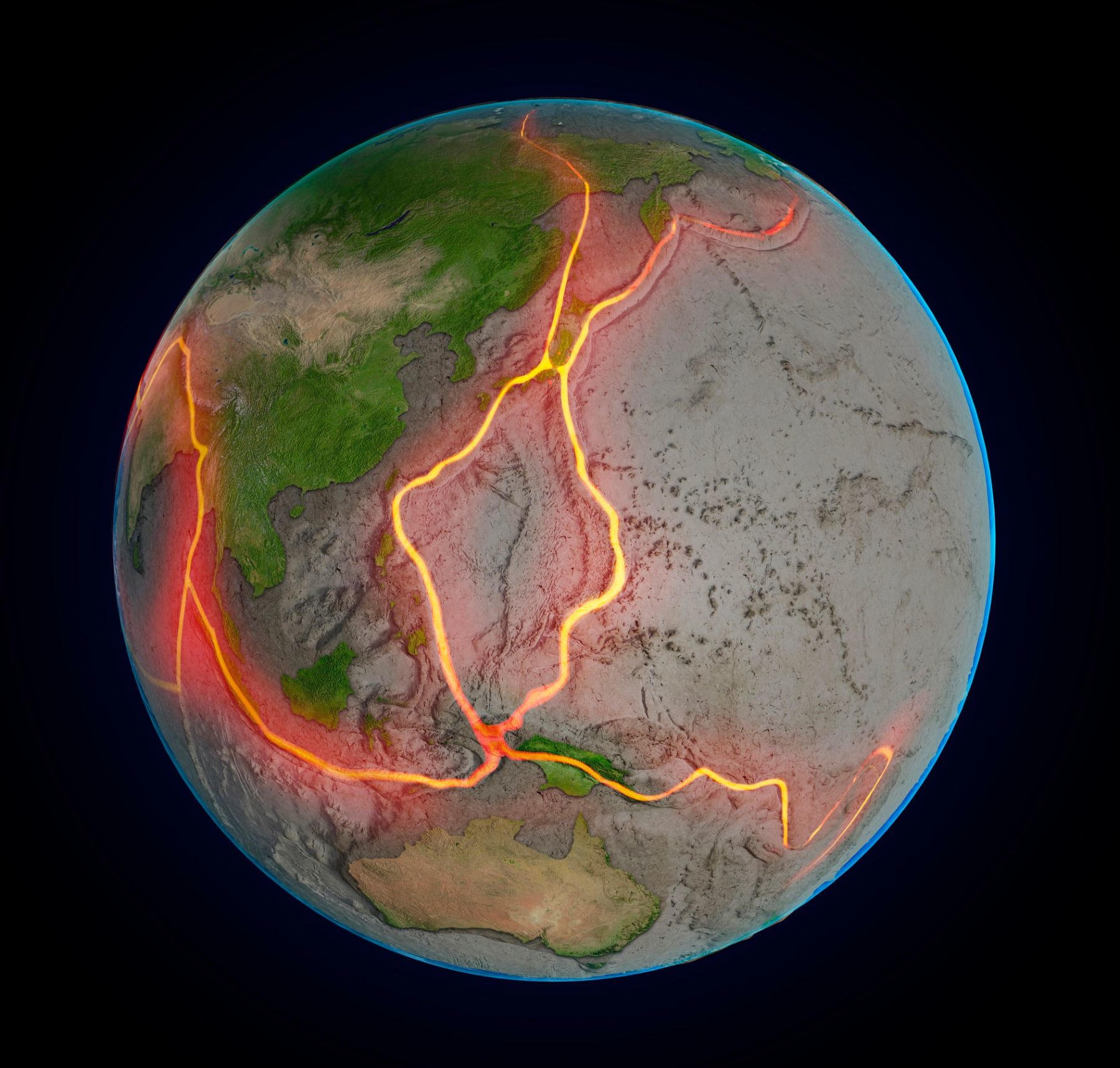
Volcanoes like those on Easter Island are so-called ‘hotspot volcanoes’. These are common in the Pacific Ocean; Hawai’i is a famous example. They form from large blobs of rock that slowly rise from the deep Earth’s mantle – so-called mantle plumes.
When they get close to the base of the Earth’s plates, the rocks of the plume as well as from the surrounding mantle melt and form volcanoes. Scientists have known since the 1960s that mantle plumes stay in place for a very long time while the Earth’s plates move over them. Every time the plate shifts a bit, the mantle plume produces a new volcano.
This explains the rows of extinct underwater volcanoes in the Pacific Ocean, with one or a few active ones at the end. Had the team found evidence that the mantle plume under Easter Island has been active for 165 million years?
Subduction zones
To answer that question, Rojas-Agramonte needed evidence from the geology of the ‘Ring of Fire’, an area around the ocean with many earthquakes and volcanism, where oceanic plates dip (‘subduct’) into the Earth’s mantle. So she contacted Utrecht geologist Douwe van Hinsbergen.
“The difficulty is that the plates from 165 million years ago have long since disappeared in those subduction zones,” says Van Hinsbergen, who had reconstructed the vanished pieces in detail. When he added a large volcanic plateau to those reconstructions at the site of present-day Easter Island 165 million years ago, it turned out that that plateau must have disappeared under the Antarctic Peninsula some 110 million years ago.

“And that just so happened to coincide with a poorly understood phase of mountain building and crust deformation in that exact spot. That mountain range, whose traces are still clearly visible, could well be the effect of subduction of a volcanic plateau that formed 165 million years ago.”
His reconstruction therefore showed that the Easter Island mantle plume could very well have been active for that long. This would solve the geological mystery of Easter Island: the ancient zircon minerals would be remnants of earlier magmas that were brought to the surface from deep inside the earth, along with younger magmas in volcanic eruptions.
Inconsistencies
But then another problem presents itself. The classical ‘conveyor belt theory’ was already difficult to reconcile with the observation that mantle plumes stay in place while everything around them continues to move.
Van Hinsbergen: “People explained this by saying that plumes rise so fast that they are not affected by a mantle that was moving with the plates. And that new plume material is constantly being supplied under the plate to form new volcanoes.” But in that case, old bits of the plume, with the old zircons, should have been carried off by those mantle currents, away from the location of Easter Island, and could not now be there at the surface. “From that, we draw the conclusion that those ancient minerals could have been preserved only if the mantle surrounding the plume is basically as stationary as the plume itself.”
The discovery of the ancient minerals on Easter Island therefore suggests that the Earth’s mantle behaves fundamentally differently and moves much slower than has always been assumed; a possibility that both Rojas-Agramonte and Van Hinsbergen and their teams raised a few years ago in studies on the Galapagos Islands and New Guinea, and for which Easter Island now provides new clues.
Reference: “Zircon xenocrysts from Easter Island (Rapa Nui) reveal hotspot activity since the middle Jurassic” by Yamirka Rojas-Agramonte, Natalia Pardo, Douwe J.J. van Hinsbergen, Christian Winter, María Paula Marroquín-Gómez, Shoujie Liu, Axel Gerdes, Richard Albert, Shitou Wu and Antonio Garcia-Casco, 29 November 2023, ESS Open Archive.
DOI: 10.22541/au.170129661.17646127/v1
Never miss a breakthrough: Join the SciTechDaily newsletter.
Follow us on Google and Google News.
18 Comments
Is it possible that the zircon minerals being of that age could have been a part of an old tectonic plate or just part of a rock formation that survived the melting and crystallization process of the mantle, possibly being somehow lodged in the uppermost part of the mantle for that length of time and as such becoming a part of the younger rock formation?
We are repeating facts over & over to call it education so when theories are presented it takes time to work out the politics involved, the egos of the scientists, their research backgrounds, all the machinations of science, so l asked AI about the expanding earth theory, convinced it was correct, it looks like all the land above sea level fits neatly into a smaller ball. AI informs me it is a redundant theory???1970
Sounds like a new take on “global warming”
Thank You!
The Department of Redundancy
Department
This is the comment I was looking for. The Expanding Earth theory explains so much, and whenever Continental Drift theories are met with complications like the ones found in this article, the Expanding Earth theory handles it perfectly. When I first learned of it, I thought it was silly, but the more I studied it, the more perfectly it makes sense. No other explanation exists for while whale fossils are found on the tops of mountains.
I am curious over one thing
The world as we see it now is very much like you see it
Example Africa fits neatly into south America north America drifted from Europe leaving Greenland in the middle
Iceland wasn’t there it was formed by a hotspot much later
But the PACIFIC ICEAN RIM is quite different a huge circular basin full if water and hotspots
This huge circular rim could quite easily have been formed by the moon bring ejected from earth 4.657 billion years ago
COUKD IT BE POSSIBLE ???
Just for fun,, Some scientist studying MT. ST. HELENS decided to test the age of some newly extruded rock there. It should have tested as being “ZERO ” basically. But instead, it came out saying that this brand- new earth was 2.5 MILLION YEARS OLD!!!!
What the St. Helens zircons suggest is that they crystallized about 2.5 million years ago, but the magma remained liquid and capable of erupting to the present day. Zircons have a very high melting temperature, meaning that they are one of the first minerals to crystalize as the magma cools.
Zircons are very refractory and chemically inert. Therefore, they can survive a long time even in a sedimentary environment. The solution to the conundrum is to take a large number of samples and a plot the ages to get an age distribution. If the distribution is multi-modal, then it can probably be assumed safely that there is more than one source. One might have to look for other minor elements to support the idea of multiple sources. A simple normal distribution suggests that most of the zircons were crystallized around the mean age, with the range (+/- 2-3 sigma) suggesting the length of time the zircons were crystallizing.
Assuming one even believes in atheistic theories and milliins of years mumbo-jumbo.
So you’re preparing for the God of Knowledge with…belief?
I have wanted to learn plate tectonics my entire life. Always been fascinated. Alas I am too old now.
You’re never too old to learn new things and to accept changes in theories that science uncovers. That’s the nature of science.
Go forth and learn😁
The problem isn’t learning something new, it is how to prevent forgetting it. 🙂
Thej trctonic playes are a very interesting subject
Easter Island fascinates me🏝️😃🐣
It’s good to ponder things, but in the face of new information that contradicts what we know it’s not the best idea to make assumptions or to draw conclusions, and certainly isnt necessary in order to present the information.
“Mysterious” whoa, more stuff for the periodic table? Or, more scientific babble discussing basement rock composition versus sedimentary deposited stuff?
Plate techonice were finally nailed down in the 60s. However like Missoula floods, denied by science for decades prior.
This zircon is a remarkable proof of how relative and fragile everything is, especially our knowledge.
It started in geology with fossils, geosynclines and fixists, to get to plate tectonics and mobilists, and now we are still struggling with 5-o symmetrical syngonia and cosmic influences, but we also discovered water in the mantle as well as biomineralogy that we don’t even know what to do with yet. However, we behave as if everything is OK and great.
But (as jusualy) the question is how deep do we throw? – Well, let’s say up to about 10 km. Given that our 3rd stone from the Sun has a radius of cca. 6,200 km, this practically means that all of us geologists together still live in the era of 2-D geology. And look at the miracle, with it we manage to interpret the geology of the Moon, Mars and even Europa or the Io, which are orbiting Jupiter there. That sounds really nice, until some kind of 3-D data appears, such as those little zircons, and there are a bunch of others.
Then comes the reset, because we still have no idea about the foundations of geology (except for some models and simulations based on AI, machine programming and probability of events): about fluid mechanics, plasma and pressure states of matter below 10km!
Well, only when we solve those little problems with 3D geology, only then can we start solving tasks and problems from 4-D geology. About which we can only to guess, and in reality we cannot even imagine, but that is science and it cannot be otherwise.