

Close Menu
    Facebook X (Twitter) Instagram
    SciTechDaily
    • Biology
    • Chemistry
    • Earth
    • Health
    • Physics
    • Science
    • Space
    • Technology
    Facebook X (Twitter) Pinterest YouTube RSS
    SciTechDaily
    Home»Technology»Unlocking the Secrets of Dynamic Piezoelectricity in Ferroelectric Hafnia
    Technology

    Unlocking the Secrets of Dynamic Piezoelectricity in Ferroelectric Hafnia

    By Helmholtz-Zentrum Berlin für Materialien und EnergieFebruary 28, 2024No Comments4 Mins Read
    Facebook Twitter Pinterest Telegram LinkedIn WhatsApp Email Reddit
    Share
    Facebook Twitter LinkedIn Pinterest Telegram Email Reddit
    Abstract Astrophysics Physics Tunnel Art Concept
    An international research team has discovered that the piezoelectric properties of Hf0.5Zr0.5O2 capacitors can be dynamically altered by external electrical cycling, leading to the inversion of the piezoelectric effect’s sign. This revelation, supported by density functional theory, suggests the possibility of creating non-piezoelectric ferroelectric compounds, opening new avenues for the development of advanced ferroelectric HfO2-based devices. Credit: SciTechDaily.com

    Hafnium oxide thin films are a fascinating class of materials with robust ferroelectric properties in the nanometer range. While the ferroelectric behavior is extensively studied, results on piezoelectric effects have so far remained mysterious. A new study now shows that the piezoelectricity in ferroelectric Hf0.5Zr0.5O2 thin films can be dynamically changed by electric field cycling. Another ground-breaking result is a possible occurrence of an intrinsic non-piezoelectric ferroelectric compound. These unconventional features in hafnia offer new options for use in microelectronics and information technology.

    Since 2011, it has been known that certain hafnium oxides, are ferroelectric, that is, they possess a spontaneous electric polarization whose direction can be switched in the opposite one by applying an external electric field. All ferroelectrics exhibit piezoelectricity and, most often, a positive longitudinal piezoelectric coefficient (d33). This means that the crystal expands if the applied electric field is in the same direction as the electrical polarization.

    However, for hafnia, studies have shown contradictory results, with different hafnia films expanding or contracting in the same experimental conditions. Moreover, the ferroelectric polarization can apparently switch against the electrical field, which is called “anomalous” switching.
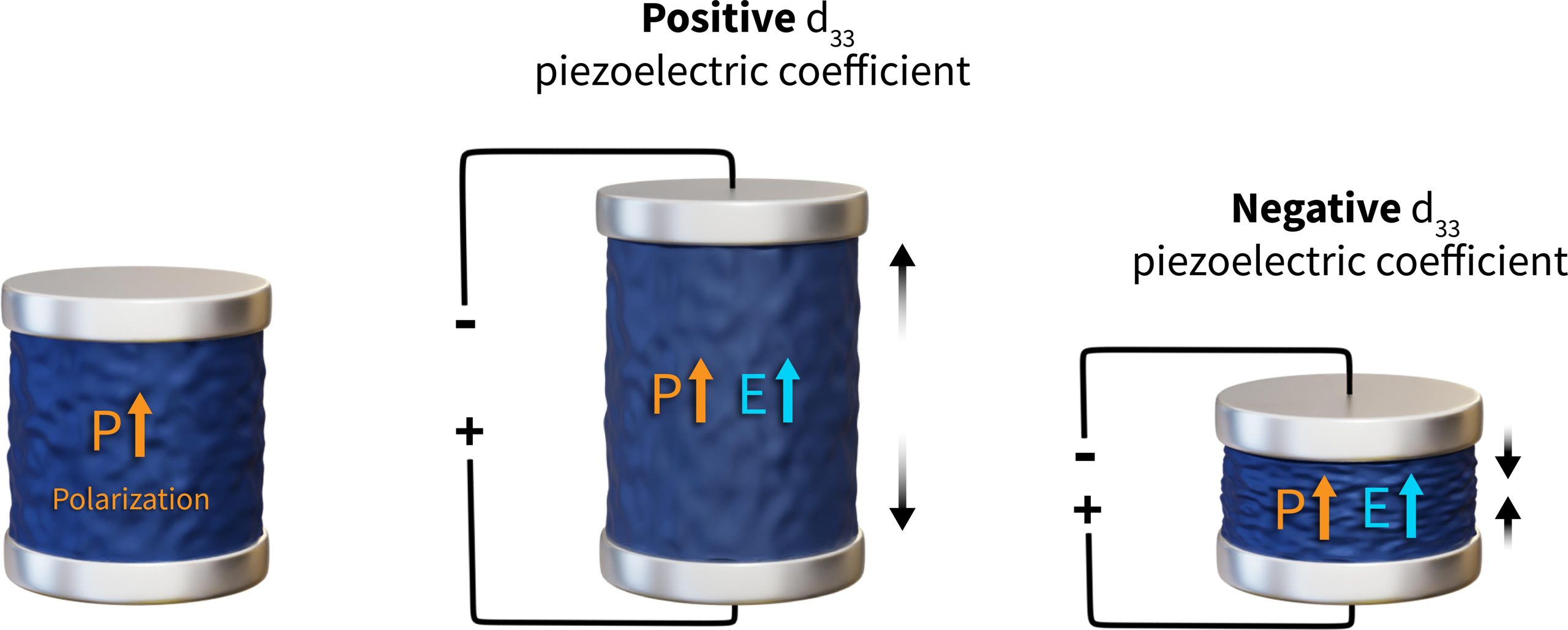
    Unconventional Piezoelectricity in Ferroelectric Hafnia
    The effect: polarisation and electric field are pointing in the same direction. With positive d33, the sample expands, whereas the material is contracting when d33 is negative. Credit: Laura Canil

    Unconventional Behavior Investigated

    An international collaboration led by Prof. Dr. Catherine Dubourdieu, HZB, has now elucidated for the first time some aspects of these mysterious results and discovered an unconventional behavior in hafnia. They investigated Hf0.5Zr0.5O2 (HZO) capacitors using piezoresponse force microscopy (PFM): a conductive needle scans the sample surface under a small electrical voltage and measures the local piezoelectric response.

    Switching Piezoelectricity

    Their study revealed that piezoelectricity in HZO is not an invariable parameter but is a dynamic entity that can be changed, in the very same material, by an external stimulus such as electrical cycling. The ferroelectric HZO capacitors undergo a complete uniform inversion of the piezoelectric d33 coefficient sign, from positive to negative, upon electric field cycling. Every single location of the ferroelectric capacitor undergoes such a change passing through zero local piezoelectricity upon suitable number of ac cycles.

    PFM Phase Images of a W/HZO/W-Capacitor
    PFM phase images of a W/HZO/W-capacitor. The pristine sample shows a positive piezoelectric coefficient (left). After more than 8000 cycles of an ac-electric field, the piezoelectric coefficient has changed its sign and is negative (right). The polarization is pointing downward in both images. Credit: HZB

    New Option: Ferroelectric Materials Without Piezoelectricity

    Density functional theory calculations suggest that the positive d33 in the initial state is due to a metastable polar orthorhombic phase that gradually evolves, under ac cycling, towards the fully developed stable polar phase with negative d33. The DFT calculations not only suggest a mechanism for the d33 sign inversion but also predict a groundbreaking result: a possible occurrence of an intrinsic non-piezoelectric ferroelectric compound, which is observed experimentally.

    New Applications

    “For the first time, we have been able to experimentally observe a sign inversion of the piezoelectric effect in the whole area of a capacitor in these Hafnia Zirconia ferroelectrics under applied ac electric field,” Catherine Dubourdieu states. This discovery has enormous potential for technological applications.

    “As the piezoelectricity in these materials can be dynamically changed and even nullified while the polarization remains robust, we see fantastic prospects for developing ferroelectric HfO2-based devices with electromechanical functionalities. Moreover, from a fundamental standpoint, the possibility of a non-piezoelectric ferroelectric compound would revolutionize our vision of ferroelectricity,” says Catherine Dubourdieu.

    Reference: “Electrically induced cancellation and inversion of piezoelectricity in ferroelectric Hf0.5Zr0.5O2” by Haidong Lu, Dong-Jik Kim, Hugo Aramberri, Marco Holzer, Pratyush Buragohain, Sangita Dutta, Uwe Schroeder, Veeresh Deshpande, Jorge Íñiguez, Alexei Gruverman and Catherine Dubourdieu, 29 January 2024, Nature Communications.
    DOI: 10.1038/s41467-024-44690-9

    Never miss a breakthrough: Join the SciTechDaily newsletter.
    Follow us on Google and Google News.

    Helmholtz Center Berlin Helmholtz-Zentrum Berlin
    Share. Facebook Twitter Pinterest LinkedIn Email Reddit

    Related Articles

    Quantum Leap: Redefining Complex Problem-Solving

    Unlocking the Secrets of Semiconductors With a Single CLIMAT Measurement

    Scientists Reveal the Secrets Behind Record-Breaking Tandem Solar Cell

    Predicting Semiconductor Solar Cell Performance From Terahertz and Microwave Spectroscopy

    New World Record: Almost 30% Efficiency for Next-Generation Tandem Solar Cells

    World Record: Perovskite/Silicon Tandem Solar Cells on the Magic Threshold of 30% Efficiency

    Revealed: 3D Quantum Spin Liquid That Could Power Future Information Technologies

    New Possibilities for Graphene in Thin-Film Photovoltaics

    Scientists Achieve Solar Hydrogen Production Breakthrough

    Leave A Reply Cancel Reply

    • Facebook
    • Twitter
    • Pinterest
    • YouTube

    Don't Miss a Discovery

    Subscribe for the Latest in Science & Tech!

    Trending News

    The Universe Is Expanding Too Fast and Scientists Can’t Explain Why

    “Like Liquid Metal”: Scientists Create Strange Shape-Shifting Material

    Early Warning Signals of Esophageal Cancer May Be Hiding in Plain Sight

    Common Blood Pressure Drug Shows Surprising Power Against Deadly Antibiotic-Resistant Superbug

    Scientists Uncover Dangerous Connection Between Serotonin and Heart Valve Disease

    Scientists Discover a “Protector” Protein That Could Help Reverse Hair Loss

    Bone-Strengthening Discovery Could Reverse Osteoporosis

    Scientists Uncover Hidden Trigger Behind Stem Cell Aging

    Follow SciTechDaily
    • Facebook
    • Twitter
    • YouTube
    • Pinterest
    • Newsletter
    • RSS
    SciTech News
    • Biology News
    • Chemistry News
    • Earth News
    • Health News
    • Physics News
    • Science News
    • Space News
    • Technology News
    Recent Posts
    • Scientists Overcome Major Quantum Bottleneck, Potentially Transforming Teleportation and Computing
    • Quantum Physics’ Strangest Problem May Hold the Key to Time Itself
    • Scientists Create “Liquid Gears” That Spin Without Touching
    • The Simple Habit That Could Help Prevent Cancer
    • Forgotten Medicinal Plant Shows Promise in Fighting Dangerous Superbugs
    Copyright © 1998 - 2026 SciTechDaily. All Rights Reserved.
    • Science News
    • About
    • Contact
    • Editorial Board
    • Privacy Policy
    • Terms of Use

    Type above and press Enter to search. Press Esc to cancel.