
Close Menu
    Facebook X (Twitter) Instagram
    SciTechDaily
    • Biology
    • Chemistry
    • Earth
    • Health
    • Physics
    • Science
    • Space
    • Technology
    Facebook X (Twitter) Pinterest YouTube RSS
    SciTechDaily
    Home»Science»Unlocking the Secrets of Snowflakes’ Shapes
    Science

    Unlocking the Secrets of Snowflakes’ Shapes

    By SciTechDailyDecember 12, 2011No Comments2 Mins Read
    Facebook Twitter Pinterest Telegram LinkedIn WhatsApp Email Reddit
    Share
    Facebook Twitter LinkedIn Pinterest Telegram Email Reddit
    Unlocking the Secrets of Snowflakes' Shapes
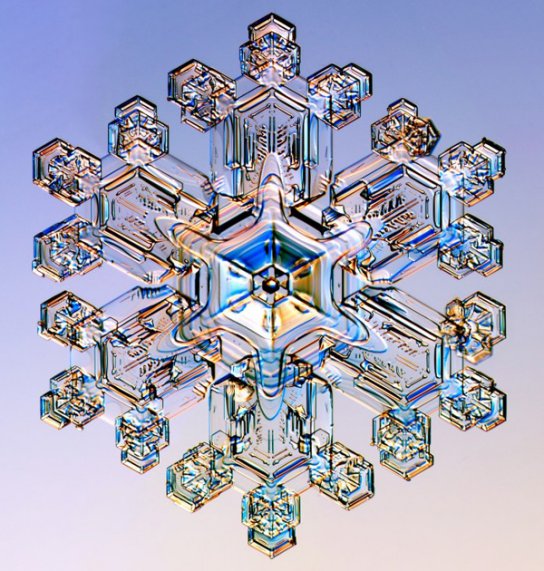
    Snowflake Credit: Kenneth Libbrecht

    The above photo is one of the many Snowflake photos taken by Kenneth Libbrecht of CalTech with a special snowflake photomicroscope showing snow crystals from around North America. The images are stunning as well as very appropriate for this time of year.

    Most snowflakes start out as a simple hexagonal crystal of ice and then branch out, forming the familiar arms with their amazingly intricate patterns. Temperature can also affect the patterns of ice crystal growth. For instance, when they are near -2 °C (28 °F), they grow into tiny, flat discs. At -5 °C (23 °F), they form thin columns and needles. Near -15 °C (5 °F) produces the thinnest, but largest flakes and at temperatures below -30 °C (-22 °F), they go back to columns. Different temperatures give different results. Electric fields can also affect the growth of ice crystals. Electric fields influence the way water molecules diffuse through the air in the vicinity of the ice surface. In fact, they grow snowflakes in the lab all year long, but still have a lot to learn.

    They grow so large and flat due to instability in their growth. The instability creates a “sharpening effect.” As the crystal develops at -15 °C, a small ridge builds up at the edge, which spreads out toward the moist air in a sharp blade. Because the corners of the hexagon stick out farther than the center, they collect moisture and grow faster. Click the link above for more great images.

    Never miss a breakthrough: Join the SciTechDaily newsletter.
    Follow us on Google and Google News.

    California Institute of Technology Crystals Snowflakes
    Share. Facebook Twitter Pinterest LinkedIn Email Reddit

    Related Articles

    Paradigm Challenging Discovery: Diamonds Grown Without High Pressure

    2D Ferroelectric Liquid Crystal: The Next Big Thing in Display Technology

    Researchers Add New “Twist” to Classical Material Design

    Roman Relics to Tech Treasures: Glass Fragments Unlock Future Secrets

    The Intersection of Math and AI: A New Era in Problem-Solving

    Nature’s Nanotechnology: The Wonders of Ancient Roman Glass

    Evolution of Vertebrate Armor: How Fish Evolved Their Protective Bony Scales

    Holographic Beetles and Liquid Crystals: The Science of Ultra-Secure QR Codes

    Protein Power Unleashed: Spitrobot Makes Time-Resolved Crystallography Accessible

    Leave A Reply Cancel Reply

    • Facebook
    • Twitter
    • Pinterest
    • YouTube

    Don't Miss a Discovery

    Subscribe for the Latest in Science & Tech!

    Trending News

    Don’t Miss: A Brilliant Venus and Glowing Harvest Moon Light Up the Sky

    New Twist on the Einstein Problem Reveals Unexpected Physics

    JWST Captures Stunning Evidence of How Supermassive Black Holes Feed

    Early Exercise May Permanently Change How Much Energy the Body Uses To Move

    New Molecule Wipes Out Aggressive Lymphoma Tumors in Mice in Just 11 Days

    The Human Family Tree May Need a Major Rewrite

    Scientists Find a Surprising Cancer-Fighting Effect in Dark Sweet Cherries

    New AI Detects Hidden Warning Signs of Solar Eruptions Hours Before They Emerge

    Follow SciTechDaily
    • Facebook
    • Twitter
    • YouTube
    • Pinterest
    • Newsletter
    • RSS
    SciTech News
    • Biology News
    • Chemistry News
    • Earth News
    • Health News
    • Physics News
    • Science News
    • Space News
    • Technology News
    Recent Posts
    • Pomegranates Could Unlock a New Treatment for Heart Failure
    • Africa’s Giant Herbivores Were Disappearing Millions of Years Before Humans Could Hunt Them
    • This Utah Mountain Is Hiding Enough Ice To Fill 600 Olympic Pools
    • Vagus Nerve Stimulation Could Unlock the Brain’s Hidden Learning Potential
    • Your Mother’s Age May Leave a Biological Mark That Lasts for Generations
    Copyright © 1998 - 2026 SciTechDaily. All Rights Reserved.
    • Science News
    • About
    • Contact
    • Editorial Board
    • Privacy Policy
    • Terms of Use

    Type above and press Enter to search. Press Esc to cancel.