
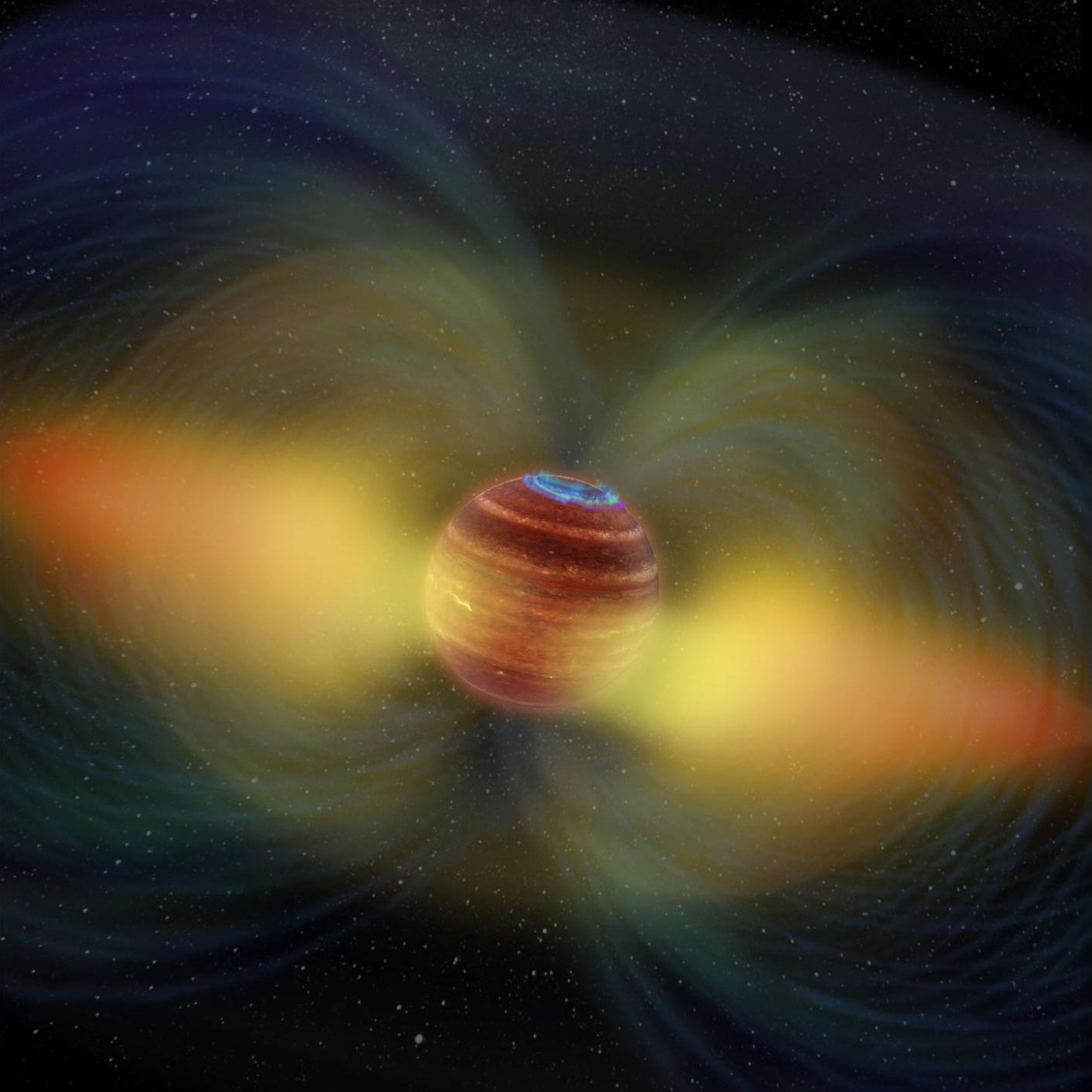
For the first time, astronomers have discovered a radiation belt outside our solar system, around a brown dwarf called LSR J1835+3259. The belt is 10 million times more intense than Jupiter’s and represents a crucial step in the exploration of potentially habitable, Earth-size planets. The discovery was made possible by a global network of 39 radio dishes.
Radiation belts are doughnut-shaped magnetic structures enveloping a planet that are filled with extremely high-energy electrons and charged particles.
Originally discovered first around Earth in 1958 with the Explorer 1 and 3 satellites, radiation belts are now known to be a common feature in the solar system: All of the planets with large-scale magnetic fields — including Earth, Jupiter, Saturn, Uranus, and Neptune — have them. However, no radiation belt has been clearly seen outside of our solar system until now.
The First Extrasolar Radiation Belt
A small team of astronomers, led by Melodie Kao, formerly of Arizona State University and now a 51 Pegasi b Fellow at the University of California, Santa Cruz, and including Professor Evgenya Shkolnik of ASU’s School of Earth and Space Exploration, have discovered the first radiation belt outside of our solar system. The results were published on May 15 in the journal Nature.
The discovery was made around the “brown dwarf” LSR J1835+3259, which is about the same size as Jupiter but a lot more dense. Located only 20 light years away in the constellation Lyra, it’s not quite heavy enough to be a star, but it’s too heavy to be a planet. Because radiation belts had previously never been clearly visible outside our solar system, it was unknown if they could exist around objects other than planets.
“This is a critical first step in finding many more such objects and honing our skills to search for smaller and smaller magnetospheres, eventually enabling us to study those of potentially habitable, Earth-size planets,” said Shkolnik, who has been studying the magnetic fields and habitability of exoplanets for many years.
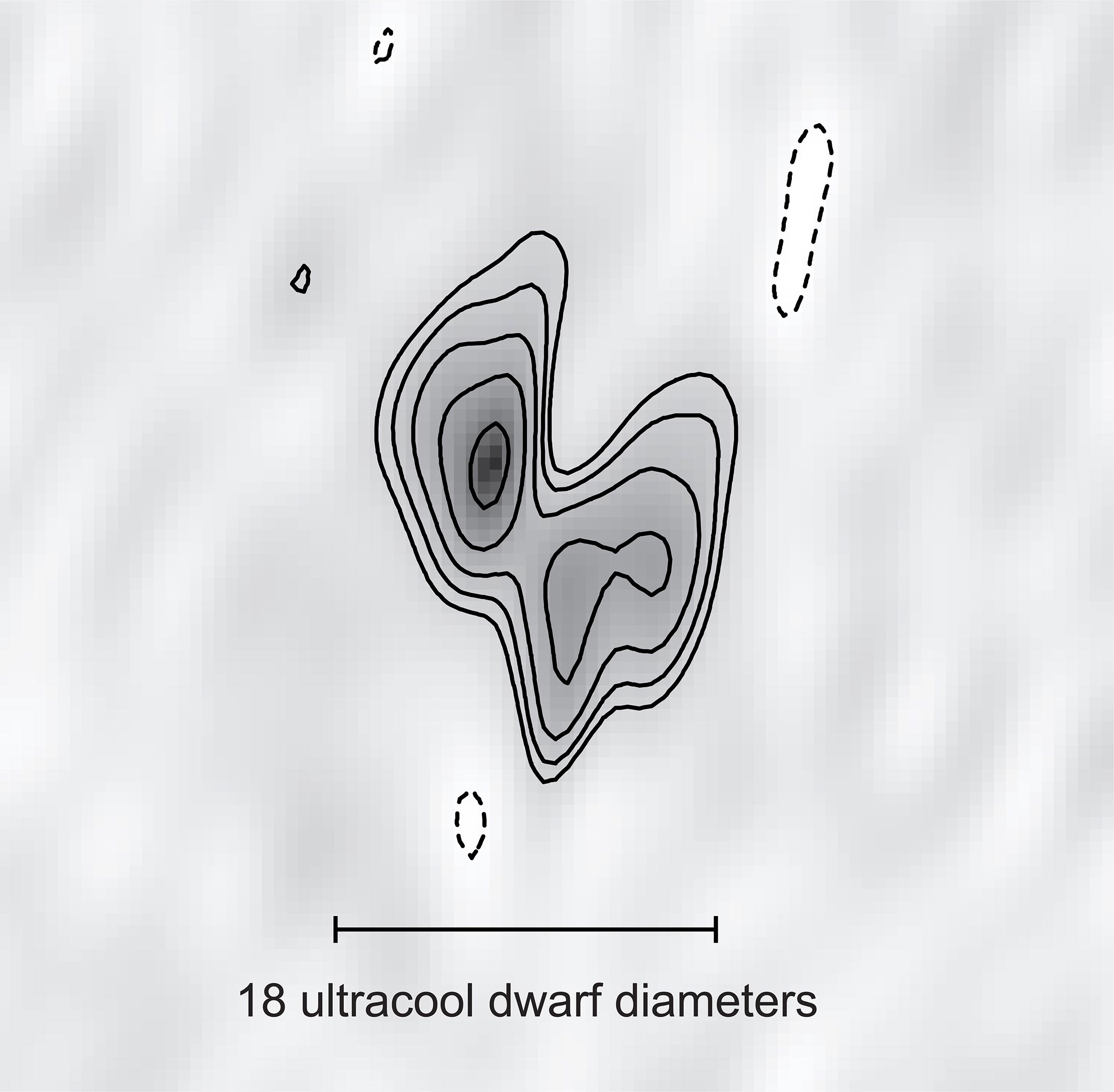
Although invisible to the human eye, the radiation belt discovered by this team is a giant structure. Its outer diameter spans at least 18 Jupiter diameters across, and the brightest inner regions are separated by 9 Jupiter diameters. Made of particles traveling near the speed of light and glowing brightest at radio wavelengths, this newly discovered extrasolar radiation belt is almost 10 million times more intense than Jupiter’s, which itself is millions of times brighter than Earth’s and showcases the most energetic particles of any solar system planet.
The team captured three high-resolution pictures of the radio-emitting electrons trapped in LSR J1835+3259’s magnetosphere over the course of a year using an observing technique now famous for imaging our galaxy’s black hole.
By coordinating 39 radio dishes spanning Hawaii to Germany to make an Earth-sized telescope, the team resolved the brown dwarf’s dynamic magnetic environment, known as the “magnetosphere,” the first observed outside the solar system. They could even see the shape of this magnetic field clearly enough to infer that it is likely a dipole magnetic field like Earth’s and Jupiter’s.
“By combining radio dishes from across the world, we can make incredibly high-resolution images to see things no one has ever seen. Our image is comparable to reading the top row of an eye chart in California while standing in Washington, D.C.,” said co-author Professor Jackie Villadsen of Bucknell University.
Aurora vs. Radiation Belt
However, Kao and her team had early clues that they would find a radiation belt around this brown dwarf. By the time the team conducted these observations in 2021, radio astronomers had already observed that LSR J1835+3259 emitted two types of detectable radio emissions. Kao herself was on a team that confirmed six years prior that its periodically flashing radio emission, similar to a lighthouse, was an aurora at radio frequencies.
But LSR J1835+3259 also had steadier and fainter radio emissions. The data showed that these fainter emissions can’t come from stellar flares and are, in fact, very similar to Jupiter’s radiation belts.
The team’s findings suggest that such a phenomenon might be more universal than initially thought — occurring not just on planets but also on brown dwarfs, low-mass stars and possibly even very high-mass stars.
Implications for Magnetic Fields and Habitability
The region around a planet’s magnetic field — the magnetosphere — including that of Earth, can protect the planet’s atmosphere and surfaces from damage caused by solar and cosmic high-energy particles.
“When we’re thinking about the habitability of exoplanets, the role of their magnetic fields in maintaining a stable environment is something to consider in addition to things like the atmosphere and climate,” Kao said.
In addition to the seen radiation belt, their research revealed the difference in the “shapes” and spatial location of an aurora (akin to Earth’s northern lights) versus a radiation belt from an object outside of our solar system.
“Auroras can be used to measure the strength of the magnetic field, but not the shape. We designed this experiment to showcase a method for assessing the shapes of magnetic fields on brown dwarfs and eventually exoplanets,” Kao said. “One analogy is that radiation belts are like the ‘yards’ of planets living in the neighborhood that is our solar system, except instead of flowers, we have energetic particles glowing at different wavelengths and brightnesses.
“The particular properties of each radiation belt tells us something about that planet’s energetic, magnetic and particle resources: how quickly it’s spinning, how strong its magnetic field is, how close it lives to the sun, if it has moons that can supply more particles or rings like Saturn’s that will absorb them, and more. For the first time, we’re able to see what sorts of ‘yards’ brown dwarfs and low-mass stars have. I’m excited for the day that we can learn about the magnetospheric yards inhabited by exoplanets.”
Reference: “Resolved imaging confirms a radiation belt around an ultracool dwarf” by Melodie M. Kao, Amy J. Mioduszewski, Jackie Villadsen and Evgenya L. Shkolnik, 15 May 2023, Nature.
DOI: 10.1038/s41586-023-06138-w
This work is supported by NASA and the Heising-Simons Foundation.
The team was led by Melodie Kao, formerly a NASA Hubble Postdoctoral Fellow at ASU, and currently a Heising-Simons 51 Pegasi b Fellow at UC Santa Cruz, and consists of Amy Mioduszewski, associate scientist at the National Radio Astronomy Observatory, Professor Jackie Villadsen at Bucknell University and Professor Evgenya Shkolnik at ASU. They used the Karl G. Jansky Very Large Array, the Very Long Baseline Array, and the Robert C. Byrd Greenbank Telescope managed by the National Radio Astronomy Observatory (NRAO) in the United States and the Effelsberg radio telescope operated by the Max Planck Institute for Radio Astronomy in Germany for the High Sensitivity Array.
Never miss a breakthrough: Join the SciTechDaily newsletter.
Follow us on Google and Google News.