
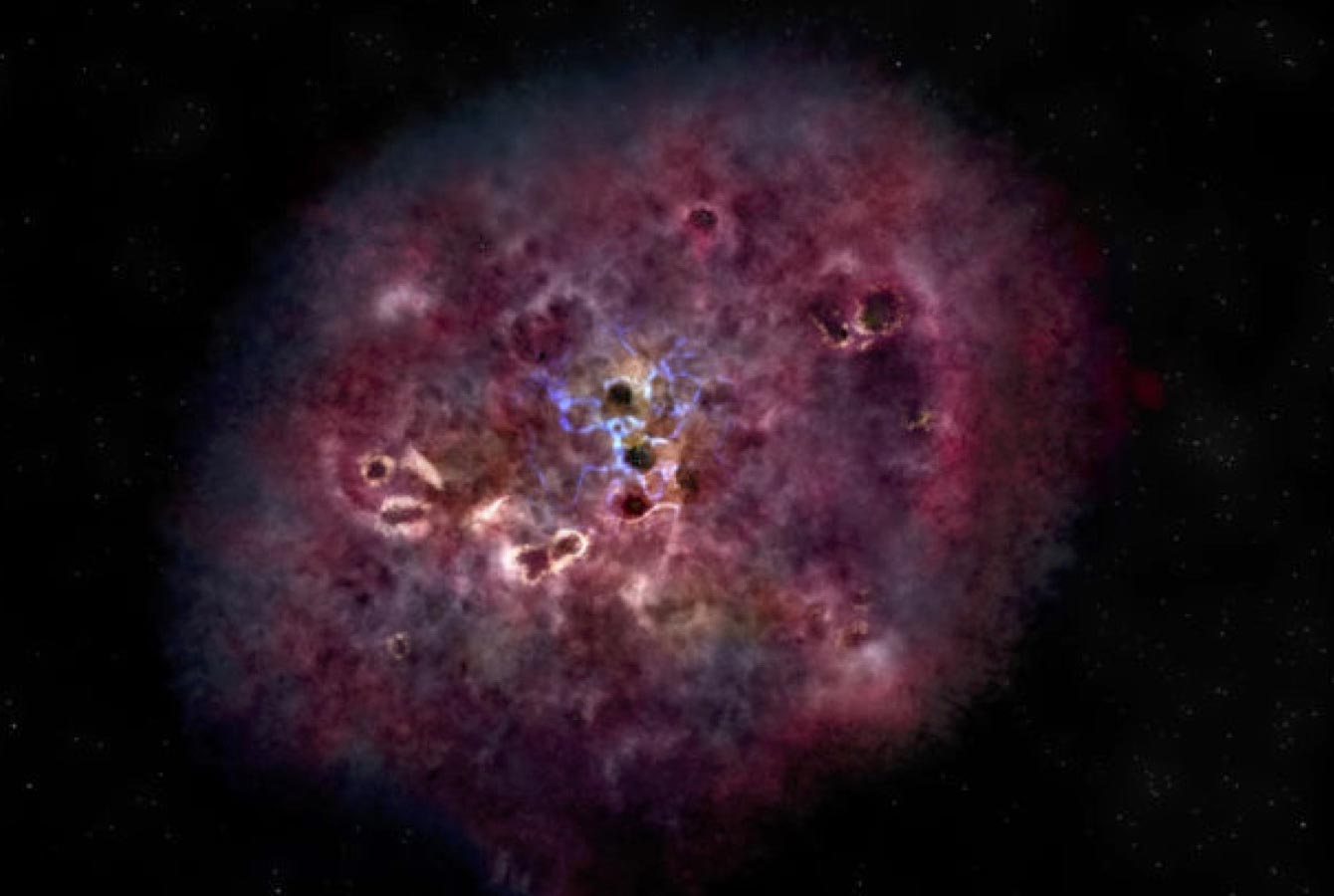
XMM-2599 lived fast and died young, says University of California, Riverside-led international team.
An international team of astronomers led by scientists at the University of California, Riverside, has found an unusual monster galaxy that existed about 12 billion years ago, when the universe was only 1.8 billion years old.
Dubbed XMM-2599, the galaxy formed stars at a high rate and then died. Why it suddenly stopped forming stars is unclear.
“Even before the universe was 2 billion years old, XMM-2599 had already formed a mass of more than 300 billion suns, making it an ultramassive galaxy,” said Benjamin Forrest, a postdoctoral researcher in the UC Riverside Department of Physics and Astronomy and the study’s lead author. “More remarkably, we show that XMM-2599 formed most of its stars in a huge frenzy when the universe was less than 1 billion years old, and then became inactive by the time the universe was only 1.8 billion years old.”
The team used spectroscopic observations from the W. M. Keck Observatory’s powerful Multi-Object Spectrograph for Infrared Exploration, or MOSFIRE, to make detailed measurements of XMM-2599 and precisely quantify its distance.
Study results appear in the Astrophysical Journal.
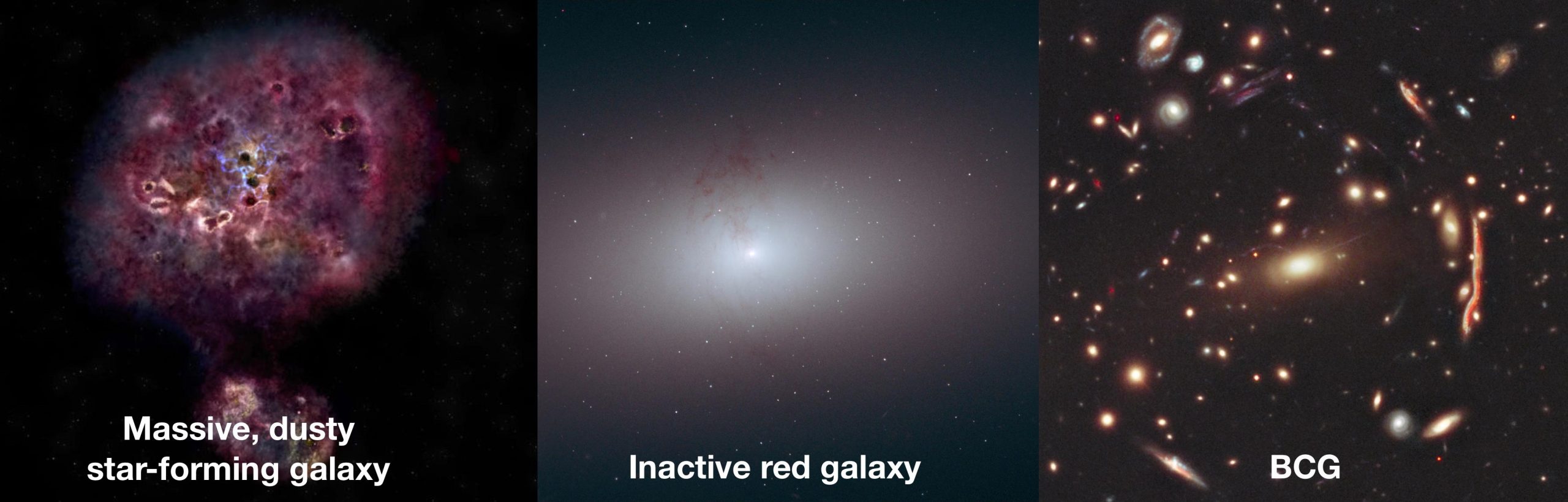
“In this epoch, very few galaxies have stopped forming stars, and none are as massive as XMM-2599,” said Gillian Wilson, a professor of physics and astronomy at UCR in whose lab Forrest works. “The mere existence of ultramassive galaxies like XMM-2599 proves quite a challenge to numerical models. Even though such massive galaxies are incredibly rare at this epoch, the models do predict them. The predicted galaxies, however, are expected to be actively forming stars. What makes XMM-2599 so interesting, unusual, and surprising is that it is no longer forming stars, perhaps because it stopped getting fuel or its black hole began to turn on. Our results call for changes in how models turn off star formation in early galaxies.”
The research team found XMM-2599 formed more than 1,000 solar masses a year in stars at its peak of activity — an extremely high rate of star formation. In contrast, the Milky Way forms about one new star a year.
“XMM-2599 may be a descendant of a population of highly star-forming dusty galaxies in the very early universe that new infrared telescopes have recently discovered,” said Danilo Marchesini, an associate professor of astronomy at Tufts University and a co-author on the study.
The evolutionary pathway of XMM-2599 is unclear.
“We have caught XMM-2599 in its inactive phase,” Wilson said. “We do not know what it will turn into by the present day. We know it cannot lose mass. An interesting question is what happens around it. As time goes by, could it gravitationally attract nearby star-forming galaxies and become a bright city of galaxies?”
Co-author Michael Cooper, an associate professor of astronomy at UC Irvine, said this outcome is a strong possibility.
“Perhaps during the following 11.7 billion years of cosmic history, XMM-2599 will become the central member of one of the brightest and most massive clusters of galaxies in the local universe,” he said. “Alternatively, it could continue to exist in isolation. Or we could have a scenario that lies between these two outcomes.”
The team has been awarded more time at the Keck Observatory to follow up on unanswered questions prompted by XMM-2599.
“We identified XMM-2599 as an interesting candidate with imaging alone,” said co-author Marianna Annunziatella, a postdoctoral researcher at Tufts University. “We used Keck to better characterize and confirm its nature and help us understand how monster galaxies form and die. MOSFIRE is one of the most efficient and effective instruments in the world for conducting this type of research.”
Reference: “An Extremely Massive Quiescent Galaxy at z = 3.493: Evidence of Insufficiently Rapid Quenching Mechanisms in Theoretical Models” by Ben Forrest, Marianna Annunziatella, Gillian Wilson, Danilo Marchesini, Adam Muzzin, M. C. Cooper, Z. Cemile Marsan, Ian McConachie, Jeffrey C. C. Chan, Percy Gomez, Erin Kado-Fong, Francesco La Barbera, Ivo Labbé, Daniel Lange-Vagle, Julie Nantais, Mario Nonino, Theodore Peña, Paolo Saracco, Mauro Stefanon and Remco F. J. van der Burg, 5 February 2020, The Astrophysical Journal Letters.
DOI: 10.3847/2041-8213/ab5b9f
Other researchers taking part include Daniel Lange-Vagle and Theodore Peña of Tufts University; Adam Muzzin and Cemile Marsan of York University, Canada; Ian McConachie and Jeffrey Chan of UCR; Percy Gomez of Keck Observatory; Erin Kado-Fong of Princeton University; Francesco La Barbera of INAF-Osservatorio Astronomico di Capodimonte, Italy; Ivo Labbe of Swinburne University of Technology, Australia; Julie Nantais of Andrés Bello National University, Santiago, Chile; Mario Nonino of Astronomical Observatory of Trieste, Italy; Paolo Saracco of Astronomical Observatory of Brera, Italy; Mauro Stefanon of Leiden University, Netherlands; and Remco F. J. van der Burg of the European Southern Observatory, Germany.
Wilson led the W. M. Keck Observatory data acquisition. Forrest led the processing and analysis.
The study was supported by grants from the National Science Foundation and NASA.
Never miss a breakthrough: Join the SciTechDaily newsletter.
Follow us on Google and Google News.