
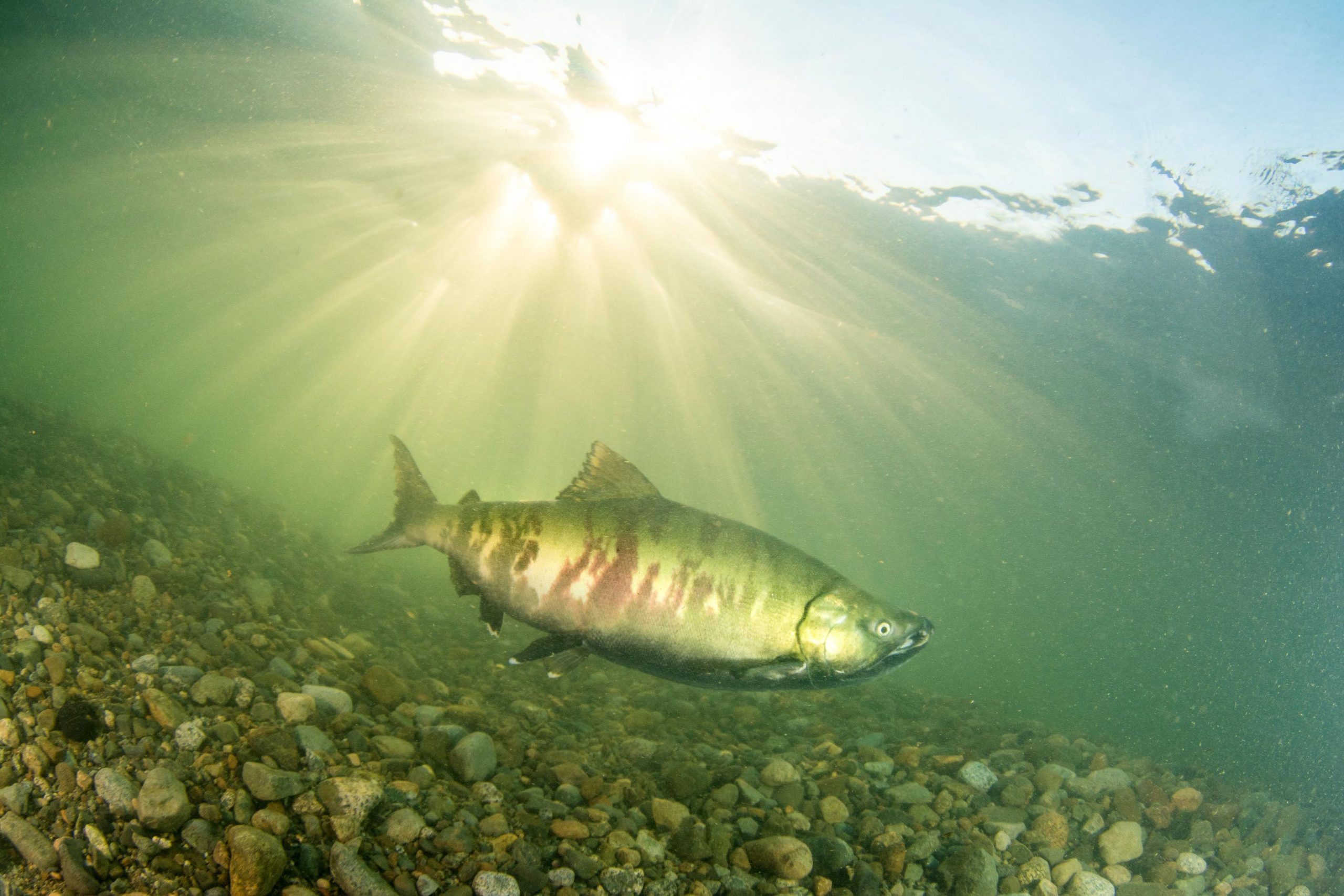
In order to reverse salmon declines, researchers say, more than 1,200 barriers blocking off streams and habitats need to be removed.
For perhaps the first time ever, researchers have mapped out the true extent of habitat loss for salmon in the Lower Fraser River, one of the most important spawning and rearing grounds for Pacific salmon in B.C.
Salmon have lost access to as much as 85 percent of their historical floodplain habitat—the biologically rich wetlands next to a river or stream that typically harbor wildlife—due to dikes and similar infrastructure, say researchers at UBC and the Raincoast Conservation Foundation.
“Only around 101 square kilometers out of an estimated 659 square kilometers of historical floodplains remain accessible to salmon,” says lead author Riley Finn, a research associate with the Conservation Decisions Lab in the faculty of forestry at UBC.
“This loss is particularly critical for populations of coho and Chinook, which rely more heavily on these habitats for rearing, compared to other types of salmon,” says Finn.
The team also found that up to 64 percent of streams are now off-limits to salmon due to in-stream barriers like dams, floodgates and road culverts, blocking off important channels for migrating salmon, which spend part of their lives at sea but return to their natal streams to spawn and rear their young.
According to Finn, there are currently more than 1,200 barriers preventing salmon from accessing approximately 2,224 kilometers of streams.
Devastating Habitat Fragmentation
The results of the study reveal the magnitude of the loss of salmon habitat in Canada’s most productive salmon river, says senior author Dr. Tara Martin, a professor of forest and conservation sciences at UBC, and suggests this loss of habitat is a major contributor to current salmon declines.
“Fraser salmon are being impacted by multiple threats in both their freshwater and marine habitats,” says Dr. Martin.
“If salmon do not have sufficient habitat to breed and complete their life cycle, then none of the other conservation management actions we take will matter.”
In order to come up with their assessments, the researchers studied historical vegetation records, old surveyor and topographical maps dating back to the 1850s, as well as other records pertaining to the Lower Fraser–a region that spans 20,203 square kilometers between Hope and Boundary Bay in South Delta.
“Given the magnitude of habitat loss in the Fraser, large-scale habitat protection and restoration is a key component in efforts to restore wild populations of salmon to the Lower Fraser,” adds Dr. Martin. “We are using these results to identify priority areas to remove barriers and restore salmon habitat to have the greatest benefits for salmon recovery.”
Reference: “Quantifying lost and inaccessible habitat for Pacific salmon in Canada’s Lower Fraser River” by Riley J. R. Finn, Lia Chalifour, Sarah E. Gergel, Scott G. Hinch, David C. Scott and Tara G. Martin, 8 July 2021, Ecosphere.
DOI: 10.1002/ecs2.3646
Never miss a breakthrough: Join the SciTechDaily newsletter.
Follow us on Google and Google News.
2 Comments
I love eating salmon. send me more info. thanks…
$9 Billion Wasted – 40 Years of Conservation Spending Fails To Improve Columbia Basin Wild Fish Stocks
So what are you doing about it we just wasted nine thousand million dollars because you don’t know what you’re doing what are you going to waste the next nine billion on? We’re screwing with mother nature all with good intension of course. Problem is nine billion should have cleaned up every salmon spawning river in Canada. There’s too many fingers in the pie like homelessness there needs to a central agency in each province in charge there’s too many little groups that are only interested in the money where it goes is secondary to their pockets. Mostly bandaid measures. Ever notice how food banks are now big business now they have lavis new vehicles and fancy distribution outlets and dozens of minor ineffective groups with there has out and god knows where the money goes. We’ve spent billions on both conservation and homelessness and we’re worse off now then ten twenty years ago. It’ll never be fixed too much greed the money has to strict controls with money only to groups that prove their plans will benefit the wildlife and human beings it is allocated to help.