
Close Menu
    Facebook X (Twitter) Instagram
    SciTechDaily
    • Biology
    • Chemistry
    • Earth
    • Health
    • Physics
    • Science
    • Space
    • Technology
    Facebook X (Twitter) Pinterest YouTube RSS
    SciTechDaily
    Home»Health»Natural Killer T Cells: In Breast Cancer, the Best Defense Is a Strong Offense
    Health

    Natural Killer T Cells: In Breast Cancer, the Best Defense Is a Strong Offense

    By Cold Spring Harbor LaboratoryDecember 7, 2021No Comments3 Mins Read
    Facebook Twitter Pinterest Telegram LinkedIn WhatsApp Email Reddit
    Share
    Facebook Twitter LinkedIn Pinterest Telegram Email Reddit
    Breast Epithelial Cells
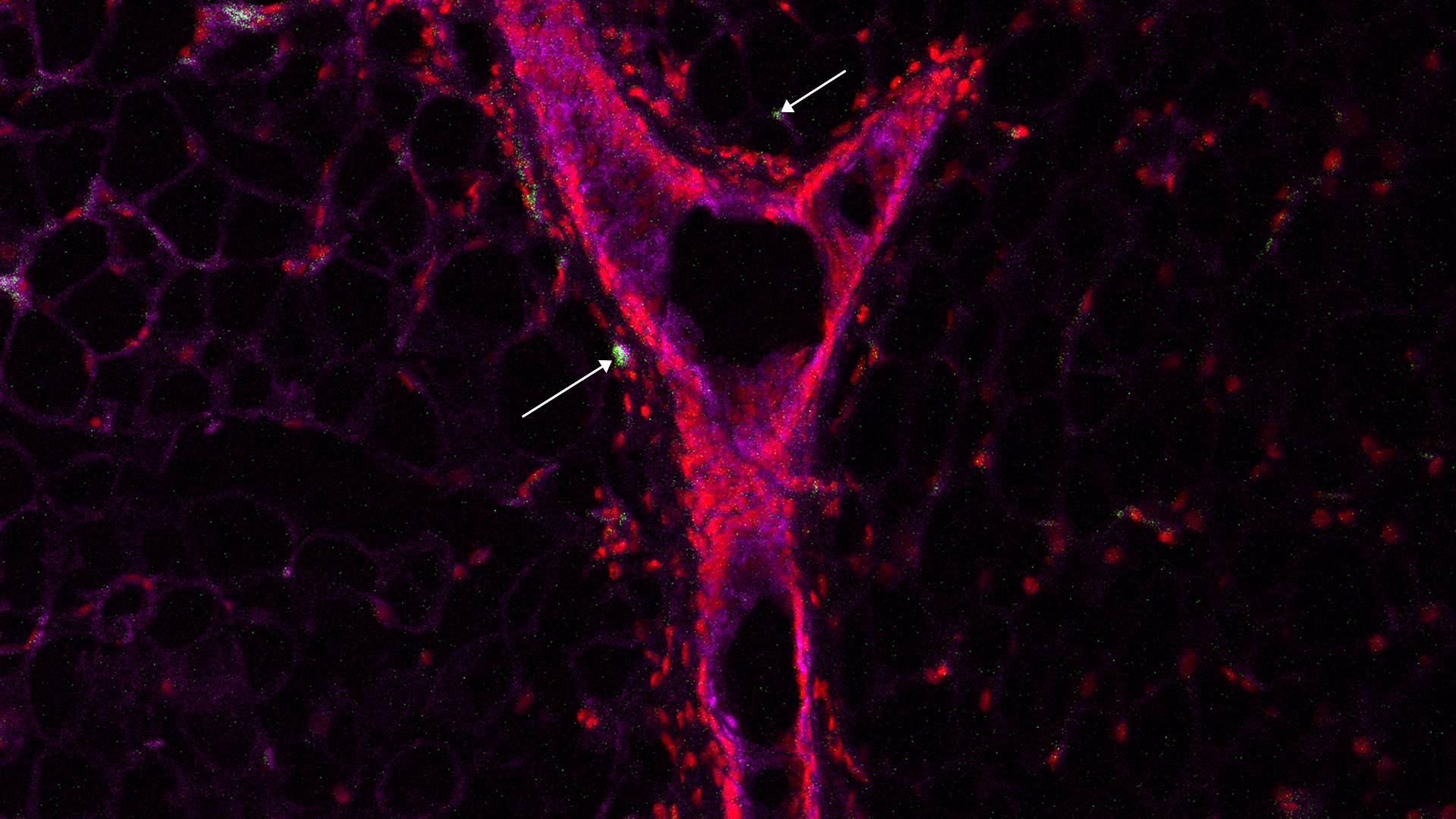
    Cold Spring Harbor Laboratory Associate Professor Camila dos Santos’ lab discovered that after pregnancy, breast cells call in specialized immune cells called Natural Killer T (NKT) cells to prevent tumors from arising. This image shows mouse breast epithelial cells (red and magenta) after a pregnancy. The cells are calling in NKT cells (green, pointed out with white arrows) to kill any epithelial cells that may become cancerous. Credit: Hanasoge Somasundara/dos Santos lab/CSHL, 2021

    Pregnancy prompts breast cells to produce CD1d, which recruits NKT immune cells to guard against cancer.

    Your immune system is constantly patrolling your body to keep you healthy. Sometimes, immune cells are also called into action to address a potential problem. Cold Spring Harbor Laboratory (CSHL) Associate Professor Camila dos Santos’ lab discovered that after pregnancy, breast cells call in immune system reinforcements called Natural Killer T (NKT) cells to prevent tumors from arising. This finding illuminates a new way in which pregnancy reduces the risk of breast cancer.

    In the immune system, there are two lines of defense. The first is the innate response, which involves immune cells that attack any foreign molecule they encounter. The second is the adaptive response, which consists of immune cells that respond specifically to calls for help from certain molecules. NKT cells are a unique population of cells that are present throughout the body and that can participate in both responses. CSHL graduate student Amritha Varshini Hanasoge Somasundara says that in post-pregnancy:

    “There is an increase in this specific [NKT] cell type, and only in the mammary gland. We don’t see the expansion everywhere else in the body, even though NKT cells are present everywhere else in the body.”

    The team wanted to know what the larger number of NKT cells were doing in the breast tissue. Hanasoge discovered that in mice, breast epithelial cells, which line lactation ducts, produce a specific protein called CD1d after pregnancy. If the cells did not present CD1d, the researchers observed no increase in NKT cells in the tissue; the epithelial cells became cancerous and grew into tumors. Hanasoge and dos Santos think that CD1d molecules are calling in NKT cells to monitor the epithelial cells in the breast tissue after pregnancy. If they become cancerous, the NKT cells can quickly kill them to prevent tumor growth. 

    CD1d: The Tumor Watchdog Protein

    The team’s findings establish a novel link between pregnancy and the immune system in preventing breast cancer. The dos Santos lab wants to know how these findings can be translated into humans and what other factors may influence an abundance of NKT cells in breast tissue, such as aging and menopause, which are both associated with increased breast cancer risk. Dos Santos says:

    “One of the hypotheses that we are working on now is: do pregnancies later on in life bring in the same expansion of the same subtypes of immune cells as pregnancies that took place early in life?” 

    The team published their findings on December 7, 2021, in Cell Reports.

    Reference: “Parity-induced changes to mammary epithelial cells control NKT cell expansion and mammary oncogenesis” by Amritha Varshini Hanasoge Somasundara, Matthew A. Moss, Mary J. Feigman, Chen Chen, Samantha L. Cyrill, Michael F. Ciccone, Marygrace C. Trousdell, Macy Vollbrecht, Siran Li, Jude Kendall, Semir Beyaz, John E. Wilkinson and Camila O. dos Santos, 7 December 2021, Cell Reports.
    DOI: 10.1016/j.celrep.2021.110099

    Never miss a breakthrough: Join the SciTechDaily newsletter.
    Follow us on Google and Google News.

    Breast Cancer Cancer Cell Biology Cold Spring Harbor Laboratory Immunology
    Share. Facebook Twitter Pinterest LinkedIn Email Reddit

    Related Articles

    RNA-Binding Proteins: Molecular Targeted Therapy for Difficult-to-Treat Breast Cancer

    Just a Small Number of Cells in a Tumor Can Enable Cancer To Spread to Other Parts of the Body

    Common Antidepressant Medication Helps Fight Cancer in Mice – May Activate Immune System to Shrink Tumors

    New Technology Makes Cancer Tumors Eliminate Themselves

    A Clue to How Some Fast-Growing Cancer Tumors Hide in Plain Sight

    Chemicals in Areas Surrounding Tumors Subvert the Immune System and Enable Cancer to Evade Attack

    Scientists Discover a Way to Control the Immune System’s “Natural Killer” Cells With “Invisible” Stem Cells

    Cancer Cells Can Become Invisible to the Immune System – Here’s How

    Scientists Discover New Protein Shield That Protects Broken DNA

    Leave A Reply Cancel Reply

    • Facebook
    • Twitter
    • Pinterest
    • YouTube

    Don't Miss a Discovery

    Subscribe for the Latest in Science & Tech!

    Trending News

    Popular Sugar-Free Sweetener Linked to Liver Disease, Study Warns

    What Is Hantavirus? The Deadly Disease Raising Alarm Worldwide

    Scientists Just Discovered How the Universe Builds Monster Black Holes

    Scientists Unveil New Treatment Strategy That Could Outsmart Cancer

    A Simple Vitamin May Hold the Key to Treating Rare Genetic Diseases

    Scientists Think the Real Fountain of Youth May Be Hiding in Your Gut

    Ravens Don’t Follow Wolves, They Predict Them

    This Common Knee Surgery May Be Doing More Harm Than Good

    Follow SciTechDaily
    • Facebook
    • Twitter
    • YouTube
    • Pinterest
    • Newsletter
    • RSS
    SciTech News
    • Biology News
    • Chemistry News
    • Earth News
    • Health News
    • Physics News
    • Science News
    • Space News
    • Technology News
    Recent Posts
    • Popular Supplement Ingredient Linked to Shorter Lifespan in Men
    • Scientists May Have Found a Way To Repair Nerve Damage in Multiple Sclerosis
    • GLP-1 Weight Loss Linked To Dramatically Lower Risk of Sleep Apnea, Kidney Disease and More
    • Scientists Uncover the Surprising Source of Strange Clouds Near the Milky Way’s Supermassive Black Hole
    • This Dazzling Green Snake Was Hiding in Plain Sight for Decades
    Copyright © 1998 - 2026 SciTechDaily. All Rights Reserved.
    • Science News
    • About
    • Contact
    • Editorial Board
    • Privacy Policy
    • Terms of Use

    Type above and press Enter to search. Press Esc to cancel.