
Close Menu
    Facebook X (Twitter) Instagram
    SciTechDaily
    • Biology
    • Chemistry
    • Earth
    • Health
    • Physics
    • Science
    • Space
    • Technology
    Facebook X (Twitter) Pinterest YouTube RSS
    SciTechDaily
    Home»Physics»Ventilation Matters: Engineering Airflow To Prevent the Spread of COVID-19
    Physics

    Ventilation Matters: Engineering Airflow To Prevent the Spread of COVID-19

    By American Institute of PhysicsNovember 5, 20212 Comments3 Mins Read
    Facebook Twitter Pinterest Telegram LinkedIn WhatsApp Email Reddit
    Share
    Facebook Twitter LinkedIn Pinterest Telegram Email Reddit
    Engineering Airflow to Avoid Spreading COVID-19
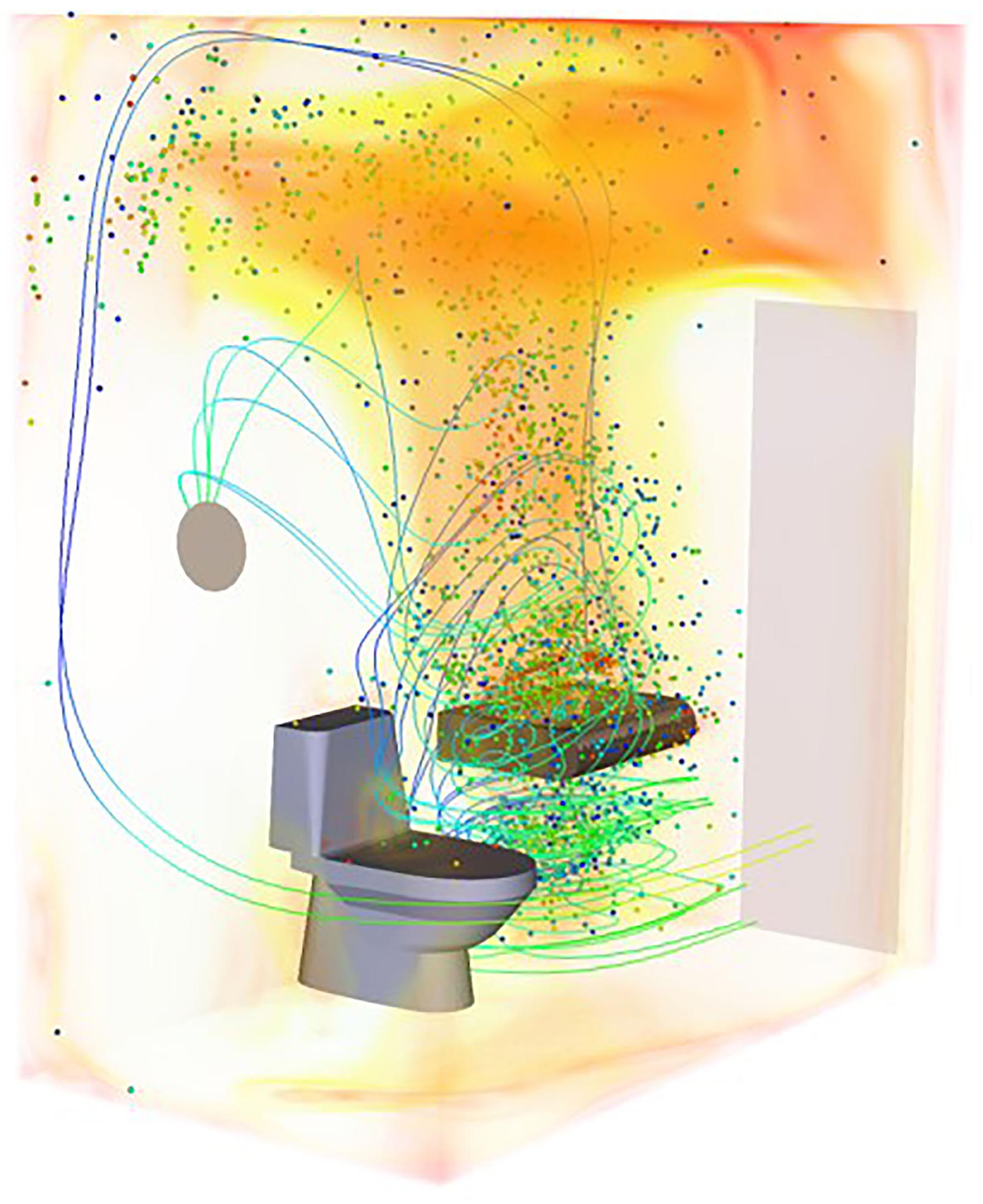
    Recirculating flow in a dead zone over the wash basin can trap infectious particles for a long time. Credit: Vivek Kumar, Ansys Inc.

    Ventilation systems designed to avoid spreading COVID-19 should be based on the air circulation within a room.

    As we approach two full years of the COVID-19 pandemic, we now know it spreads primarily through airborne transmission. The virus rides inside tiny microscopic droplets or aerosol ejected from our mouths when we speak, shout, sing, cough, or sneeze. It then floats within the air, where it can be inhaled and transmitted.

    This inspired researchers in India to explore how we can better understand and engineer airflow to mitigate the transmission of COVID-19. To do this, they used their knowledge of airflow around aircraft and engines to tailor the airflow within indoor spaces.

    In Physics of Fluids, from AIP Publishing, they report computer simulations of airflow within a public washroom showing infectious aerosols in dead zones can linger up to 10 times longer than the rest of the room. These dead zones of trapped air are frequently found in corners of a room or around furniture.

    Public Washrooms Pose Elevated Risks

    Washrooms generate aerosols and are present within offices, restaurants, schools, planes, trains, and other public spaces. They have been identified as a potential source of infection transmission within densely populated areas in India.

    “We explored a small, single-person facility used by many, one after another,” said Krishnendu Sinha, a professor of aerospace engineering at the Indian Institute of Technology Bombay. “I have a similar washroom in my house, which made it easier to study it. Mobility was restricted, and laboratories were closed, but this allowed us to continue our study during the lockdown.”

    Unexpected Danger Near Doors, Windows, and AC Units

    The researchers discovered that the chances of infection are significantly higher in a dead zone.

    “Surprisingly, they can be near a door or window, or right next to where an air conditioner is blowing in air,” he said. “You might expect these to be safe zones, but they are not.”

    Computer simulations show “air flows in circuitous routes, like a vortex,” said Vivek Kumar, a co-author. “Ideally, air should be continuously removed from every part of the room and replaced by fresh air. This isn’t easy to do when air is recirculating in a dead zone.”

    The biggest questions around airflow center around how to ventilate indoor spaces to minimize infection spread. Where should fans and ventilation ducts be placed? How many of them? How much air should flow through them?

    “Currently, ventilation design is often based on air changes per hour (ACH),” said Sinha. “These design calculations assume fresh air reaches every corner of the room uniformly. From computer simulations and experiments within a real washroom, we know this does not occur.

    “ACH can be 10 times lower for dead zones. To design ventilation systems to be more effective against the virus, we need to place ducts and fans based on the air circulation within the room. Blindly increasing the volume of air through existing ducts will not solve the problem.”

    Reference: “Effect of recirculation zones on the ventilation of a public washroom” by Krishnendu Sinha, Mani Shankar Yadav, Utkarsh Verma, Janani Srree Murallidharan and Vivek Kumar, 2 November 2021, Physics of Fluids.
    DOI: 10.1063/5.0064337

    Never miss a breakthrough: Join the SciTechDaily newsletter.
    Follow us on Google and Google News.

    American Institute of Physics COVID-19 Fluid Dynamics Public Health
    Share. Facebook Twitter Pinterest LinkedIn Email Reddit

    Related Articles

    How COVID-19 Social Distancing Creates Pedestrian “Traffic Jams”

    Safe Social Distancing Alert: Long Streams of Virus-Laden Droplets Can Trail Behind Infected Individuals

    COVID-19 Pandemic Could Be Stopped if at Least 70% of the Public Wore Face Masks Consistently

    COVID-19 Transmission: Tracking Flight Trajectory of Evaporating Cough Droplets

    Aerosol Microdroplets Not Very Effective at Spreading the COVID-19 Virus

    Scientists Compare How COVID-19 Cough Clouds Travel With and Without Face Masks

    Droplet Spread From Humans Doesn’t Always Follow Airflow – Important Implications for Spread of COVID-19

    How Face Mask Construction & Materials Matter for Containing Coughing & Sneezing Droplets

    Seeing Is Believing: Comparing Facemask Effectiveness in Mitigating Transmission of COVID-19

    2 Comments

    1. Roto on November 5, 2021 8:59 am

      Nonsense on Ivermectin.

      Reply
    2. Rio on November 9, 2021 4:14 am

      This is me

      Reply
    Leave A Reply Cancel Reply

    • Facebook
    • Twitter
    • Pinterest
    • YouTube

    Don't Miss a Discovery

    Subscribe for the Latest in Science & Tech!

    Trending News

    New Study Reveals Why Ozempic Works Better for Some People Than Others

    Climate Change Is Altering a Key Greenhouse Gas in a Way Scientists Didn’t Expect

    New Study Suggests Gravitational Waves May Have Created Dark Matter

    Scientists Discover Why the Brain Gets Stuck in Schizophrenia

    Scientists Engineer “Tumor-Eating” Bacteria That Devour Cancer From Within

    Even “Failed” Diets May Deliver Long-Term Health Gains, Study Finds

    NIH Scientists Discover Powerful New Opioid That Relieves Pain Without Dangerous Side Effects

    Collapsing Plasma May Hold the Key to Cosmic Magnetism

    Follow SciTechDaily
    • Facebook
    • Twitter
    • YouTube
    • Pinterest
    • Newsletter
    • RSS
    SciTech News
    • Biology News
    • Chemistry News
    • Earth News
    • Health News
    • Physics News
    • Science News
    • Space News
    • Technology News
    Recent Posts
    • Scientists Say This Natural Hormone Reverses Obesity by Targeting the Brain
    • This 15,000-Year-Old Discovery Changes What We Know About Early Human Creativity
    • 35-Million-Year-Old Mystery: Strange Arachnid Discovered Preserved in Amber
    • Revolutionary Gas Turbine Generates Power Without Air Compression
    • Is AI Really Just a Tool? It Could Be Altering How You See Reality
    Copyright © 1998 - 2026 SciTechDaily. All Rights Reserved.
    • Science News
    • About
    • Contact
    • Editorial Board
    • Privacy Policy
    • Terms of Use

    Type above and press Enter to search. Press Esc to cancel.