
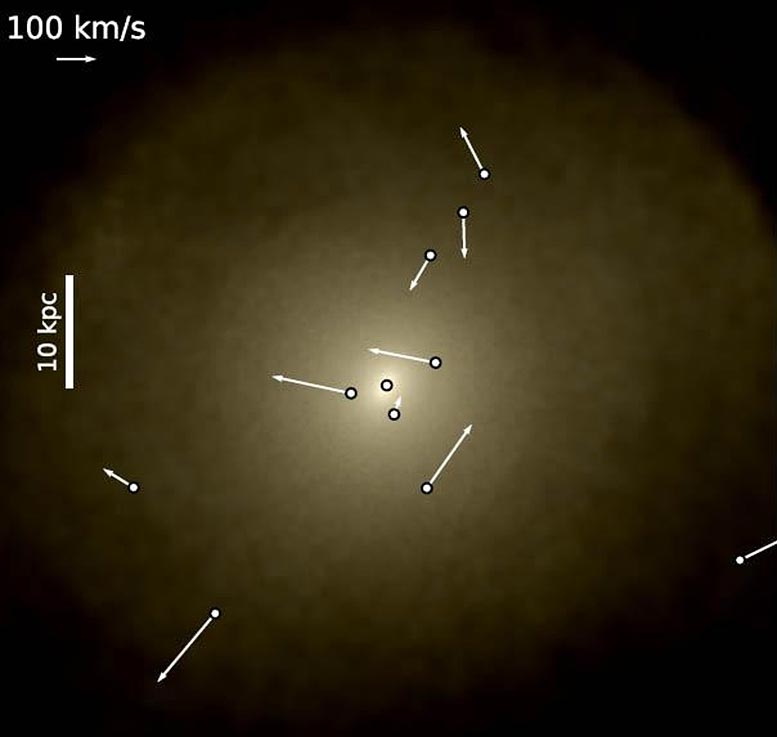
Simulations show that not all supermassive black holes settle into galactic centers after mergers.
Every massive galaxy is believed to host a supermassive black hole (SMBH) at its center. Its mass is correlated with the mass of the inner regions of its host (and also with some other properties), probably because the SMBH grows and evolves as the galaxy itself grows, through mergers with other galaxies and the infall of material from the intergalactic medium. When material makes its way to the galactic center and accretes onto the SMBH, it produces an active galactic nucleus (AGN); outflows or other feedback from the AGN then act disruptively to quench star formation in the galaxy. Modern cosmological simulations now self-consistently trace star formation and SMBH growth in galaxies from the early universe to the present day, confirming these ideas.
The merger process naturally results in some SMBHs that are slightly offset from the center of the enlarged galaxy. The path to a single, combined SMBH is complex. Sometimes a binary SMBH is first formed, which then gradually merges into one. Detectable gravitational wave emission can be produced in this process. However, the merger can sometimes stall or be disrupted – understanding why is one of the key puzzles in SMBH’s evolution. New cosmological simulations with the ROMULUS code predict that even after billions of years of evolution some SMBHs do not join the nucleus but end up instead wandering through the galaxy.
CfA astronomer Angelo Ricarte led a team of colleagues characterizing such wandering black holes. Using the ROMULUS simulations the team finds that in today’s universe (that is, about 13.7 billion years after the Big Bang) about ten percent of the mass in black holes might be in wanderers. At earlier times in the universe, two billion years after the Big Bang or younger, these wanderers appear to be even more significant and contain most of the mass in black holes. Indeed, the scientists find that in these early epochs the wanderers also produce most of the emission coming from the SMBH population. In a related paper, the astronomers explore the observational signatures of the wandering SMBH population.
Reference: “Origins and demographics of wandering black holes” by Angelo Ricarte, Michael Tremmel, Priyamvada Natarajan, Charlotte Zimmer and Thomas Quinn, 26 March 2021, Monthly Notices of the Royal Astronomical Society.
DOI: 10.1093/mnras/stab866
Never miss a breakthrough: Join the SciTechDaily newsletter.
Follow us on Google and Google News.
6 Comments
These simulations suggesting wandering supermassive Black Holes sound a bit like science fiction.
While everyone is focused on supermassive Black Holes at the centers of galaxies, another possibility exists. According to String Theory, a brane (dimensional membrane) surrounds our universe. What if such branes, rather than Black Holes, are also the centers of galaxies? Superheated gas would also form around branes, and they would explain how the matter in the universe became concentrated as galaxies even as the universe was, and still is, flying apart from the Big Bang at a rate that absolutely won’t allow any matter (quarks, even) to gravitationally attract each other to form anything. It would also explain those low-mass stars at the center of the Milky Way and the Andromeda galaxy, and other curious phenomena seen at those centers. How would we know if the center is a Black Hole or a brane? If material (gas, etc.) is seen swirling into the center, it’s a Black Hole. If material doesn’t swirl in, that would be support for a brane. The physical creation of brane-centered galaxies using the quantum foam and similar to Hawking radiation can be described in my YouTube https://www.youtube.com/watch?v=IaxfuKXdhkg
Howards,
first of all string theory is not a theory despite it’s name. It is a collection of hypothesis and they are extremely many, thousands. So with a collection of thousands slightly different hypothesis it is sometimes easy to find one that suits our purpose.
The early universe was much denser than today. Expansion do not affect locally collected objects like in a galaxy cluster nor in even smaller size objects. Gravity simply wins. So galaxy formation is what was going on then, how do you think our older galaxies were formed? All in all there is no need for an alternative explanation for the forming of galaxies nor their black holes, and even if there was a need string theory would probably not help in this regard. String theory would have to be further developed until either dismissed or become a real theory that have been tested and not shown be wrong despite trying!
Expansion rate, disregarding inflation have been increasing for a few billion years. Before this it wasn’t as fast as it became somewhere in the second half of the universe lifetime. The universe were denser and perfect for star formation and this is were our old objects come from today!
String Theory certainly is a theory, with many aspects to it. If you disagree with me, discuss it with Edward Witten or Brian Greene, or many others.
The universe expansion certainly does affect things like galaxy clusters. In fact, that’s one of the examples used by Perlmutter and colleagues to explain Dark Energy. My view of String Theory explains why Dark Energy is just a math mistake we’re making, and you can see the specifics in my YouTube – Dark Energy – A String Theory Way at https://www.youtube.com/watch?v=0b6t0jO7IgQ&t=12s. Enjoy.
The merger process naturally results in some SMBHs that are slightly offset from the center of the enlarged galaxy. The path to a single, combined SMBH is complex. Sometimes a binary SMBH is first formed which then gradually merges into one.
if one supermassive black hole rotating clockwise meets another supermassive black hole rotating clockwise would we have a merger
if one supermassive black hole rotating anticlockwise meets another supermassive black hole rotating anticlockwise would we have a merger
if one supermassive black hole rotating clockwise meets another supermassive black hole rotating anticlockwise would we have a wanderer
if one supermassive black hole rotating anticlockwise meets another supermassive black hole rotating clockwise would we have a wanderer
a wanderer or merger 2 b
that is the question 2 b a wanderer r 2 b a merger
Every spiral galaxy. Other galaxies are known not to have them (SMBH) at their core.
bro we gonna get sucked up or something