
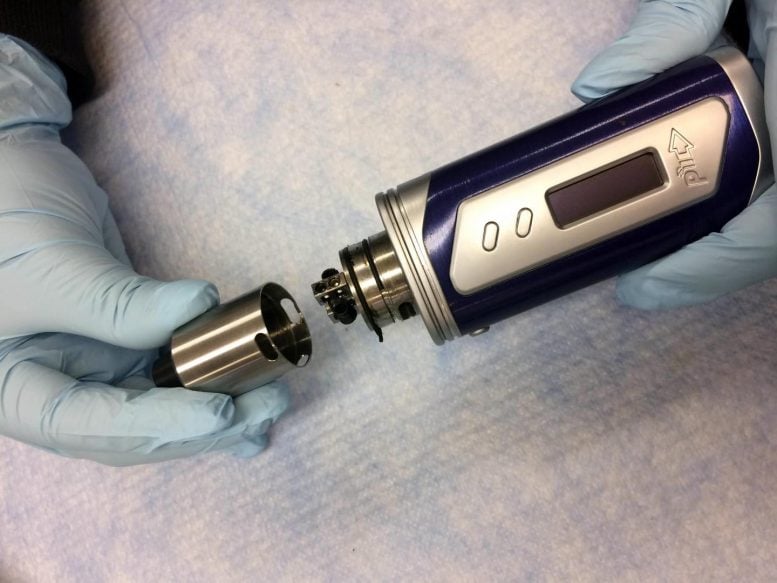
A team of scientists at the University of California, Riverside, has found the concentration of metals in electronic cigarette aerosols — or vapor — has increased since tank-style electronic cigarettes were introduced in 2013.
Electronic cigarettes, which consist of a battery, atomizing unit, and refill fluid, are now available in new tank-style designs, equipped with more powerful batteries and larger capacity reservoirs for storing more refill fluid. But the high-power batteries and atomizers used in these new styles can alter the metal concentrations that transfer into the aerosol.
“These tank-style e-cigarettes operate at higher voltage and power, resulting in higher concentrations of metals, such as lead, nickel, iron, and copper, in their aerosols,” said Monique Williams, a postdoctoral researcher in the Department of Molecular, Cell, and Systems Biology, and the first author of the research paper that appears today in Scientific Reports. “Most of the metals in e-cigarette aerosols likely come from the nichrome wire, tin solder joints, brass clamps, insulating sheaths, and wicks — components of the atomizer unit.”
The researchers examined six tank-style electronic cigarettes and found all the aerosols had metals that appeared to originate in the atomizers. Further, they found the model with the fewest metal parts in its atomizer had the fewest metals in its aerosol.
Of the 19 metals they screened, aluminum, calcium, chromium, copper, iron, lead, magnesium, nickel, silicon, tin, and zinc were from components in the atomizing units.
“Concentrations of the metals, such as lead, in the aerosols increased with more voltage,” Williams said. “Concentrations of some elements — chromium, lead, and nickel — were high enough to be a health concern. We found the concentrations of chromium, copper, lead, nickel, and zinc exceeded the proposed permissible exposure limit from the Occupational Safety and Health Administration.”

Chromium, lead, and nickel are known carcinogens. Prolonged exposure to chromium could cause gastrointestinal effects, nasal and lung cancer, respiratory irritation, and lung function impairment. Prolonged exposure to lead could produce vomiting, diarrhea, cardiovascular effects, and lung cancer. Nickel inhalation could cause lung disease, damage to the nasal cavity, lung irritation, lung inflammation, hyperplasia in pulmonary cells, and fibrosis.
The researchers analyzed the following six tanks and their atomizers: Kangertech Protank, Aspire Nautilus tank, Kanger T3S tank, Tsunami 2.4, Smok tank, and Clone. They collected aerosols from these brands using two methods and found the total concentrations of metals varied, ranging from 43 to 3,138 micrograms per liter with the “impinger method” of collection and 226 to 6,767 micrograms per liter with the “cold trap method.”
“When batteries with more power are used in these tank-style e-cigarettes, their atomizing units can heat to temperatures greater than 300 ºC (572 ºF), which could produce harmful byproducts,” said Prue Talbot, a professor of cell biology, who led the research team. “The presence of heavy metals, including some known carcinogens, in e-cigarette aerosols is concerning because with prolonged exposure they could cause adverse health effects.
“Our data on tank-style e-cigarettes and the concentrations of metals they deliver may be useful to regulatory agencies, health care providers, and consumers,” she added.
###
The National Institute of Drug Abuse, and Food and Drug Administration Center for Tobacco Products supported the study. Williams was partially supported by a predoctoral fellowship from the Tobacco-Related Disease Research Program of California and a postdoctoral training grant from the National Institutes of Health.
Talbot and Williams were joined in the study by UC Riverside’s Jun Li.
Reference: “Effects of Model, Method of Collection, and Topography on Chemical Elements and Metals in the Aerosol of Tank-Style Electronic Cigarettes” by Monique Williams, Jun Li and Prue Talbot, 27 September 2019, Scientific Reports.
DOI: 10.1038/s41598-019-50441-4
Never miss a breakthrough: Join the SciTechDaily newsletter.
Follow us on Google and Google News.