
Close Menu
    Facebook X (Twitter) Instagram
    SciTechDaily
    • Biology
    • Chemistry
    • Earth
    • Health
    • Physics
    • Science
    • Space
    • Technology
    Facebook X (Twitter) Pinterest YouTube RSS
    SciTechDaily
    Home»Space»Watch Live: Copernicus Sentinel-6 Michael Freilich Launch
    Space

    Watch Live: Copernicus Sentinel-6 Michael Freilich Launch

    By European Space Agency (ESA)November 21, 2020No Comments3 Mins Read
    Facebook Twitter Pinterest Telegram LinkedIn WhatsApp Email Reddit
    Share
    Facebook Twitter LinkedIn Pinterest Telegram Email Reddit
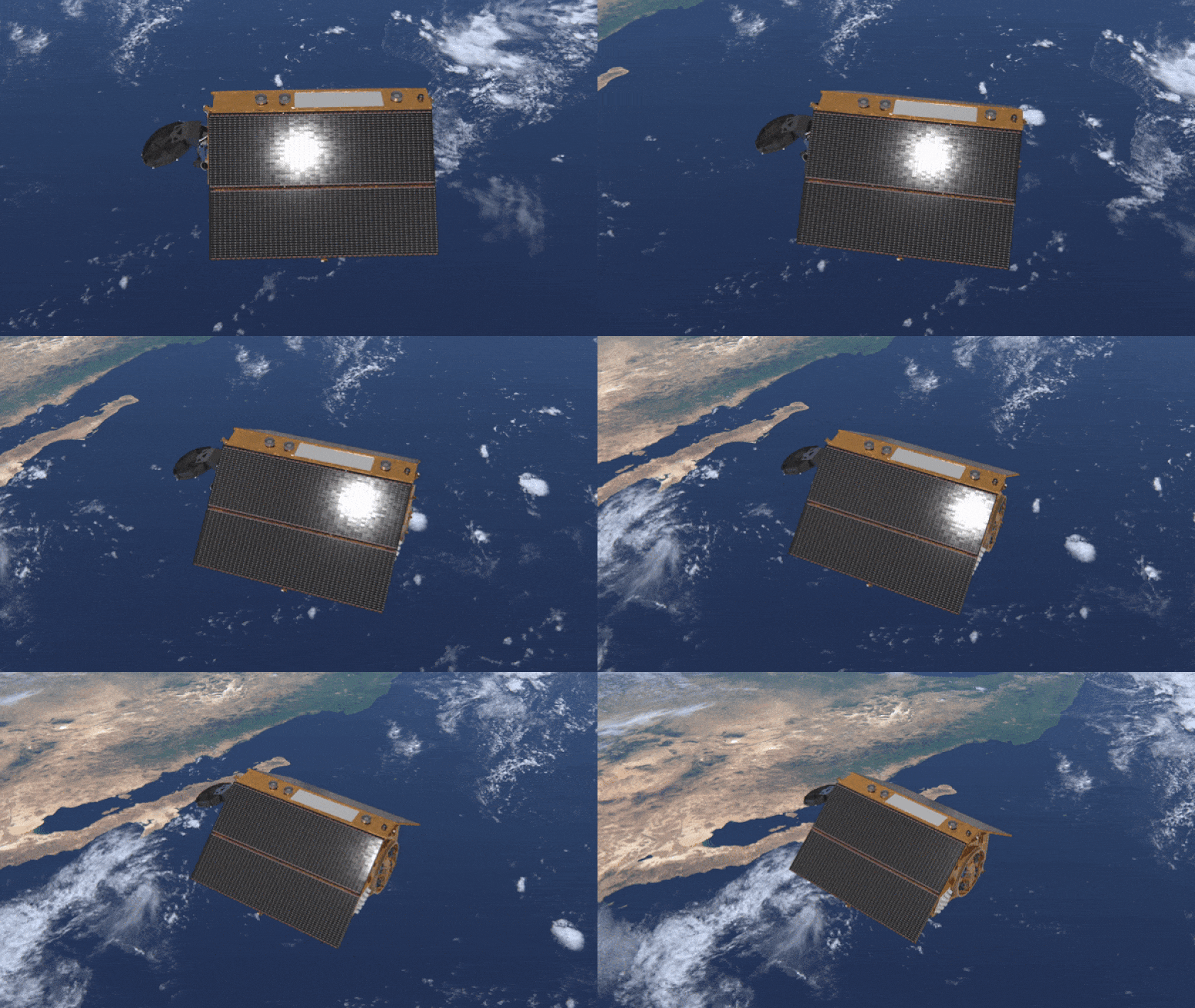
    Sentinel-6 Satellite Over California
    Sentinel-6 Satellite Over California. The Copernicus Sentinel-6 is taking on the role of radar altimetry reference mission, continuing the long-term record of measurements of sea-surface height started in 1992 by the French–US Topex Poseidon and then the Jason series of satellite missions. While Sentinel-6 is one of the European Union’s family of Copernicus satellite missions, its implementation is the result of a unique cooperation between ESA, Eumetsat, NASA and NOAA. The Copernicus Sentinel-6 mission comprises two identical satellites launched five years apart. The first, Sentinel-6 Michael Freilich, launches on November 21, 2020, from the Space Launch Complex 4 East at the Vandenberg Air Force Base near the city of Lompoc in California, US. Credit: ESA/ATG Medialab

    Watch the launch of the Copernicus Sentinel-6 Michael Freilich ocean-monitoring satellite on ESA Web TV on Saturday, November 21 from 17:45 CET (08:45 PST).

    Also available at NASA Live.

    A joint European-US satellite built to monitor sea-level change, the satellite will liftoff atop a Space X Falcon 9 rocket on 21 November at 17:17 GMT (18:17 CET, 09:17 PST) from the Vandenberg Air Force Base in California, US. The weather will be monitored constantly until the precise moment of liftoff to determine whether or not to authorize the launch.
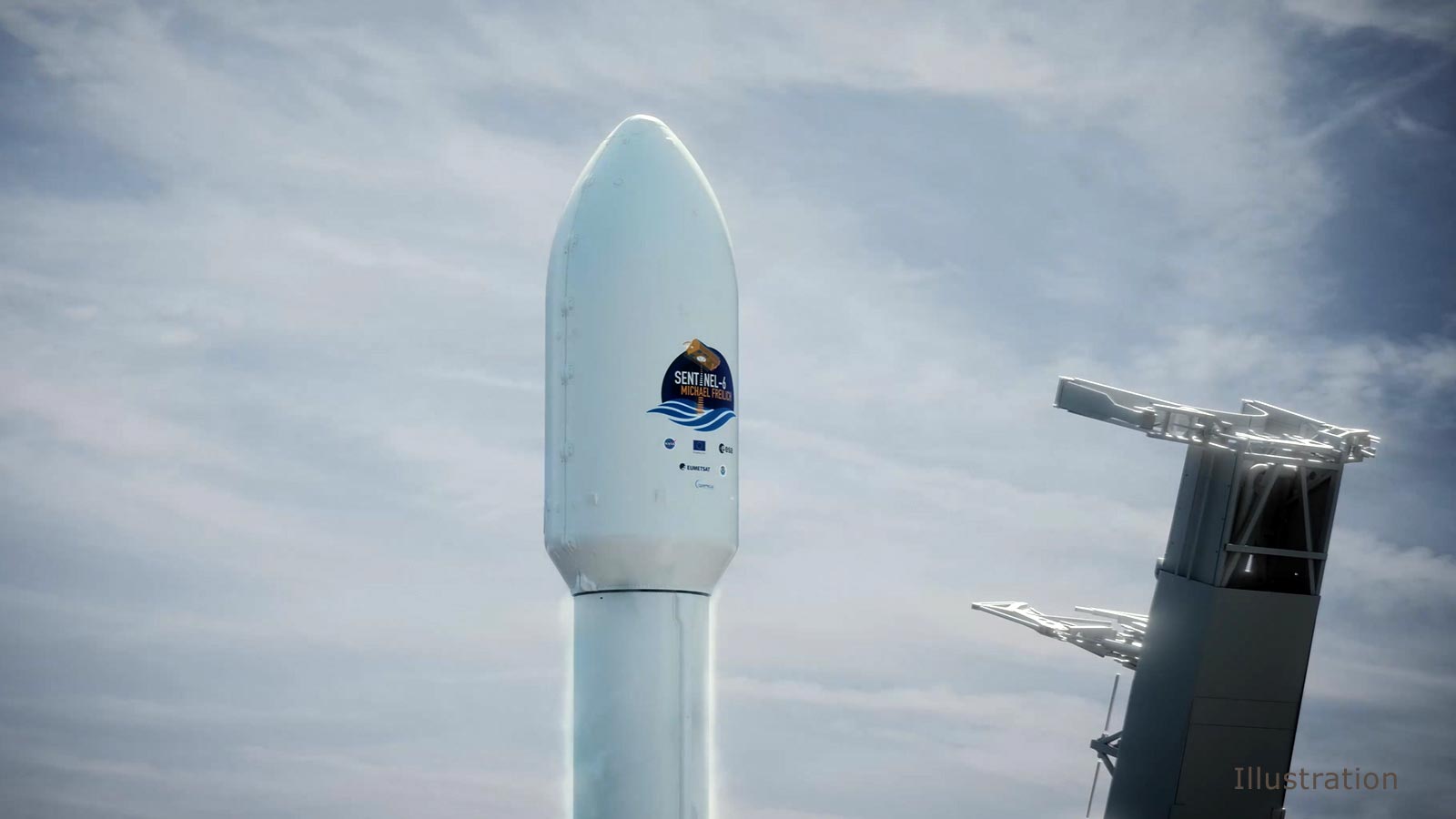
    Sentinel-6 SpaceX Falcon 9 Rocket
    This illustration shows the SpaceX Falcon 9 rocket’s nose cone, with the Sentinel-6 Michael Freilich satellite inside, shortly before launch. Credit: NASA/JPL-CaltechSpaceX

    Join as experts from all partners in the mission, as well as data users and beneficiaries, discuss details regarding the mission.

    Key events after launch (times approximate):

    2 minutes and 16 seconds after launch: main engine cut off, second stage separation and then second-engine Start 1 will occur in quick succession. Reusable Falcon 9 first stage then begins its automated boost-back to the launch site for a powered landing.

    3 minutes: After protecting the satellite as the rocket traveled through the atmosphere, the launch vehicle’s nose cone will separate and jettisoned.

    8 minutes: Stage-II engine cut-off.

    53 minutes: Stage-II first restart for a 15 second burn, followed by Stage-II engine cut-off.

    58 minutes: launch vehicle and satellite separation.

    1 hour and 7 minutes: satellite begins solar panel deployment.

    1 hour and 33 minutes: planned first contact for satellite telemetry downlink by ground stations in Alaska.
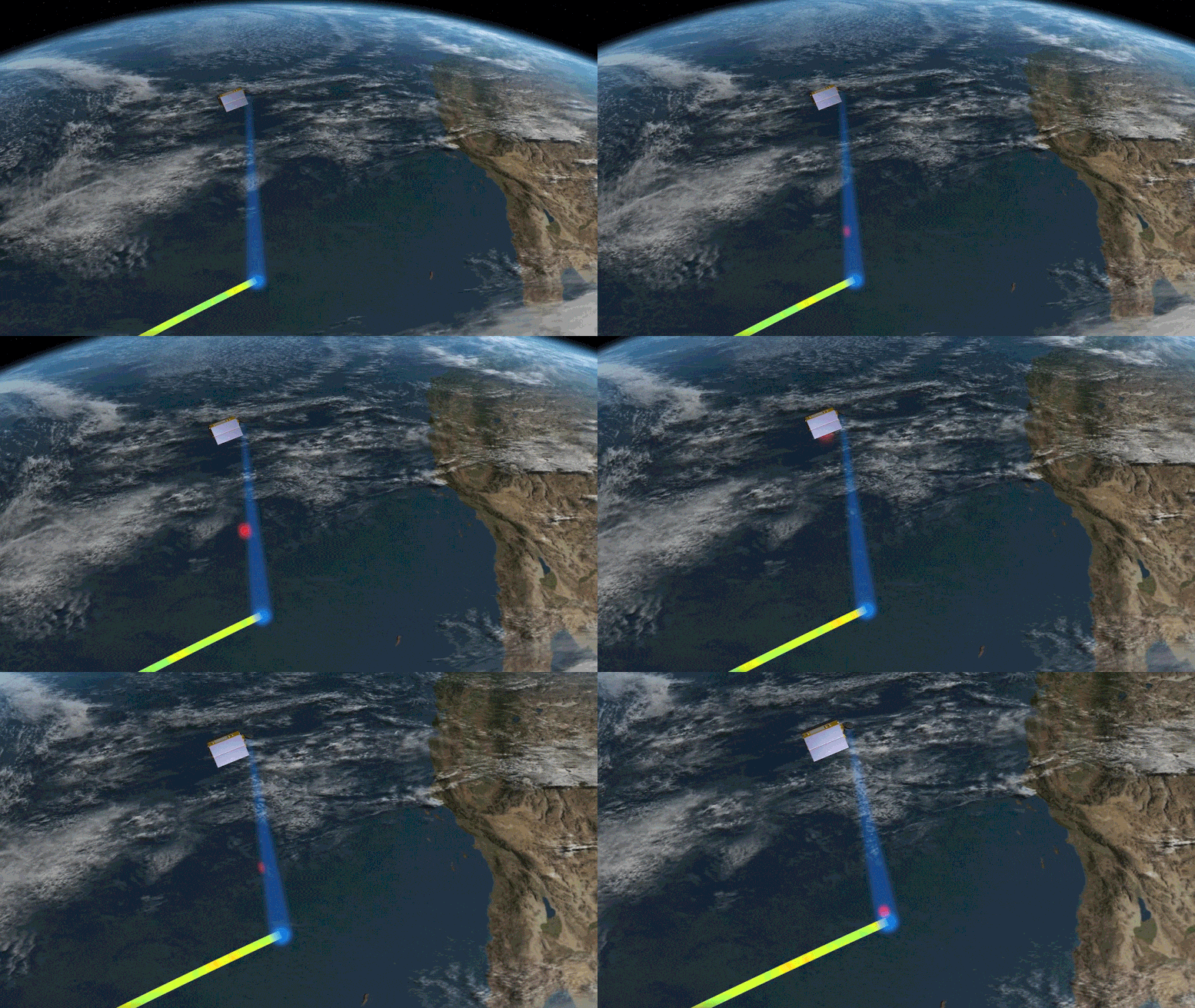
    Sentinel-6 Michael Freilich Satellite Radar Pulse
    This animation shows the radar pulse from the Sentinel-6 Michael Freilich satellite’s altimeter bouncing off the sea surface in order to measure the height of the ocean. Credit: NASA/JPL-Caltech

    Charting sea level

    The Copernicus Sentinel-6 Michael Freilich satellite is the first of two identical satellites to provide critical measurements of sea-level change.

    Once safely in orbit, the satellite will continue the long-term record of reference sea-surface height measurements and extend the records of sea level into its fourth decade. The satellite will map 95% of Earth’s ice-free ocean every 10 days and provide crucial information for operational oceanography and climate studies.

    Since sea-level rise is a key indicator of climate change, accurately monitoring the changing height of the sea surface over decades is essential for climate science, for policy-making, and for protecting those in low-lying regions at risk.

    The satellite was renamed in honor of Michael H. Freilich, the former director of NASA’s Earth Science Division. The mission is a collaboration between ESA, the European Commission, EUMETSAT, NASA and NOAA, with support from the French space agency CNES.

    Never miss a breakthrough: Join the SciTechDaily newsletter.
    Follow us on Google and Google News.

    European Space Agency Jason-CS/Sentinel-6 Mission NASA
    Share. Facebook Twitter Pinterest LinkedIn Email Reddit

    Related Articles

    This Nearby Galaxy Shows How Frozen Clouds Ignite Into Stars

    This Chaotic Spiral Galaxy Is Still Recovering From a Cosmic Collision

    Hubble Zooms In on a Galaxy That Maps the Universe’s Expansion

    Hubble Captures a Dazzling Spiral Galaxy Alive With Birth and Destruction

    Hubble Spots a Glowing “Ring of Fire” in a Distant Spiral Galaxy

    Dust, Light & Ancient Collisions: The Sombrero Galaxy Like You’ve Never Seen It

    Star Formation in Motion: Hubble Reveals Spiraling Stars and Sculpted Nebulae

    Inside the Sombrero Galaxy: Stunning New Insights from James Webb

    NASA’s Orion Spacecraft for Artemis III Hits Major Milestone at Kennedy

    Leave A Reply Cancel Reply

    • Facebook
    • Twitter
    • Pinterest
    • YouTube

    Don't Miss a Discovery

    Subscribe for the Latest in Science & Tech!

    Trending News

    Scientists May Have Found the Key to Jupiter and Saturn’s Moon Mystery

    Scientists Uncover Brain Changes That Link Pain to Depression

    Saunas May Do More Than Raise Body Temperature – They Activate Your Immune System

    Exercise in a Pill? Metformin Shows Surprising Effects in Cancer Patients

    Hidden Oceans of Magma Could Be Protecting Alien Life

    New Study Challenges Alzheimer’s Theories: It’s Not Just About Plaques

    Artificial Sweeteners May Harm Future Generations, Study Suggests

    Splashdown! NASA Artemis II Returns From Record-Breaking Moon Mission

    Follow SciTechDaily
    • Facebook
    • Twitter
    • YouTube
    • Pinterest
    • Newsletter
    • RSS
    SciTech News
    • Biology News
    • Chemistry News
    • Earth News
    • Health News
    • Physics News
    • Science News
    • Space News
    • Technology News
    Recent Posts
    • This Strange Material Can Turn Superconductivity on and off Like a Switch
    • Scientists Discover Game-Changing New Way To Treat High Cholesterol
    • Breakthrough Drug Delays Rheumatoid Arthritis for Years After Treatment Ends
    • This Small Change to Your Exercise Routine Could Be the Secret to Living Longer
    • Physicists Discover a Strange New Kind of One-Dimensional Particle
    Copyright © 1998 - 2026 SciTechDaily. All Rights Reserved.
    • Science News
    • About
    • Contact
    • Editorial Board
    • Privacy Policy
    • Terms of Use

    Type above and press Enter to search. Press Esc to cancel.