
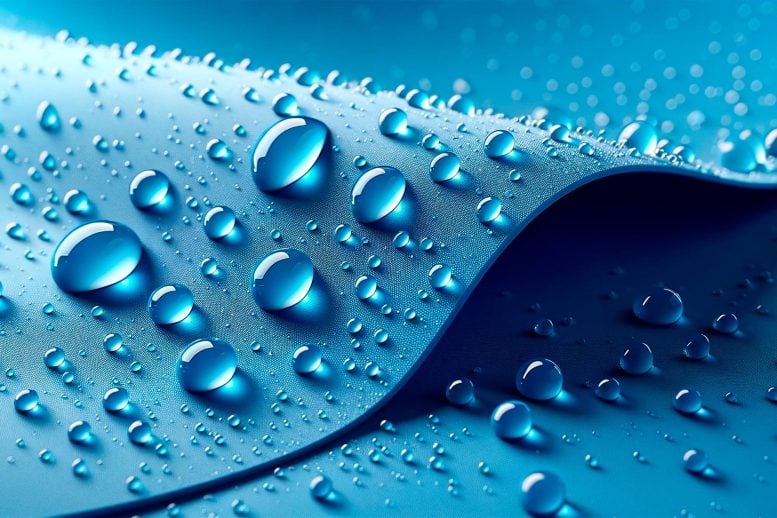
A species of spider lives its entire life underwater, despite having lungs that can only breathe atmospheric oxygen. How does it do it? This spider, known as the Argyroneta aquatica, has millions of rough, water-repellent hairs that trap air around its body, creating an oxygen reservoir and acting as a barrier between the spider’s lungs and the water.
Harnessing Plastrons for Material Science
This thin layer of air is called a plastron and for decades, material scientists have been trying to harness its protective effects. Doing so could lead to underwater superhydrophobic surfaces able to prevent corrosion, bacterial growth, the adhesion of marine organisms, chemical fouling, and other deleterious effects of liquid on surfaces. But plastrons have proved highly unstable under water, keeping surfaces dry for only a matter of hours in the lab.
Now, a team of researchers led by the Harvard John A. Paulson School of Engineering and Applied Sciences (SEAS), the Wyss Institute for Biologically Inspired Engineering at Harvard, the Friedrich-Alexander-Universität Erlangen-Nürnberg in Germany, and Aalto University in Finland have developed a superhydrophobic surface with a stable plastron that can last for months under water. The team’s general strategy to create long-lasting underwater superhydrophobic surfaces, which repel blood and drastically reduce or prevent the adhesion of bacterial and marine organisms such as barnacles and mussels, opens a range of applications in biomedicine and industry.
Research Discoveries and Challenges
“Research in bioinspired materials is an extremely exciting area that continues to bring into the realm of man-made materials elegant solutions evolved in nature, which allows us to introduce new materials with properties never seen before,” said Joanna Aizenberg, Amy Smith Berylson Professor of Materials Science and Professor of Chemistry & Chemical Biology at SEAS and co-author of the paper. “This research exemplifies how uncovering these principles can lead to developing surfaces that maintain superhydrophobicity under water.”
Aizenberg is also an associate faculty member of the Wyss Institute.
The research is published in Nature Materials.
Researchers have known for 20 years that a stable, underwater plastron was theoretically possible but, until now, haven’t been able to show it experimentally.
One of the biggest issues with plastrons is that they need rough surfaces to form, like the hair of Argyroneta aquatica. But this roughness makes the surface mechanically unstable and susceptible to any small perturbation in temperature, pressure, or tiny defect.
Innovative Techniques and Findings
Current techniques to assess artificially made superhydrophobic surfaces only take into account two parameters, which don’t give enough information about the stability of the air plastron underwater. Aizenberg, Jaakko V. I. Timonen and Robin H. A. Ras from Aalto University, and Alexander B. Tesler and Wolfgang H. Goldmann from FAU and their teams identified a larger group of parameters, including information on surface roughness, the hydrophobicity of the surface molecules, plastron coverage, contact angles, and more, which, when combined with thermodynamic theory, allowed them to figure out if the air plastron would be stable.
With this new method and a simple manufacturing technique, the team designed a so-called aerophilic surface from a commonly used and inexpensive titanium alloy with a long-lasting plastron that kept the surface dry thousands of hours longer than previous experiments and even longer than the plastrons of living species.
“We used a characterization method that had been suggested by theorists 20 years ago to prove that our surface is stable, which means that not only have we made a novel type of extremely repellent, extremely durable superhydrophobic surface, but we can also have a pathway of doing it again with a different material,” said Tesler, a former postdoctoral fellow at SEAS and the Wyss Institute, and lead author of the paper.
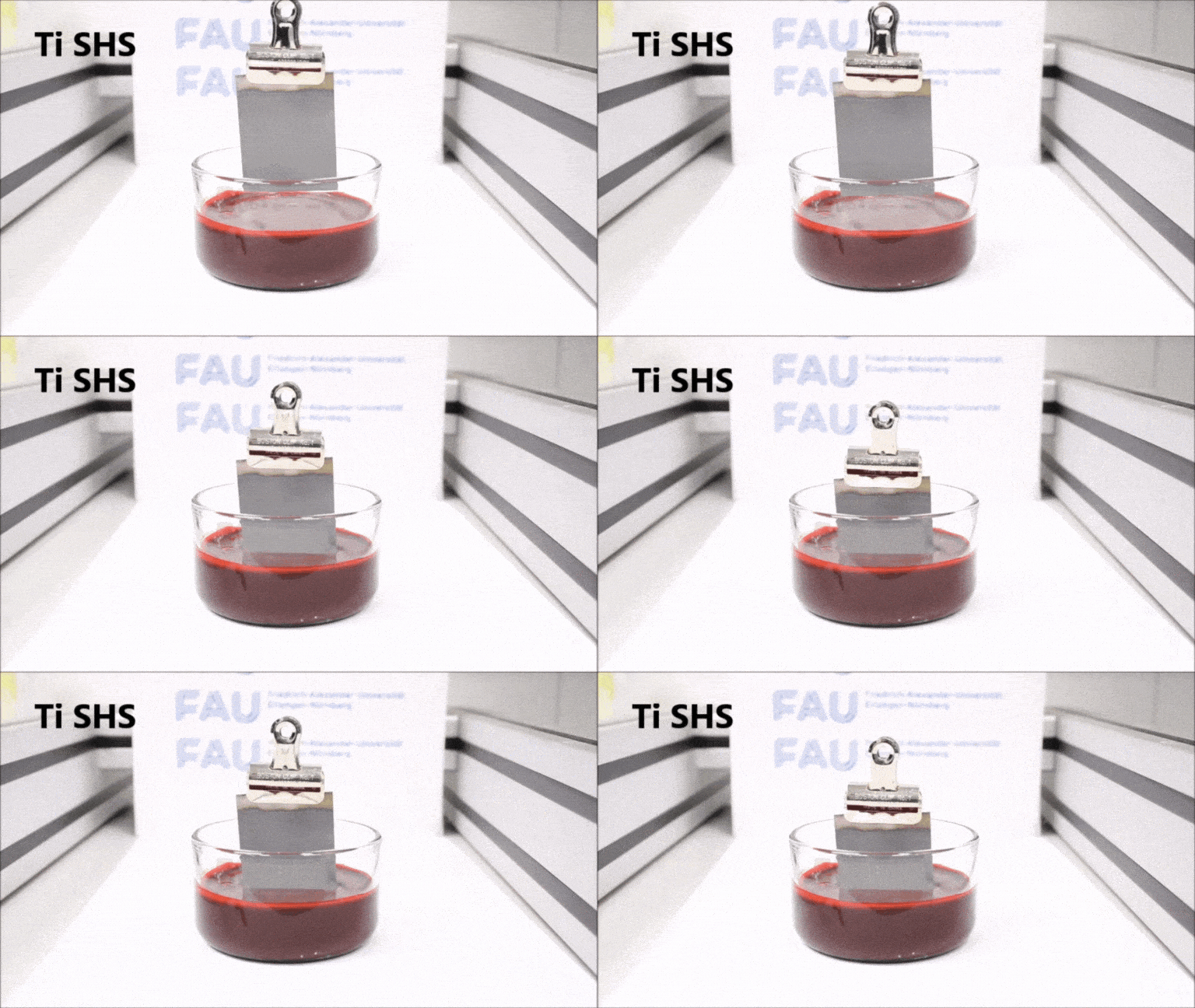
To prove the stability of the plastron, the researchers put the surface through the ringer — bending it, twisting it, blasting it with hot and cold water, and abrading it with sand and steel to block the surface remaining aerophilic. It survived 208 days submerged in water and hundreds of dunks in a petri dish of blood. It severely reduced the growth of E.coli and barnacles on its surface and stopped the adhesion of mussels altogether.
Applications and Future Prospects
“The stability, simplicity, and scalability of this system make it valuable for real-world applications,” said Stefan Kolle, a graduate student at SEAS and co-author of the paper. “With the characterization approach shown here, we demonstrate a simple toolkit that allows you to optimize your superhydrophobic surface to reach stability, which dramatically changes your application space.”
That application space includes biomedical applications, where it could be used to reduce infection after surgery or as biodegradable implants such as stents, according to Goldmann, senior author of the paper, and former Harvard fellow. It also includes underwater applications, where it could prevent corrosion in pipelines and sensors. In the future, it could even be used in combination with the super-slick coating known as SLIPS, the Slippery Liquid-Infused Porous Surfaces, developed by Aizenberg and her team more than a decade ago, to protect surfaces even further from contamination.
Reference: “Long-term stability of aerophilic metallic surfaces underwater” by Alexander B. Tesler, Stefan Kolle, Lucia H. Prado, Ingo Thievessen, David Böhringer, Matilda Backholm, Bhuvaneshwari Karunakaran, Heikki A. Nurmi, Mika Latikka, Lena Fischer, Shane Stafslien, Zoran M. Cenev, Jaakko V. I. Timonen, Mark Bruns, Anca Mazare, Ulrich Lohbauer, Sannakaisa Virtanen, Ben Fabry, Patrik Schmuki, Robin H. A. Ras, Joanna Aizenberg and Wolfgang H. Goldmann, 18 September 2023, Nature Materials.
DOI: 10.1038/s41563-023-01670-6
This paper was co-authored by Lucia H. Prado, Ingo Thievessen, David Böhringer, Lena Fischer, Mark Bruns, Anca Mazare, Ulrich Lohbauer, Sannakaisa Virtanen, Ben Fabry, Patrik Schmuki, and Wolfgang H. Goldmann of the Friedrich-Alexander-Universität Erlangen-Nürnberg in Germany; and Matilda Backholm, Bhuvaneshwari Karunakaran, Heikki A. Nurmi, Mika Latikka, Zoran M. Cenev, Jaakko V. I. Timonen and Robin H. A. Ras of Aalto University in Finland; and Shane Stafslien of North Dakota State University.
Never miss a breakthrough: Join the SciTechDaily newsletter.
Follow us on Google and Google News.
1 Comment
This is excellent news. Most superhydrophobic coatings are very fragile, with nanostructures that repel water but get crushed by any pressure. They could be rinsed off, but not wiped off.
Hopefully they make this cheap. Durable superhydrophobic inexpensive surfaces will change your life. From clothes that don’t stain, to cars that don’t get muddy and clean themselves in the rain, to hats for goldfish.