
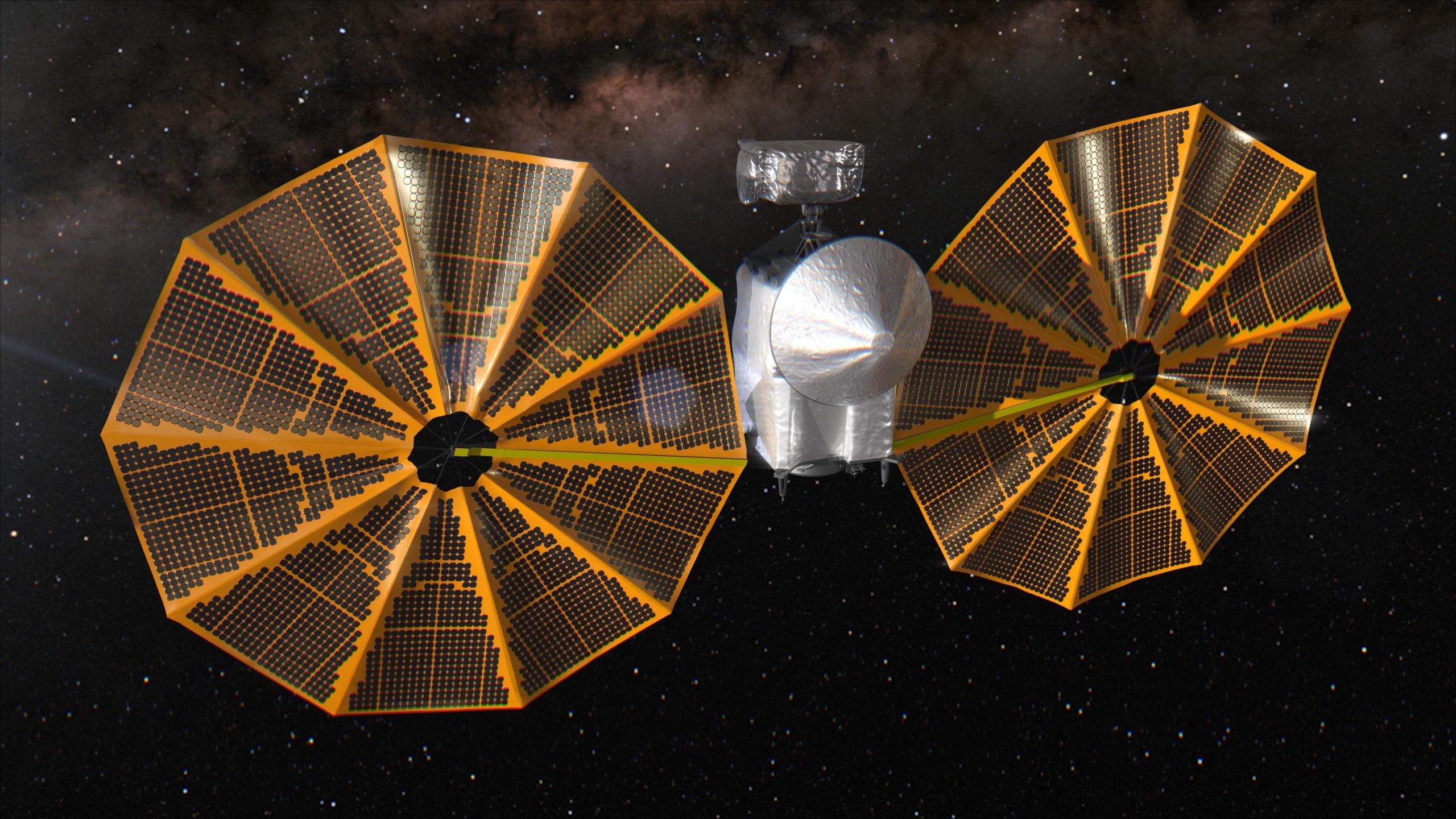
NASA is preparing to launch a new spacecraft on a quest to unlock the mysteries of our Solar System’s formation. Named for the fossilized human ancestor, Lucy will be the first mission to study the Trojan asteroids associated with, but not close to, Jupiter. Lucy is scheduled to launch no earlier than Saturday, October 16, on a United Launch Alliance Atlas V 401 rocket from Space Launch Complex-41 on Cape Canaveral Space Force Station in Florida.
Just as the mission’s namesake provided insight into humanity’s evolution, the Lucy mission could revolutionize our knowledge of planetary origins and the formation of the solar system. During its 12-year journey, Lucy will visit a record-breaking eight different asteroids — a Main Belt asteroid and seven Trojans that are believed to be remnants from the formation of the outer planets.
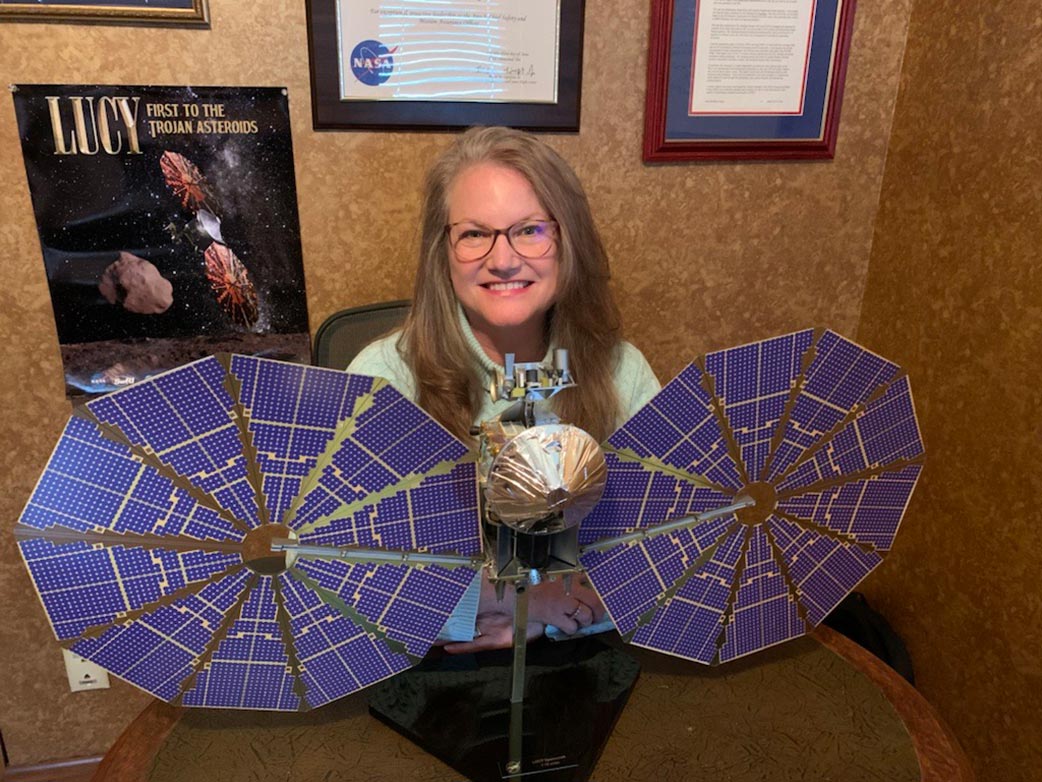
Sherry Jennings, mission manager at Marshall for Lucy, sat down with us this week to answer several questions about the mission.
What’s the most exciting thing about the Lucy mission to you?
Trojan asteroids have witnessed first-hand the history of the outer solar system. Thus, they present us with a unique opportunity to better understand planet formation and solar system evolution. These primitive bodies hold vital clues to deciphering the history of the solar system.
What are the science instruments on the spacecraft and what data do we expect?
Lucy hosts three scientific instruments that will gather data to help scientists unlock the mysteries of planet and solar system formation.
Lucy Thermal Emissions Spectrometer (L’TES), a version of which is currently flying on the OSIRIS-REx mission, will study the thermal environment of the Trojan surfaces, resulting in a better understanding of the physical properties of the regolith such as grain sizes and subsurface layering.
L’Ralph, similar to instruments currently flying on the New Horizons and OSIRIS-REX missions, is the combination of a Multi-spectral Visible Camera (MVIC) and an infrared imaging spectrometer use to look for ice and organics and will be determining the mineral makeup of the asteroids.
Long Range Reconnaissance Imager (L’LORRI), will provide detailed images of the surface of the Trojans. L’LORRI is a clone of the New Horizons instrument which was used to capture the iconic images of the New Horizons Pluto flyby and should produce images of the Trojans that will help scientists in understanding the geological features and crater counts – aiding with determining the age of the Trojans.
What is your favorite thing about your job and working this mission?
As a mission manager on the Lucy mission, I’m responsible for making sure the project team has the resources they need to be successful. Having the privilege of being a part of a team that hopes to produce scientific discoveries that change or improve our understanding of the evolution of our solar system inspires me.
I am grateful to have worked on such an ambitious mission with a team of talented people from across this country. This team has persevered and maintained a “can do” attitude through challenges of integrating and testing hardware during a global pandemic, along with numerous and significant technical challenges. It will be bittersweet when Lucy launches. I will miss working with this team, but I am very excited to see the amazing discoveries that result from the Lucy mission.
What does the Planetary Missions Office at Marshall do? How does this help missions like Lucy?
Our office manages the Discovery, New Frontiers, and Solar System Exploration programs with missions that explore the inner planets, outer planets, the moon, asteroids, comets, and even targets beyond our solar system. We recently added lunar instruments that fly on the Commercial Lunar Payload Services landers to our portfolio. Our goal is to enhance the probability of mission success of by providing technical oversight as well as specialized support as needed.
We are a fast-paced organization and the development of our projects from the preliminary design review to launch averages only 39 months. Lucy is the first of three launches for our office in less than a year.
For Lucy, we have worked together with the project team every step of the way through development ensuring availability of any additional resources required to maneuver due to the pandemic.
Lucy is a Discovery Mission managed by the Planetary Missions Program Office at NASA’s Marshall Space Flight Center in Huntsville, Alabama, for NASA’s Planetary Science Division. The mission is led by the Principal Investigator from the Boulder, Colorado office of Southwest Research Institute. NASA Goddard Space Flight Center in Greenbelt, Maryland, is the primary NASA center for Lucy, providing overall project management, systems engineering, and safety and mission assurance. Lockheed Martin Space in Denver built the spacecraft. KinetX in Simi Valley, California, provides mission navigation. Launch operations will be conducted by NASA’s Kennedy Space Center in Florida.
Never miss a breakthrough: Join the SciTechDaily newsletter.
Follow us on Google and Google News.