

Dark energy is still a mystery, but powerful new telescopes are set to uncover clues. With NASA and ESA leading the charge, the next decade could finally reveal what’s driving the universe apart.
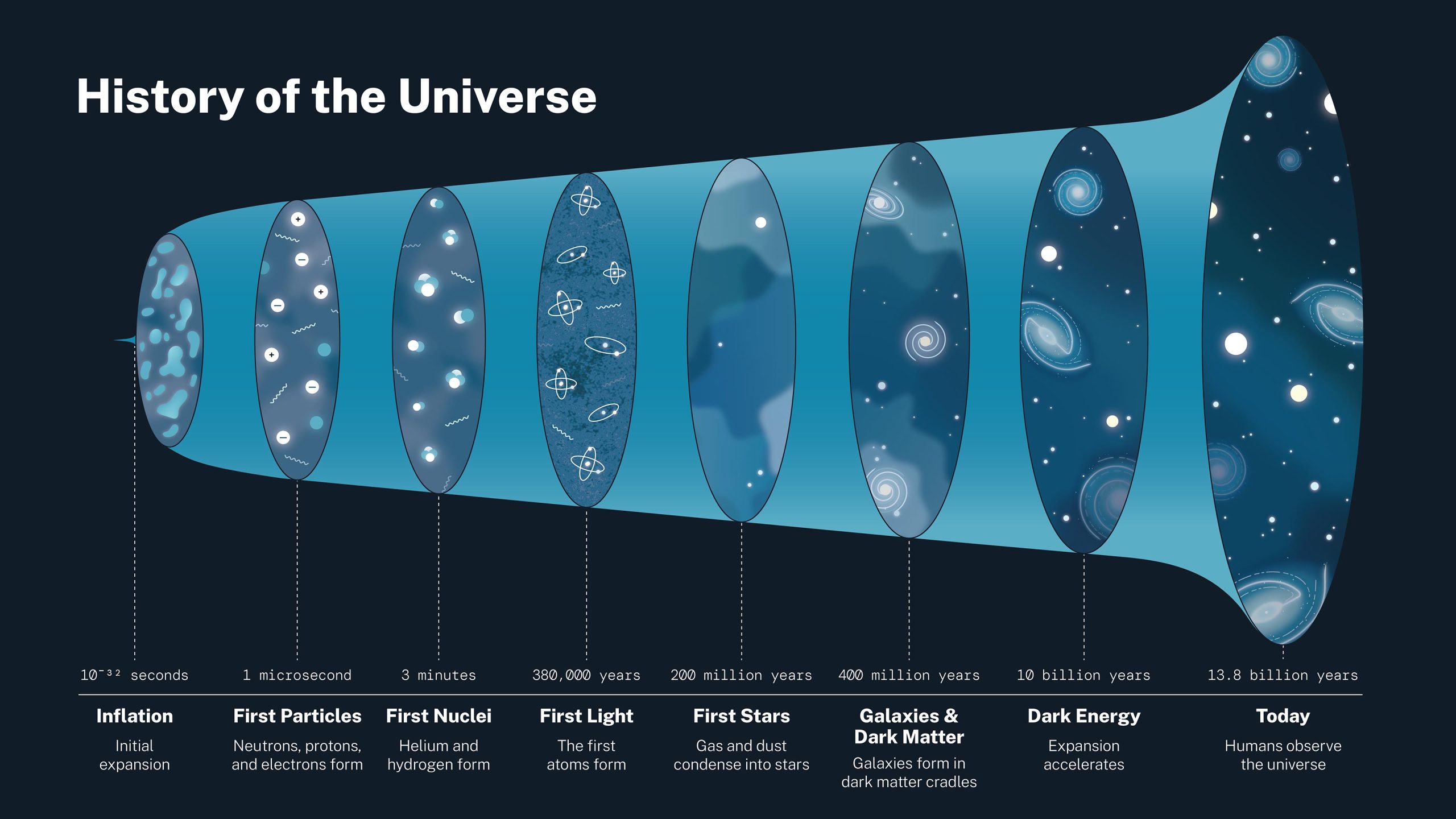
Around 13.8 billion years ago, the universe burst into existence with an event known as the Big Bang. In an instant, space expanded at an unimaginable rate. After this initial surge, gravity took over, gradually slowing the expansion. For billions of years, it seemed like the universe was simply coasting outward. But then, something unexpected happened.
Roughly nine billion years after the Big Bang, the universe’s expansion began to speed up again—defying the gravitational pull that should have been slowing it down. Scientists realized that some unknown force was pushing space apart at an accelerating rate. They named this mysterious phenomenon dark energy.
But what exactly is dark energy?
The short answer: we don’t know. But what we do know is that dark energy is real, it’s driving the universe’s accelerated expansion, and it makes up about 68-70% of everything in existence.
A Brief History
It All Started With Cepheids
Though dark energy wasn’t discovered until the late 1990s, the journey toward understanding cosmic expansion began much earlier. In 1912, American astronomer Henrietta Swan Leavitt made a groundbreaking discovery while studying Cepheid variables — a class of stars that pulsate in brightness with a precise rhythm.
Leavitt found that a Cepheid star’s brightness cycle is directly linked to its actual luminosity — the total amount of light it emits. This discovery gave astronomers a powerful tool: by measuring a Cepheid’s pulsation period, they could calculate its distance from Earth.
Around this same time in history, astronomer Vesto Slipher observed spiral galaxies using his telescope’s spectrograph, a device that splits light into the colors that make it up, much like the way a prism splits light into a rainbow. He used the spectrograph, a relatively recent invention at the time, to see the different wavelengths of light coming from the galaxies in different spectral lines. With his observations, Silpher was the first astronomer to observe how quickly the galaxy was moving away from us, called redshift, in distant galaxies. These observations would prove to be critical for many future scientific breakthroughs, including the discovery of dark energy.
Redshift is a term used when astronomical objects are moving away from us and the light coming from those objects stretches out. Light behaves like a wave, and red light has the longest wavelength. So, the light coming from objects moving away from us has a longer wavelength, stretching to the “red end” of the electromagnetic.
Discovering an Expanding Universe
The discovery of galactic redshift, the period-luminosity relation of Cepheid variables, and a newfound ability to gauge a star or galaxy’s distance eventually played a role in astronomers observing that galaxies were getting farther away from us over time, which showed how the universe was expanding. In the years that followed, different scientists around the world started to put the pieces of an expanding universe together.
In 1922, Russian scientist and mathematician Alexander Friedmann published a paper detailing multiple possibilities for the history of the universe. The paper, which was based on Albert Einstein’s theory of general relativity published in 1917, included the possibility that the universe is expanding.
In 1927, Belgian astronomer Georges Lemaître, who is said to have been unaware of Friedmann’s work, published a paper also factoring in Einstein’s theory of general relativity. And, while Einstein stated in his theory that the universe was static, Lemaître showed how the equations in Einstein’s theory actually support the idea that the universe is not static but, in fact, is actually expanding.
Astronomer Edwin Hubble confirmed that the universe was expanding in 1929 using observations made by his associate, astronomer Milton Humason. Humason measured the redshift of spiral galaxies. Hubble and Humason then studied Cepheid stars in those galaxies, using the stars to determine the distance of their galaxies (or nebulae, as they called them). They compared the distances of these galaxies to their redshift and tracked how the farther away an object is, the bigger its redshift and the faster it is moving away from us. The pair found that objects like galaxies are moving away from Earth faster the farther away they are, at upwards of hundreds of thousands of miles per second – an observation now known as Hubble’s Law, or the Hubble-Lemaître law. The universe, they confirmed, is really expanding.
Expansion is Speeding Up, Supernovae Show
Scientists previously thought that the universe’s expansion would likely be slowed down by gravity over time, an expectation backed by Einstein’s theory of general relativity. But in 1998, everything changed when two different teams of astronomers observing far-off supernovae noticed that (at a certain redshift) the stellar explosions were dimmer than expected. These groups were led by astronomers Adam Riess, Saul Perlmutter, and Brian Schmidt. This trio won the 2011 Nobel Prize in Physics for this work.
While dim supernovae might not seem like a major find, these astronomers were looking at Type 1a supernovae, which are known to have a certain level of luminosity. So they knew that there must be another factor making these objects appear dimmer. Scientists can determine distance (and speed) using an objects’ brightness, and dimmer objects are typically farther away (though surrounding dust and other factors can cause an object to dim).
This led the scientists to conclude that these supernovae were just much farther away than they expected by looking at their redshifts.
Using the objects’ brightness, the researchers determined the distance of these supernovae. And using the spectrum, they were able to figure out the objects’ redshift and, therefore, how fast they were moving away from us. They found that the supernovae were not as close as expected, meaning they had traveled farther away from us faster than ancitipated. These observations led scientists to ultimately conclude that the universe itself must be expanding faster over time.
While other possible explanations for these observations have been explored, astronomers studying even more distant supernovae or other cosmic phenomena in more recent years continued to gather evidence and build support for the idea that the universe is expanding faster over time, a phenomenon now called cosmic acceleration.
But, as scientists built up a case for cosmic acceleration, they also asked: Why? What could be driving the universe to stretch out faster over time?
Enter dark energy.
What Exactly is Dark Energy?
Right now, dark energy is just the name that astronomers gave to the mysterious “something” that is causing the universe to expand at an accelerated rate.
Dark energy has been described by some as having the effect of a negative pressure that is pushing space outward. However, we don’t know if dark energy has the effect of any type of force at all. There are many ideas floating around about what dark energy could possibly be. Here are four leading explanations for dark energy. Keep in mind that it’s possible it’s something else entirely.
Some scientists think that dark energy is a fundamental, ever-present background energy in space known as vacuum energy, which could be equal to the cosmological constant, a mathematical term in the equations of Einstein’s theory of general relativity. Originally, the constant existed to counterbalance gravity, resulting in a static universe. But when Hubble confirmed that the universe was actually expanding, Einstein removed the constant, calling it “my biggest blunder,” according to physicist George Gamow.
But when it was later discovered that the universe’s expansion was actually accelerating, some scientists suggested that there might actually be a non-zero value to the previously-discredited cosmological constant. They suggested that this additional force would be necessary to accelerate the expansion of the universe. This theorized that this mystery component could be attributed to something called “vacuum energy,” which is a theoretical background energy permeating all of space.
Space is never exactly empty. According to quantum field theory, there are virtual particles, or pairs of particles and antiparticles. It’s thought that these virtual particles cancel each other out almost as soon as they crop up in the universe, and that this act of popping in and out of existence could be made possible by “vacuum energy” that fills the cosmos and pushes space outward.
While this theory has been a popular topic of discussion, scientists investigating this option have calculated how much vacuum energy there should theoretically be in space. They showed that there should either be so much vacuum energy that, at the very beginning, the universe would have expanded outwards so quickly and with so much force that no stars or galaxies could have formed, or… there should be absolutely none. This means that the amount of vacuum energy in the cosmos must be much smaller than it is in these predictions. However, this discrepancy has yet to be solved and has even earned the moniker “the cosmological constant problem.”
Some scientists think that dark energy could be a type of energy fluid or field that fills space, behaves in an opposite way to normal matter, and can vary in its amount and distribution throughout both time and space. This hypothesized version of dark energy has been nicknamed quintessence after the theoretical fifth element discussed by ancient Greek philosophers.
It’s even been suggested by some scientists that quintessence could be some combination of dark energy and dark matter, though the two are currently considered completely separate from one another. While the two are both major mysteries to scientists, dark matter is thought to make up about 85% of all matter in the universe.
Some scientists think that dark energy could be a sort of defect in the fabric of the universe itself; defects like cosmic strings, which are hypothetical one-dimensional “wrinkles” thought to have formed in the early universe.
Some scientists think that dark energy isn’t something physical that we can discover. Rather, they think there could be an issue with general relativity and Einstein’s theory of gravity and how it works on the scale of the observable universe. Within this explanation, scientists think that it’s possible to modify our understanding of gravity in a way that explains observations of the universe made without the need for dark energy. Einstein actually proposed such an idea in 1919 called unimodular gravity, a modified version of general relativity that scientists today think wouldn’t require dark energy to make sense of the universe.
The Future
Dark energy is one of the great mysteries of the universe. For decades, scientists have theorized about our expanding universe. Now, for the first time ever, we have tools powerful enough to put these theories to the test and really investigate the big question: “what is dark energy?”
NASA plays a critical role in the ESA (European Space Agency) mission Euclid (launched in 2023), which will make a 3D map of the universe to see how matter has been pulled apart by dark energy over time. This map will include observations of billions of galaxies found up to 10 billion light-years from Earth.
NASA’s Nancy Grace Roman Space Telescope, set to launch by May 2027, is designed to investigate dark energy, among many other science topics, and will also create a 3D dark matter map. Roman’s resolution will be as sharp as NASA’s Hubble Space Telescope’s, but with a field of view 100 times larger, allowing it to capture more expansive images of the universe. This will allow scientists to map how matter is structured and spread across the universe and explore how dark energy behaves and has changed over time. Roman will also conduct an additional survey to detect Type Ia supernovae
In addition to NASA’s missions and efforts, the Vera C. Rubin Observatory, supported by a large collaboration that includes the U.S. National Science Foundation, which is currently under construction in Chile, is also poised to support our growing understanding of dark energy. The ground-based observatory is expected to be operational in 2025.
The combined efforts of Euclid, Roman, and Rubin will usher in a new “golden age” of cosmology, in which scientists will collect more detailed information than ever about the great mysteries of dark energy.
Additionally, NASA’s James Webb Space Telescope (launched in 2021), the world’s most powerful and largest space telescope, aims to make contributions to several areas of research, and will contribute to studies of dark energy.
NASA’s SPHEREx (the Spectro-Photometer for the History of the Universe, Epoch of Reionization, and Ices Explorer) mission, scheduled to launch on February 27, 2025, aims to investigate the origins of the universe. Scientists expect that the data collected with SPHEREx, which will survey the entire sky in near-infrared light, including over 450 million galaxies, could help to further our understanding of dark energy.
NASA also supports a citizen science project called Dark Energy Explorers, which enables anyone in the world, even those who have no scientific training, to help in the search for dark energy answers.
*A brief note*
Lastly, to clarify, dark energy is not the same as dark matter. Their main similarity is that we don’t yet know what they are!
Never miss a breakthrough: Join the SciTechDaily newsletter.
Follow us on Google and Google News.
6 Comments
Pressure From gravity waves?
Maybe, when the universe was younger, and galaxies closer in proximity, advanced civilizations were much more prolific in their capability of colonizing. Is that how we came into existence? Do earthlings have a deeper Akashic Record than most, across the span of time?
First the title Dark Energy is just a name for something the scientist don’t understand , there’s a lot of better explanations to use in the equation . maybe our math is flawed in that senarioe because we don’t know what is out side the universe its self .
How odd that the universe should simply pop into existence 13.8 billion yeas ago. Why not earlier, or later? Why pop into existence at all?
To misquote Rear Admiral Beattie, Battle of Jutland 1916, after two of his battle-cruisers had done the big bang thanks to German shell-fire, ” There is something wrong with our bloody mathematics today”.
Major problem number uno: Our first ideas are always the idea of a knot-head – because we didn’t know anything and we had a first notion; – but then we go right ahead and presume it is true anyway and go about ‘proving’ it. From this point, we concentrate on minutia and never look back to ask ourselves whether the first idea was simply that of a knot-head. You particle guys just keep making up particles, ’cause the math is fun, when there are no particles.
But lemme guess, that didn’t make a dent did it?
Треба змінювати Космологічну модель! В новій моделі не повинно бути місця для: 1) “Великого Вибуху”; 2) “реліктового” випромінювання; 3) темної енергії. Але там буде існувати темна матерія (доки її “темність” не буде розкрита). Всесвітнє прискорення в новій моделі має своє природне пояснення… Всесвіт трохи складніший ніж ми вважаємо.