
Close Menu
    Facebook X (Twitter) Instagram
    SciTechDaily
    • Biology
    • Chemistry
    • Earth
    • Health
    • Physics
    • Science
    • Space
    • Technology
    Facebook X (Twitter) Pinterest YouTube RSS
    SciTechDaily
    Home»Space»What Lies Beneath the Sun’s Surface? Solar Physicists Uncover Hidden Depths of Supergranules
    Space

    What Lies Beneath the Sun’s Surface? Solar Physicists Uncover Hidden Depths of Supergranules

    By New York UniversityJune 25, 2024No Comments4 Mins Read
    Facebook Twitter Pinterest Telegram LinkedIn WhatsApp Email Reddit
    Share
    Facebook Twitter LinkedIn Pinterest Telegram Email Reddit
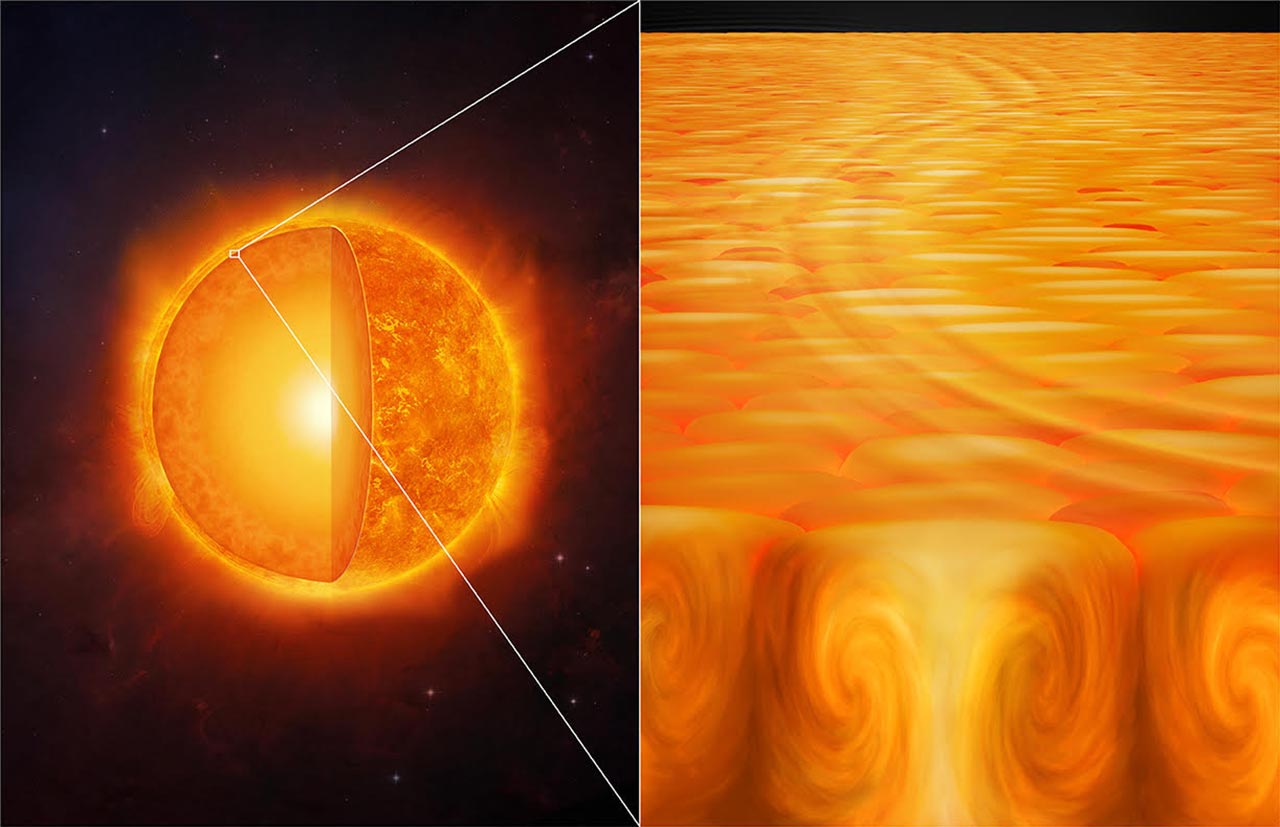
    Sun Supergranules
    Artistic Impression of the Sun’s supergranules. Supergranules transport heat near the surface of the Sun and are approximately 3 times wider than the Earth. Hot material from inside the sun rises to the surface, cools and turns over before sinking back into the interior. Scientists use sound waves to see below the surface, which appear as ripples on the surface. Credit: Melissa Weiss

    Using sound waves, scientists uncover findings that challenge standard theories of solar convection.

    A team of solar physicists has made significant discoveries about the sun’s supergranules, using data from the Solar Dynamics Observatory. Their research shows weaker downflows compared to upflows in these supergranules, indicating potential unseen components like small-scale plumes. This challenges the conventional understanding of solar convection.

    Researchers have revealed the interior structure of the sun’s supergranules, a flow structure that transports heat from the sun’s hidden interior to its surface. Led by Research Scientist Chris S. Hanson, Ph.D., the team of solar physicists at NYU Abu Dhabi’s Center for Astrophysics and Space Science (CASS) conducted an analysis of the supergranules that presents a challenge to the current understanding of solar convection.

    Breakthrough in Solar Convection Understanding

    The sun generates energy in its core through nuclear fusion; that energy is then transported to the surface, where it escapes as sunlight. In the study “Supergranular-scale solar convection not explained by mixing-length theory” published today (June 25) in the journal Nature Astronomy, the researchers explain how they utilized Doppler, intensity, and magnetic images from the helioseismic and magnetic imager (HMI) onboard NASA’s Solar Dynamics Observatory (SDO) satellite to identify and characterize approximately 23,000 supergranules.

    Since the sun’s surface is opaque to light, the NYUAD scientists used sound waves to probe the interior structure of the supergranules. These sound waves, which are generated by the smaller granules and are everywhere in the sun, have been successfully used in the past in a field known as Helioseismology.
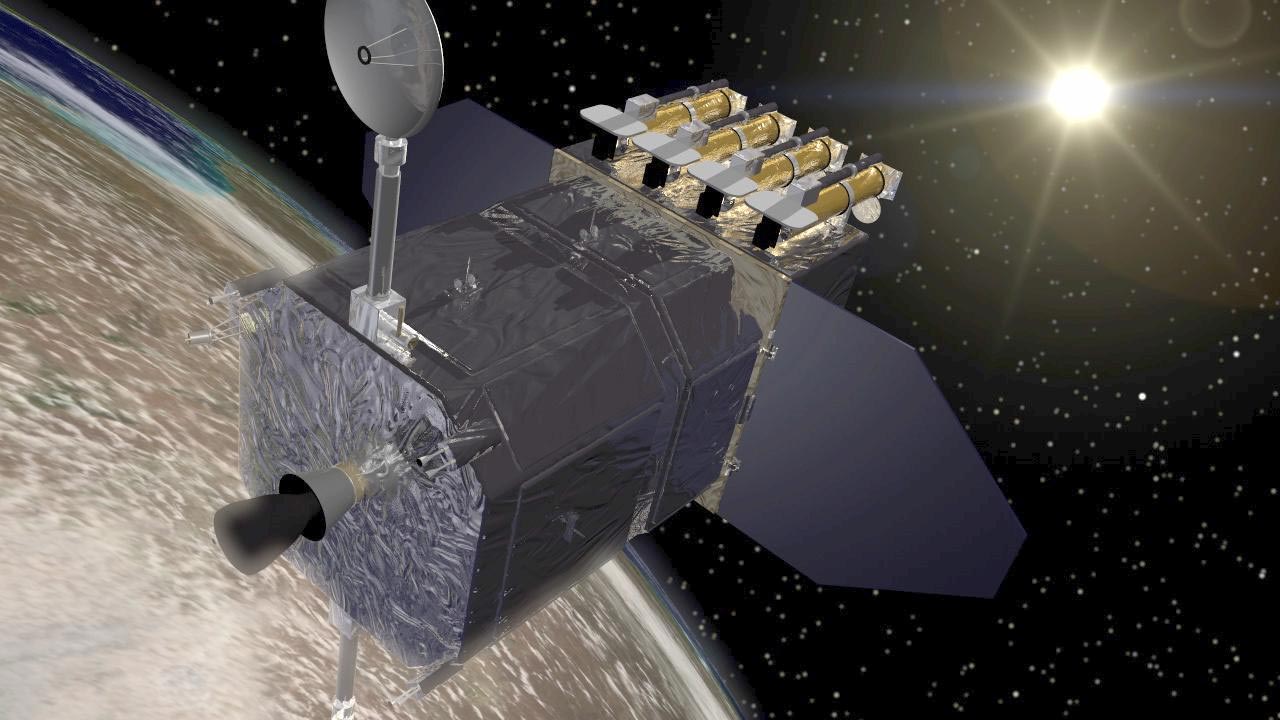
    SDO Artist's Concept
    Artist’s concept of the Solar Dynamics Observatory (SDO). Credit: NASA/Goddard Space Flight Center Conceptual Image Lab

    Methodology and Discoveries

    By analyzing such a large dataset of supergranules, which were estimated to extend 20,000 Km (~3% into the interior) below the surface of the sun, the scientists were able to determine the up and down flows associated with supergranular heat transport with unprecedented accuracy. In addition to inferring how deep the supergranules extend, the scientists also discovered that the downflows appeared ~40 percent weaker than the upflows, which suggests that some component was missing from the downflows.

    Implications for Solar Physics

    Through extensive testing and theoretical arguments, the authors theorize that the “missing” or unseen component could consist of small-scale (~100 km) plumes that transport cooler plasma down into the sun’s interior. The sound waves in the sun would be too big to sense these plumes, making the downflows appear weaker. These findings cannot be explained by the widely used mixing-length description of solar convection.

    “Supergranules are a significant component of the heat transport mechanisms of the sun, but they present a serious challenge for scientists to understand,” said Shravan Hanasoge, Ph.D., research professor, co-author of the paper and co-Principal Investigator of CASS. “Our findings counter assumptions that are central to the current understanding of solar convection, and should inspire further investigation of the sun’s supergranules.”

    Reference: “Supergranular-scale solar convection not explained by mixing-length theory” by Chris S. Hanson, Srijan Bharati Das, Prasad Mani, Shravan Hanasoge and Katepalli R. Sreenivasan, 25 June 2024, Nature Astronomy.
    DOI: 10.1038/s41550-024-02304-w

    The research was conducted within CASS at NYUAD in collaboration with Tata Institute of Fundamental Research, Princeton University, and New York University, using NYUAD’s high-performance computing resources.

    Never miss a breakthrough: Join the SciTechDaily newsletter.
    Follow us on Google and Google News.

    Astrophysics New York University Solar Dynamics Observatory Stars Sun
    Share. Facebook Twitter Pinterest LinkedIn Email Reddit

    Related Articles

    Unusual “Rosetta Stone” Solar Eruption Could Help Explain Mysterious Powerful Explosions on the Sun

    Studying the Sun From Far Away Like a Star to Understand Stellar Flares and Exoplanets

    Scientists Reveal New Clues to Determining the Solar Cycle

    NASA Spacecraft Spots an Unusual Series of Eruptions from the Sun

    Scientists Determine the Interior Rotation of a Sun-Like Star

    NASA Spacecraft Observe Magnetic Reconnection in Action

    Sun’s Magnetic Field Weaker Than a Normal Fridge Magnet

    New Observations Help Astronomers Learn How Young Stars Accrete Material and Grow

    New Light Shed on the Origins of Extreme Space Storms

    Leave A Reply Cancel Reply

    • Facebook
    • Twitter
    • Pinterest
    • YouTube

    Don't Miss a Discovery

    Subscribe for the Latest in Science & Tech!

    Trending News

    FDA-Approved Drug Shows Promise for Reversing Osteoarthritis Damage

    11,000-Year-Old Grains Reveal a Surprise About the Origins of Agriculture

    This Common Type of Medication Is Linked to Slower Cognitive Decline

    Quantum Computer Solves a Problem in 15 Minutes That Classical Methods Can’t Practically Compute

    Taking the Stairs Could Cut Your Risk of Heart-Related Death by 39%

    Scientists Uncover a Surprising New Route for Stonehenge’s Most Mysterious Stone

    A Star Near the Milky Way’s Black Hole Is Losing Mass at an Astonishing Rate

    Scientists Solve a Vitamin B12 Mystery With an Unexpected Culprit

    Follow SciTechDaily
    • Facebook
    • Twitter
    • YouTube
    • Pinterest
    • Newsletter
    • RSS
    SciTech News
    • Biology News
    • Chemistry News
    • Earth News
    • Health News
    • Physics News
    • Science News
    • Space News
    • Technology News
    Recent Posts
    • Scientists Find a Hidden Biological Link Across Different Forms of Autism
    • Scientists Discover a 3.7-Billion-Year-Old Secret of Early Life
    • Scientists Revisited a Forest Experiment That Was Forgotten for 30 Years. What They Found Was Astounding
    • Astronomers Discover a Ghostly River of Stars That Could Reveal Dark Matter
    • NASA Is Building a Moon Base – and the First Pieces Are Already Coming Together
    Copyright © 1998 - 2026 SciTechDaily. All Rights Reserved.
    • Science News
    • About
    • Contact
    • Editorial Board
    • Privacy Policy
    • Terms of Use

    Type above and press Enter to search. Press Esc to cancel.