
Close Menu
    Facebook X (Twitter) Instagram
    SciTechDaily
    • Biology
    • Chemistry
    • Earth
    • Health
    • Physics
    • Science
    • Space
    • Technology
    Facebook X (Twitter) Pinterest YouTube RSS
    SciTechDaily
    Home»Space»NASA Spacecraft Spots an Unusual Series of Eruptions from the Sun
    Space

    NASA Spacecraft Spots an Unusual Series of Eruptions from the Sun

    By Royal Academy of Sciences; NASAJune 30, 2014No Comments3 Mins Read
    Facebook Twitter Pinterest Telegram LinkedIn WhatsApp Email Reddit
    Share
    Facebook Twitter LinkedIn Pinterest Telegram Email Reddit
    Animation Shows Puffs Emanating from the Base of the Suns Atmosphere
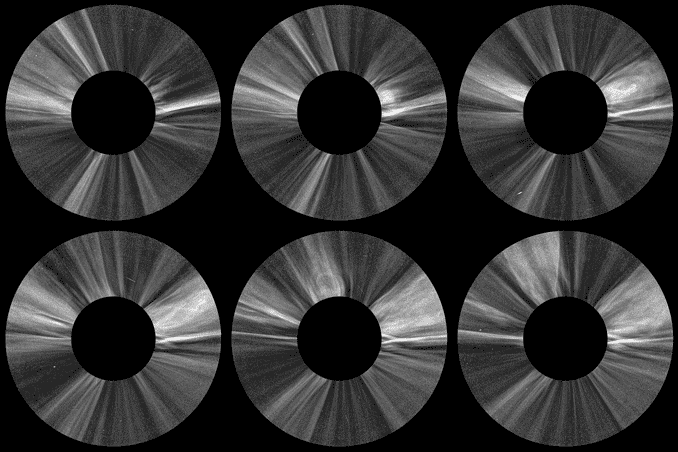
    This animation from the ESA/NASA Solar and Heliospheric Observatory shows puffs emanating from the base of the sun’s atmosphere, exploding outward into interplanetary space. These drive a later, larger eruption. The bright light of the sun itself is hidden behind the black circle at the center. Credit: ESA/NASA/SOHO/Alzate

    New research presented at the 2014 Royal Astronomical Society’s National Astronomy Meeting reveals an unusual series of puffs emanating from the base of the sun’s atmosphere, exploding outward into interplanetary space.

    A suite of NASA’s sun-gazing spacecraft have spotted an unusual series of eruptions in which a series of fast puffs forced the slow ejection of a massive burst of solar material from the sun’s atmosphere. The eruptions took place over a period of three days, starting on January 17, 2013. Nathalia Alzate, a solar scientist at the University of Aberystwyth in Wales, presented findings on what caused the puffs at the 2014 Royal Astronomical Society’s National Astronomy Meeting in Portsmouth, England.

    The sun’s outermost atmosphere, the corona, is made of magnetized solar material, called plasma, that has a temperature of millions of degrees and extends millions of miles into space. On Jan. 17, the joint European Space Agency and NASA’s Solar and Heliospheric Observatory, or SOHO, spacecraft observed puffs emanating from the base of the corona and rapidly exploding outwards into interplanetary space. The puffs occurred roughly once every three hours. After about 12 hours, a much larger eruption of material began, apparently eased out by the smaller-scale explosions.

    By looking at high-resolution images taken by NASA’s Solar Dynamics Observatory, or SDO, and NASA’s Solar Terrestrial Relations Observatory, or STEREO, over the same time period and in different wavelengths, Alzate and her colleagues could focus on the cause of the puffs and the interaction between the small and large-scale eruptions.

    NASA Spacecraft Spots an Unusual Series of Eruptions on the Sun
    This combination of three wavelengths of light from NASA’s Solar Dynamics Observatory shows one of the multiple jets that led to a series of slow coronal puffs on Jan. 17, 2013. The light has been colorized in red, green, and blue. Credit: Alzate/SDO

    “Looking at the corona in extreme ultraviolet light we see the source of the puffs is a series of energetic jets and related flares,” said Alzate. “The jets are localized, catastrophic releases of energy that spew material out from the sun into space. These rapid changes in the magnetic field cause flares, which release a huge amount of energy in a very short time in the form of super-heated plasma, high-energy radiation, and radio bursts. The big, slow structure is reluctant to erupt, and does not begin to smoothly propagate outwards until several jets have occurred.”

    Because the events were observed by multiple spacecraft, each viewing the sun from a different perspective, Alzate and her colleagues were able to resolve the three-dimensional configuration of the eruptions. This allowed them to estimate the forces acting on the slow eruption and discuss possible mechanisms for the interaction between the slow and fast phenomena.

    “We still need to understand whether there are shock waves, formed by the jets, passing through and driving the slow eruption,” said Alzate. “Or whether magnetic reconfiguration is driving the jets allowing the larger, slow structure to slowly erupt. Thanks to recent advances in observation and in image processing techniques we can throw light on the way jets can lead to small and fast, or large and slow, eruptions from the sun.”

    Never miss a breakthrough: Join the SciTechDaily newsletter.
    Follow us on Google and Google News.

    Astronomy Astrophysics SOHO Solar Dynamics Observatory Sun
    Share. Facebook Twitter Pinterest LinkedIn Email Reddit

    Related Articles

    New Clues To Predict When and Where the Sun’s Next Flare Might Explode

    Resonant Modes: Long-Period Oscillations of the Sun Discovered

    Unusual “Rosetta Stone” Solar Eruption Could Help Explain Mysterious Powerful Explosions on the Sun

    Celestial Geometry Posed a Special Opportunity During Parker Solar Probe’s 7th Solar Encounter

    Solution to the Coronal Heating Mystery Presented at 2015 TESS Meeting

    Scientists Reveal New Clues to Determining the Solar Cycle

    NASA Spacecraft Observe Magnetic Reconnection in Action

    Sun’s Magnetic Field Weaker Than a Normal Fridge Magnet

    New Observations Help Astronomers Learn How Young Stars Accrete Material and Grow

    Leave A Reply Cancel Reply

    • Facebook
    • Twitter
    • Pinterest
    • YouTube

    Don't Miss a Discovery

    Subscribe for the Latest in Science & Tech!

    Trending News

    Scientists Discover How Coffee Impacts Memory, Mood, and Gut Health

    Why Did the Neanderthals Disappear? Scientists Reveal Humans Had a Hidden Advantage

    Physicists Propose Strange Experiment Where Time Goes Quantum

    Magnesium Magic: New Drug Melts Fat Even on a High-Fat, High-Sugar Diet

    Weight-Loss Drugs Like Ozempic May Come With an Unexpected Cost

    Mezcal “Worm” in a Bottle Mystery: DNA Testing Reveals a Surprise

    New Research Reveals That Your Morning Coffee Activates an Ancient Longevity Switch

    This Is What Makes You Irresistible to Mosquitoes

    Follow SciTechDaily
    • Facebook
    • Twitter
    • YouTube
    • Pinterest
    • Newsletter
    • RSS
    SciTech News
    • Biology News
    • Chemistry News
    • Earth News
    • Health News
    • Physics News
    • Science News
    • Space News
    • Technology News
    Recent Posts
    • Harvard Scientists Reveal Secret Structure Behind How You Smell
    • Scientists Just Discovered the Hidden Trick That Keeps Your Cells Alive
    • This Simple Movement Could Be Secretly Cleaning Your Brain
    • Male Birth Control Breakthrough: Scientists Find Way To Turn Sperm Production Off and Back On
    • A Common Vitamin Could Hold the Key to Treating Fatty Liver Disease
    Copyright © 1998 - 2026 SciTechDaily. All Rights Reserved.
    • Science News
    • About
    • Contact
    • Editorial Board
    • Privacy Policy
    • Terms of Use

    Type above and press Enter to search. Press Esc to cancel.