
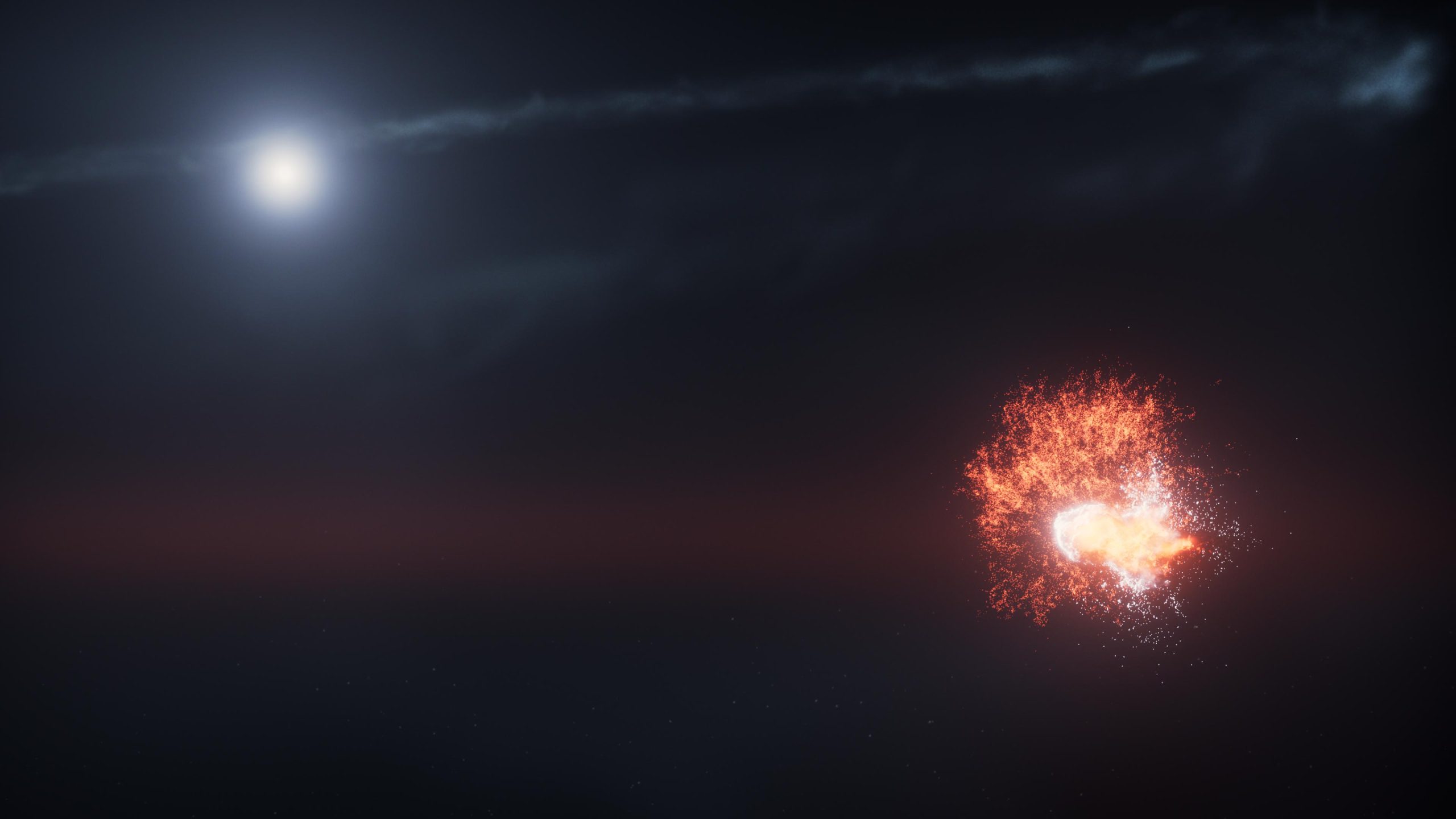
What looked like a mysterious exoplanet was actually the sparkling debris from a violent collision between massive space rocks. Even more astonishing, astronomers watched a second collision unfold in the same system, revealing a surprisingly chaotic neighborhood where new worlds may be born.
In a rare skywatching surprise, NASA’s Hubble Space Telescope (HST) recorded the aftermath of space rocks smashing together in a nearby planetary system.
Astronomers first noticed a bright point of light and thought it was a dust-coated exoplanet shining by reflected starlight. Then the “exoplanet” faded away. Not long after, a different bright object appeared, and the international research team, including Northwestern University’s Jason Wang, realized the objects were not planets. Instead, they were glowing debris left behind by a cosmic crash.
Researchers concluded that two separate, powerful impacts created two bright debris clouds inside the same planetary system. That makes the system a rare chance to watch processes linked to planet formation and to study the materials that can eventually gather into new worlds.
The study will be published today (December 18) in the journal Science.
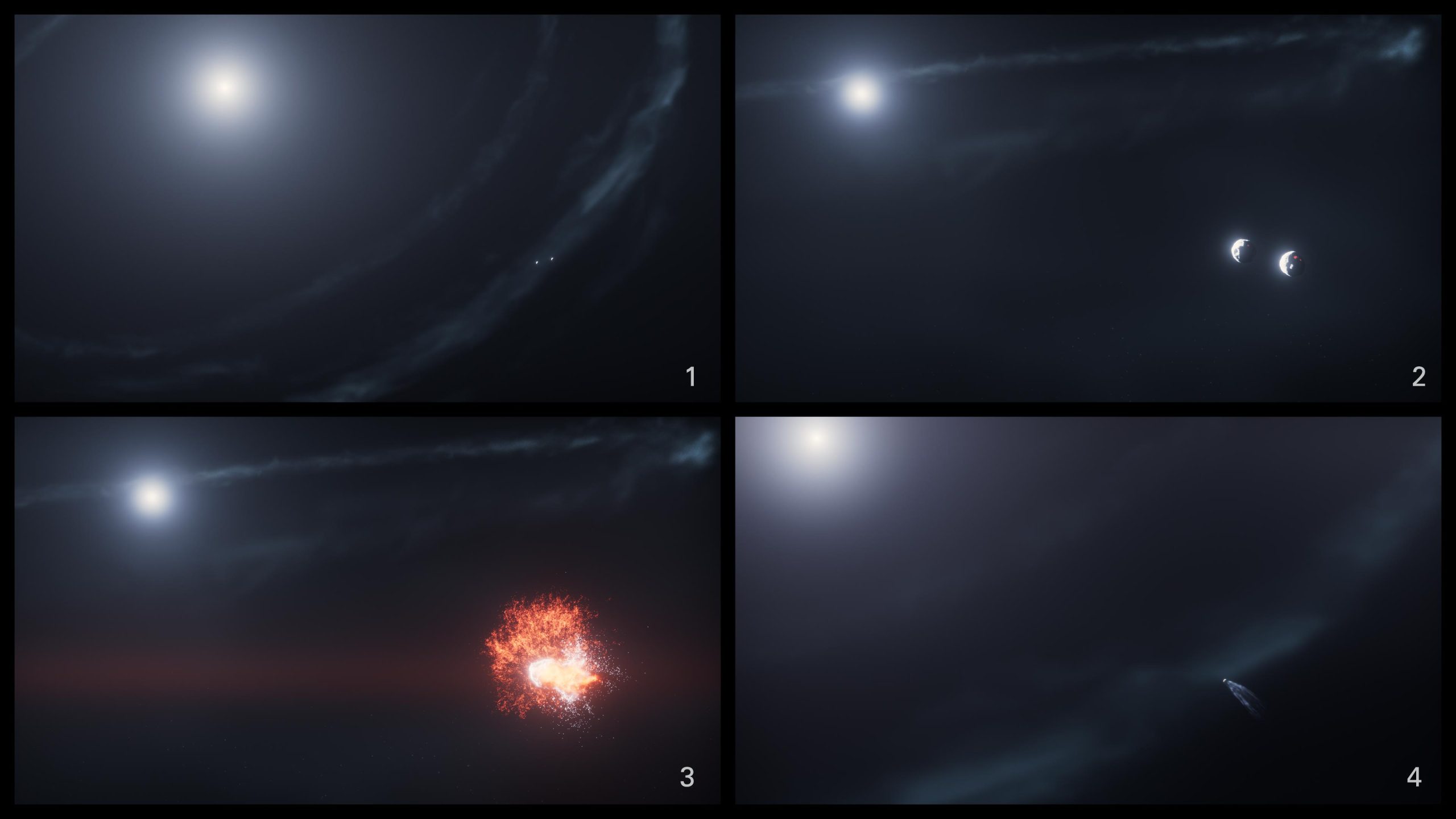
“Spotting a new light source in the dust belt around a star was surprising. We did not expect that at all,” Wang said. “Our primary hypothesis is that we saw two collisions of planetesimals — small rocky objects, like asteroids — over the last two decades. Collisions of planetesimals are extremely rare events, and this marks the first time we have seen one outside our solar system. Studying planetesimal collisions is important for understanding how planets form. It also can tell us about the structure of asteroids, which is important information for planetary defense programs like the Double Asteroid Redirection Test (DART).”
“This is certainly the first time I’ve ever seen a point of light appear out of nowhere in an exoplanetary system,” said lead author Paul Kalas, an astronomer at the University of California, Berkeley. “It’s absent in all of our previous Hubble images, which means that we just witnessed a violent collision between two massive objects and a huge debris cloud unlike anything in our own solar system today.”
Wang specializes in direct imaging of exoplanets. He is an assistant professor of physics and astronomy at Northwestern’s Weinberg College of Arts and Sciences and a member of the Center for Interdisciplinary Exploration and Research in Astrophysics (CIERA).
Fomalhaut and the mystery of a disappearing “planet”
For years, scientists have debated the true identity of a bright object known as Fomalhaut b, long considered an exoplanet candidate orbiting just outside the star Fomalhaut. The star lies about 25 light-years from Earth in the Piscis Austrinus constellation. Fomalhaut is more massive than the sun and surrounded by a complex set of dusty debris belts.
“The system has one of the largest dust belts that we know of,” said Wang, who is part of the team that has monitored the system for two decades. “That makes it an easy target to study.”
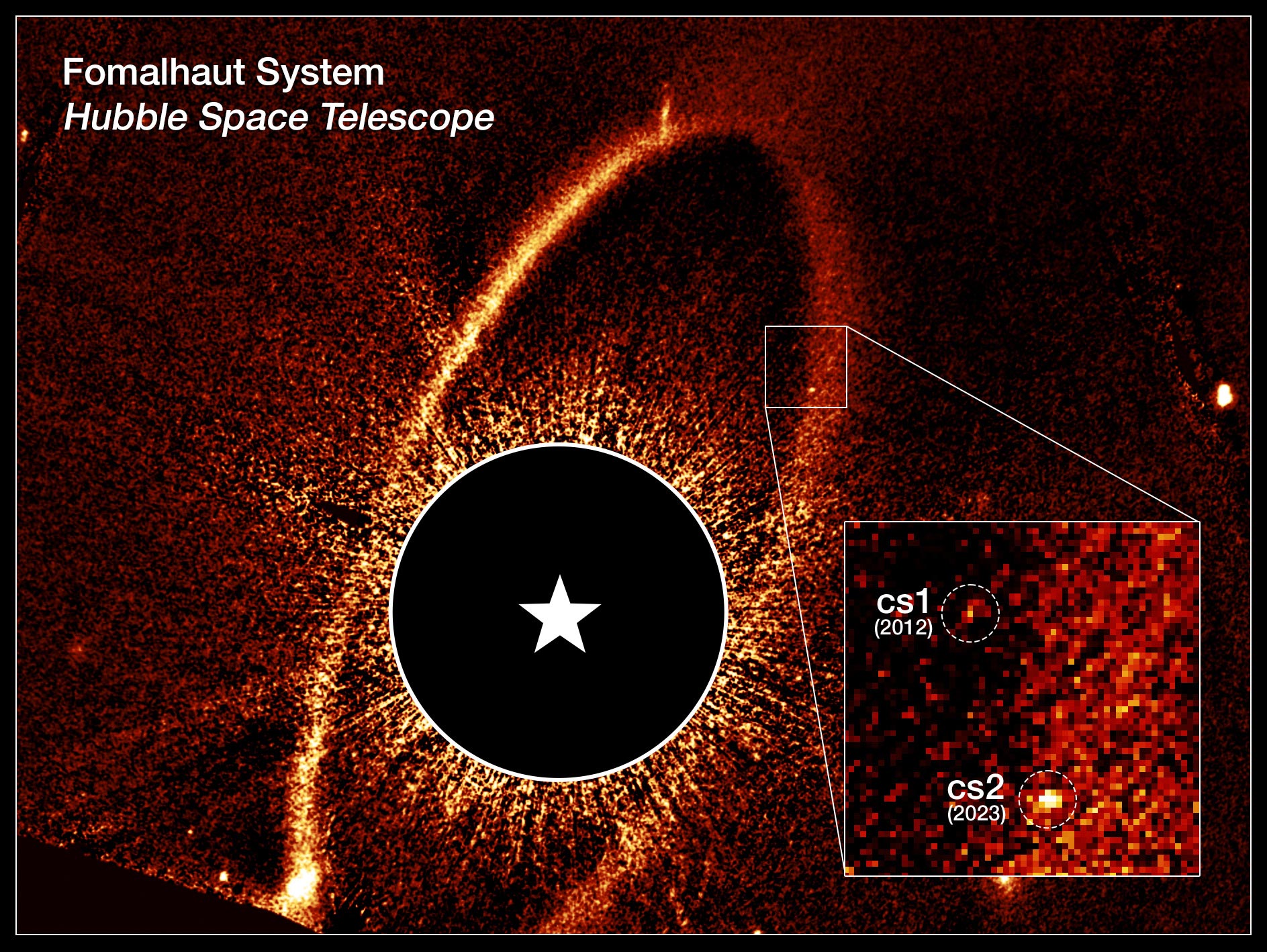
Fomalhaut b was announced in 2008, but researchers have struggled to determine whether it was a real planet or a growing cloud of dust. In 2023, scientists used the HST to take a closer look, and the strange light source was gone. In its place, another bright point appeared, shifted slightly within the same system.
“With these observations, our original intention was to monitor Fomalhaut b, which we initially thought was a planet,” Wang said. “We assumed the bright light was Fomalhaut b because that’s the known source in the system. But, upon carefully comparing our new images to past images, we realized it could not be the same source. That was both exciting and caused us to scratch our heads.”
Two collisions and two expanding debris clouds
The disappearance of Fomalhaut b (now called Fomalhaut cs1) fits the idea that it was an expanding dust cloud that gradually dispersed, likely created by an impact. The arrival of the second bright object (now called Fomalhaut cs2) strengthens the case that neither source was a planet. Instead, both appear to be dusty leftovers from violent collisions between planetesimals — the rocky building blocks of planets.
The brightness and position of Fomalhaut cs2 closely resemble how Fomalhaut cs1 looked when it was first spotted about two decades earlier. By repeatedly imaging the system, the team estimated how often these planetesimal collisions may occur.
“Theory suggests that there should be one collision every 100,000 years, or longer. Here, in 20 years, we’ve seen two,” Kalas said. “If you had a movie of the last 3,000 years, and it was sped up so that every year was a fraction of a second, imagine how many flashes you’d see over that time. Fomalhaut’s planetary system would be sparkling with these collisions.”
Because the claim is so unusual, Wang helped verify the result. He contributed one of four independent analyses confirming that the team detected two short-lived events in Fomalhaut’s dust belt.
“This is the first time we’re seeing something like this,” Wang said. “So, we had to make sure we can trust our images and that we are measuring the properties of the collision properly. I crunched the numbers to show that the four independent analyses all confidently detect a new source around the vicinity of the star.”
Why this matters for future planet hunts
The findings do more than reveal a rare natural laboratory for studying impacts. They also show how the dusty aftermath of a collision can be mistaken for a planet simply because it reflects starlight. That confusion could become a bigger issue as next-generation observatories, including the Giant Magellan Telescope, work toward directly imaging habitable-zone planets around nearby stars.
“Fomalhaut cs2 looks exactly like an extrasolar planet reflecting starlight,” Kalas said. “What we learned from studying cs1 is that a large dust cloud can masquerade as a planet for many years. This is a cautionary note for future missions that aim to detect extrasolar planets in reflected light.”
Even though Fomalhaut cs1 has now faded from view, the team will keep watching the Fomalhaut system. They plan to follow how Fomalhaut cs2 changes over time and to learn more about how collisions unfold in this neighboring stellar environment.
To do that, Wang, Kalas, and collaborators will use the Near-Infrared Camera (NIRCam) on NASA’s James Webb Space Telescope (JWST). NIRCam can capture color information that HST’s spectrograph instrument could not provide. Those color measurements can help reveal the dust grain sizes and what the debris cloud is made of, including whether it contains water and ice.
“Due to Hubble’s age, it can no longer collect reliable data of the system,” Wang said. “Fortunately, we now have the JWST. We have an approved JWST program to follow up this planetesimal collision to understand the new circumstellar source and the nature of its two parent planetesimals that collided.”
Reference: “A second planetesimal collision in the Fomalhaut system” by Paul Kalas, Jason J. Wang, Maxwell A. Millar-Blanchaer, Bin B. Ren, Mark C. Wyatt, Grant M. Kennedy, Maximilian Sommer, Thomas M. Esposito, Robert J. De Rosa and Michael Fitzgerald, 18 December 2025, Science.
DOI: 10.1126/science.adu6266
The study was supported by NASA (award number HST-GO-17139).
Never miss a breakthrough: Join the SciTechDaily newsletter.
Follow us on Google and Google News.