
Close Menu
    Facebook X (Twitter) Instagram
    SciTechDaily
    • Biology
    • Chemistry
    • Earth
    • Health
    • Physics
    • Science
    • Space
    • Technology
    Facebook X (Twitter) Pinterest YouTube RSS
    SciTechDaily
    Home»Physics»What Physicists Can Learn From the Unique Spiral Shape of Shark Intestines
    Physics

    What Physicists Can Learn From the Unique Spiral Shape of Shark Intestines

    By Biophysical SocietyFebruary 20, 2023No Comments3 Mins Read
    Facebook Twitter Pinterest Telegram LinkedIn WhatsApp Email Reddit
    Share
    Facebook Twitter LinkedIn Pinterest Telegram Email Reddit
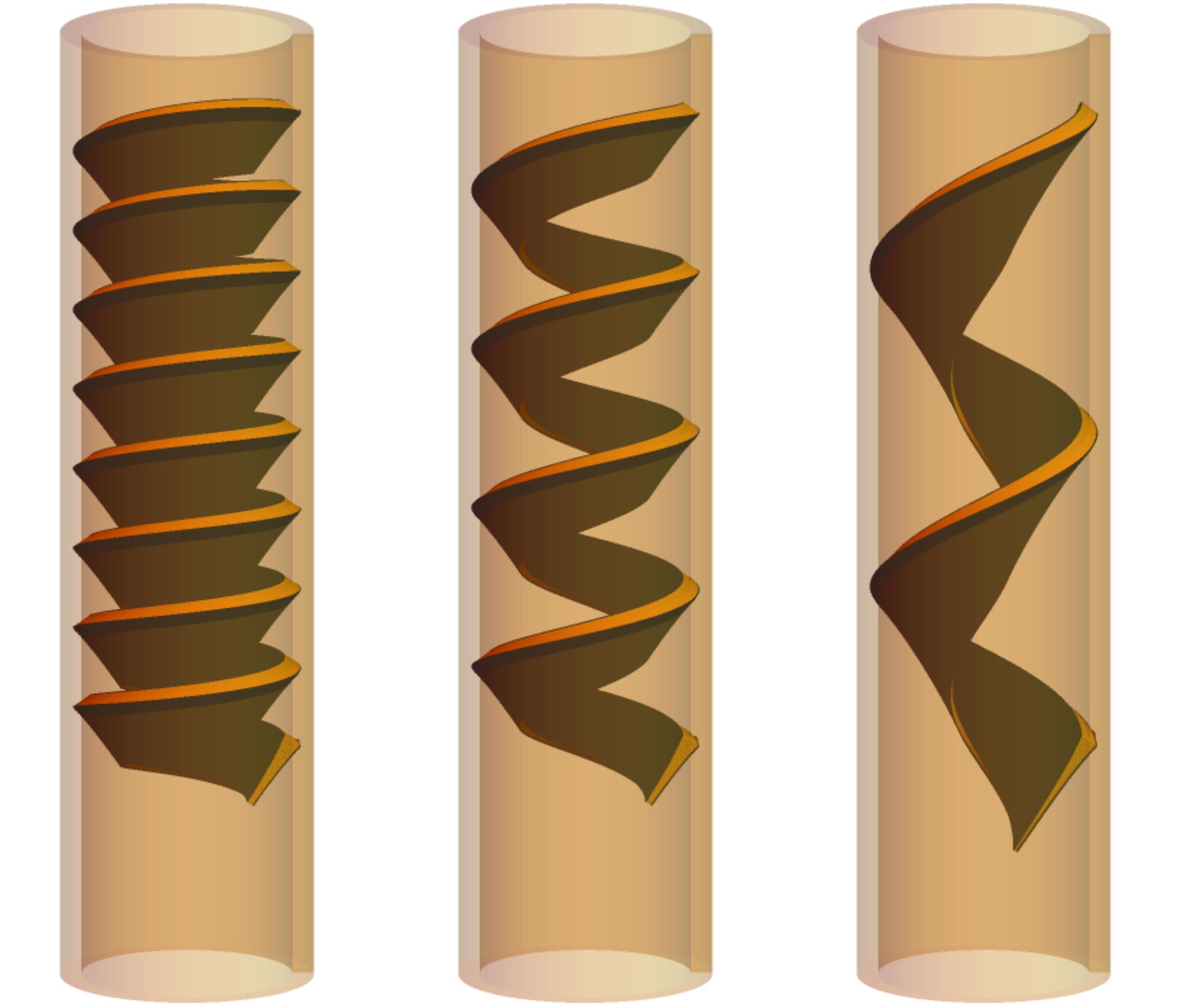
    3D Printed Helical Pipes Inspired by Shark Intestines
    Different kinds of sharks have intestines with different spiral patterns that favor fluid flow in one direction. Ido Levin and colleagues are recreating those shapes using a 3D printer in order to study the unique fluid flow inside the spirals. Credit: Image courtesy of Ido Levin

    Shark intestines have a unique spiral shape that favors fluid flow in one direction. By learning about the workings of this phenomenon, physicists hope to apply the principles to robotics and other applications.

    Inventor Nikola Tesla patented a type of pipe that he called a “valvular conduit” in 1920. It was built to draw fluid in one direction without any moving parts or added energy and has applications ranging from soft robotics to medical implants. In 2021, scientists discovered that sharks’ spiral-shaped intestines work much the same way, favoring fluid flow in one direction—from head to pelvis.

    Ido Levin, a physicist in the lab of Sarah Keller at the University of Washington, became interested in the physics flow of fluid through these shark spirals. On Monday, February 20 at the 67th Annual Biophysical Society Meeting in San Diego, California, he will present how 3D printing models of shark intestines is helping them learn about how these spirals work.

    Shark Intestines Challenge Fluid Dynamics Theory

    Levin explained that “the researchers of the 2021 study connected a tube to the shark intestines, and put water with glycerin—a very viscous fluid—through these pipes. And they showed that if you connect these intestines in the same direction as a digestive tract, you get a faster flow of fluid than if you connect them the other way around. We thought this was very interesting from a physics perspective… One of the theorems in physics actually states that if you take a pipe, and you flow fluid very slowly through it, you have the same flow if you invert it. So we were very surprised to see experiments that contradict the theory. But then you remember that the intestines are not made out of steel—they’re made of something soft, so while fluid flows through the pipe, it deforms it.”

    To study the fluid dynamics through spiral pipes, Levin and Keller collaborated with their colleagues in the Nelson Group at the University of Washington to create soft, 3D structures that mimic aspects of the shark intestines. “15 or 20 years ago, it was impossible to try and reconstruct these shapes in manmade materials,” Levin said. When they used a rigid material to 3D print the shapes, there was no difference in fluid flow in one direction or the other. However, printing the shapes using a softer elastomer led to faster fluid flow in one direction. Using these 3D-printed structures, the team is studying how the radius, pitch, and thickness of the inner structure impacts the fluid flow. With the softer materials, they can also study the coupling between flow rate and how the pipe deforms. Understanding these parameters will help in engineering similar structures that can be used for things like soft robotics.

    Up until recently, robots have been made with rigid materials and hinges. But using soft materials that can deform in different ways, like an octopus does, opens up a whole world of possibilities, Levin explains, “this is one step forward in trying to understand the basic mechanics of the interaction between membranes and flow.” One day, this seemingly simple system could control industrial or medical devices.

    Never miss a breakthrough: Join the SciTechDaily newsletter.
    Follow us on Google and Google News.

    3D Printing Biophysical Society Fluid Mechanics Sharks
    Share. Facebook Twitter Pinterest LinkedIn Email Reddit

    Related Articles

    A Shot of Science: Perfecting Espresso Extraction for Maximum Flavor

    Learn Physics in Your Kitchen: Do-It-Yourself Fluid Mechanics

    Introducing the MIT Oreometer – Mechanical Engineers Put an Oreo’s Cream Filling Through a Battery of Tests

    Simulations Reveal Fundamental Insights on Janus Particles

    Owl Wing Design With Serrated Edges Reduces Aircraft, Wind Turbine Noise Pollution

    Using Ice To Boil Water: Heat Transfer Discovery Expands on 18th Century Physics Principle

    Ocean Physics Explain Incredible Cyclones on Jupiter

    Why Teapots Always Drip – Scientists Finally Explain the “Teapot Effect”

    Unified Physics Theory Explains How Materials Transform From Solids to Liquids

    Leave A Reply Cancel Reply

    • Facebook
    • Twitter
    • Pinterest
    • YouTube

    Don't Miss a Discovery

    Subscribe for the Latest in Science & Tech!

    Trending News

    5 Simple Ways To Remember More and Forget Less

    The Atomic Gap That Could Cost the Semiconductor Industry Billions

    Researchers Finally Solve 50-Year-Old Blood Group Mystery

    Scientists Discover “Molecular Switch” That Fuels Alzheimer’s Brain Inflammation

    Trees Emit Tiny Lightning Flashes During Storms and Scientists Finally Prove It

    Pomegranate Compound Could Help Protect Against Heart Disease

    Your Blood Test Might Already Show Alzheimer’s Risk

    Scientists Were Wrong About This Strange “Rule-Breaking” Particle

    Follow SciTechDaily
    • Facebook
    • Twitter
    • YouTube
    • Pinterest
    • Newsletter
    • RSS
    SciTech News
    • Biology News
    • Chemistry News
    • Earth News
    • Health News
    • Physics News
    • Science News
    • Space News
    • Technology News
    Recent Posts
    • Scientists Complete Largest 3D Map of the Universe to Probe Dark Energy
    • Hidden Parasite Found in Popular Portuguese Lake Raises Health Concerns
    • This Simple Trick Can Boost Your Workout Endurance by 20%
    • This Popular Supplement May Interfere With Cancer Treatment, Scientists Warn
    • Scientists Propose Radical New Way To Detect Alien Life – Without Traditional Biosignatures
    Copyright © 1998 - 2026 SciTechDaily. All Rights Reserved.
    • Science News
    • About
    • Contact
    • Editorial Board
    • Privacy Policy
    • Terms of Use

    Type above and press Enter to search. Press Esc to cancel.