Close Menu
    Facebook X (Twitter) Instagram
    SciTechDaily
    • Biology
    • Chemistry
    • Earth
    • Health
    • Physics
    • Science
    • Space
    • Technology
    Facebook X (Twitter) Pinterest YouTube RSS
    SciTechDaily
    Home»Space»This Week @NASA: Naming a Moon Mountain, Mars Sample Collection, Webb Unveils Pandora’s Cluster
    Space

    This Week @NASA: Naming a Moon Mountain, Mars Sample Collection, Webb Unveils Pandora’s Cluster

    By NASAFebruary 19, 2023No Comments3 Mins Read
    Facebook Twitter Pinterest Telegram LinkedIn WhatsApp Email Reddit
    Share
    Facebook Twitter LinkedIn Pinterest Telegram Email Reddit
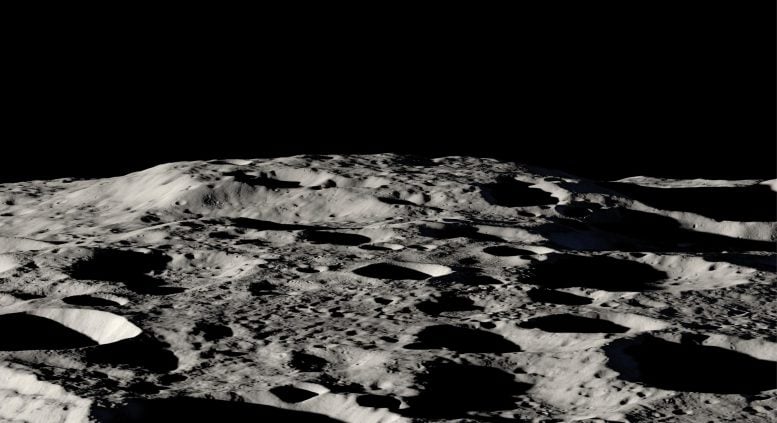
    Mons Mouton Lunar Mountain
    An illustration of Mons Mouton, a mesa-like lunar mountain that towers above the landscape carved by craters near the Moon’s South Pole. Credits: NASA/Science Visualization Studio

    Naming a mountain on the Moon …

    Watching and helping from space …

    And a sample wide shot from Mars … a few of the stories to tell you about – This Week at NASA!

    Moon Mountain Named in Honor of NASA Mathematician

    A mesa-like mountain near the Moon’s South Pole has been named “Mons Mouton” after NASA mathematician Melba Mouton. In the early days of NASA, she led a group of mathematicians whose calculations helped track spacecraft in orbit. “Mons Mouton” is adjacent to the site at which NASA’s VIPER mission will land and explore as part of NASA’s Artemis program.

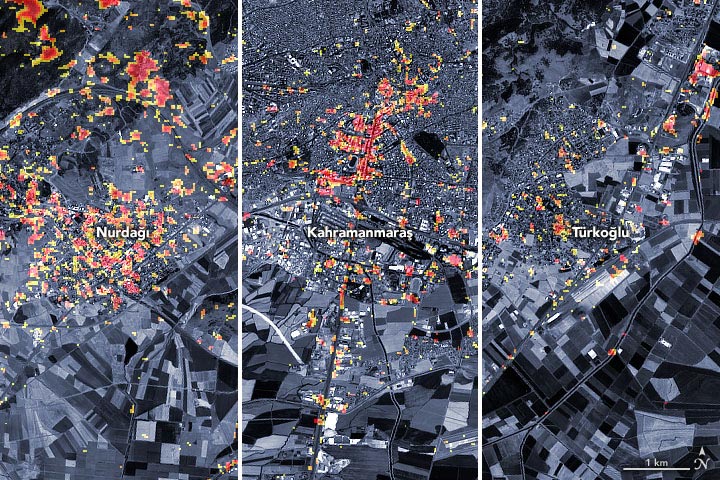
    2023 Earthquake Damage Turkey Detail
    Maps derived from data collected by PALSAR-2 on the Advanced Land Observing Satellite-2 on February 8, 2023 shows damage caused by the devastating earthquake in the Republic of Turkey in the cities of Nurdaği, Kahramanmaraş, and Türkoğlu.

    NASA Data Help with Turkey, Syria Earthquake Response

    Following the devastating earthquakes in southern Turkey and western Syria, NASA’s Earth Observatory is working to share aerial views and data from space to help relief and recovery efforts in that region. Learn more at earthobservatory.nasa.gov.

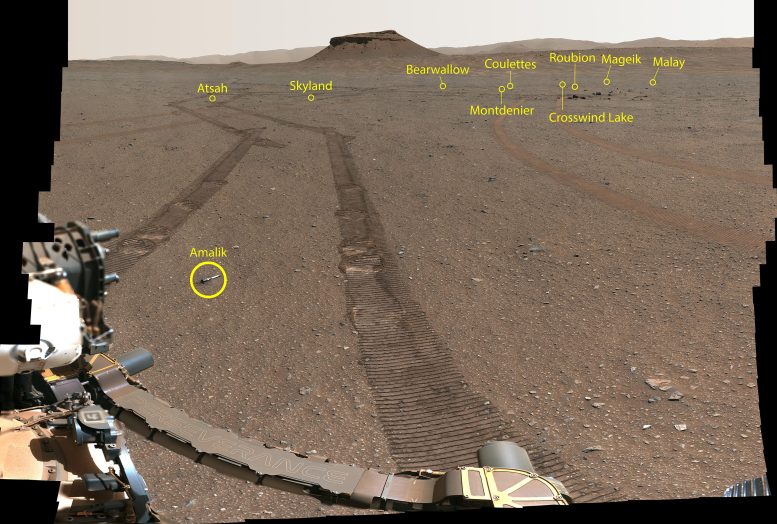
    Perseverance Enhanced Color Portrait of Mars Sample Depot Annotated
    Perseverance’s Portrait of the Sample Depot: An annotated version of the portrait captured by NASA’s Perseverance shows the location of the 10 sample tubes in the depot. The “Amalik” sample closest to the rover was about 10 feet (3 meters) away; the “Mageik” and “Malay” samples farthest away were approximately 197 feet (60 meters) from the rover. Credits: NASA/JPL-Caltech/ASU/MSSS

    Perseverance Shows Off Collection of Mars Samples

    NASA’s Perseverance Mars rover provided a panorama of its recently completed sample depot. The panorama shows the placement on the Martian surface of the 10 sample tubes that could be recovered in the future by the Mars Sample Return campaign.

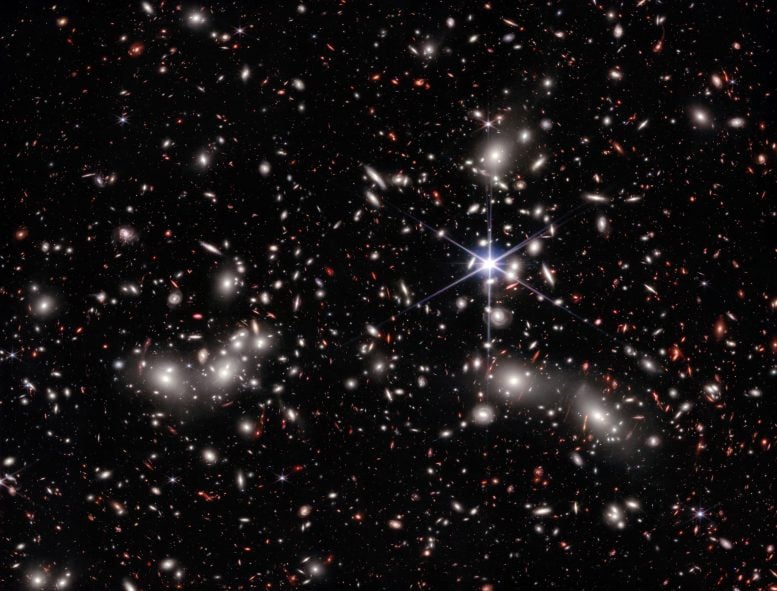
    Pandora's Cluster (Webb NIRCam Image)
    Astronomers estimate 50,000 sources of near-infrared light are represented in this image from NASA’s James Webb Space Telescope. Their light has traveled through varying distances to reach the telescope’s detectors, representing the vastness of space in a single image. A foreground star in our own galaxy, to the right of the image center, displays Webb’s distinctive diffraction spikes. Bright white sources surrounded by a hazy glow are the galaxies of Pandora’s Cluster, a conglomeration of already-massive clusters of galaxies coming together to form a megacluster. The concentration of mass is so great that the fabric of spacetime is warped by gravity, creating an effect that makes the region of special interest to astronomers: a natural, super-magnifying glass called a “gravitational lens” that they can use to see very distant sources of light beyond the cluster that would otherwise be undetectable, even to Webb. Credit: Science: NASA, ESA, CSA, Ivo Labbe (Swinburne), Rachel Bezanson (University of Pittsburgh), Image Processing: Alyssa Pagan (STScI)

    Webb Uncovers New Details in Pandora’s Cluster

    The latest deep field image from NASA’s James Webb Space Telescope features a region of space known as Pandora’s Cluster. A megacluster of galaxies there acts like a natural magnifying glass that allows much more distant galaxies in the early universe to be observed.

    That’s what’s up this week @NASA

    Never miss a breakthrough: Join the SciTechDaily newsletter.
    Follow us on Google and Google News.

    NASA
    Share. Facebook Twitter Pinterest LinkedIn Email Reddit

    Related Articles

    NASA’s Psyche Could Reveal the Secret Inside This Metal World

    NASA’s Curiosity Rover Discovers Spiderweb Ridges on Mars That Hint at Ancient Water

    NASA’s DART Impact Actually Changed an Asteroid System’s Orbit Around the Sun

    NASA’s Webb Telescope Reveals an Eerie Nebula That Looks Like a Giant Brain

    “At First, We Thought Something Was Wrong” – NASA DART Mission Reveals a Cosmic Snowball Fight

    What’s Really Happening on Venus? Scientists Reveal Surprising Patterns

    “Ghost Galaxy” Made of 99% Dark Matter Discovered 300 Million Light Years Away

    Hubble Captures a Dying Star Cracking Open the Egg Nebula

    NASA’s Curiosity Rover Finds Organic Molecules on Mars That Meteorites Can’t Explain

    Leave A Reply Cancel Reply

    • Facebook
    • Twitter
    • Pinterest
    • YouTube

    Don't Miss a Discovery

    Subscribe for the Latest in Science & Tech!

    Trending News

    Popular Sugar-Free Sweetener Linked to Liver Disease, Study Warns

    What Is Hantavirus? The Deadly Disease Raising Alarm Worldwide

    Scientists Just Discovered How the Universe Builds Monster Black Holes

    Scientists Unveil New Treatment Strategy That Could Outsmart Cancer

    A Simple Vitamin May Hold the Key to Treating Rare Genetic Diseases

    Scientists Think the Real Fountain of Youth May Be Hiding in Your Gut

    Ravens Don’t Follow Wolves, They Predict Them

    This Common Knee Surgery May Be Doing More Harm Than Good

    Follow SciTechDaily
    • Facebook
    • Twitter
    • YouTube
    • Pinterest
    • Newsletter
    • RSS
    SciTech News
    • Biology News
    • Chemistry News
    • Earth News
    • Health News
    • Physics News
    • Science News
    • Space News
    • Technology News
    Recent Posts
    • Why Are So Many New Fathers Dying? Scientists Say the U.S. Has a Dangerous Blind Spot
    • Scientists Identify Simple Supplement That Greatly Reduces Alzheimer’s Damage
    • You May Have a Dangerous Type of Cholesterol Even if Your Tests Look Normal
    • Study Reveals Dangerous Flaw in AI Symptom Checkers
    • New MRI Breakthrough Captures Stunningly Clear Images of the Eye and Brain
    Copyright © 1998 - 2026 SciTechDaily. All Rights Reserved.
    • Science News
    • About
    • Contact
    • Editorial Board
    • Privacy Policy
    • Terms of Use

    Type above and press Enter to search. Press Esc to cancel.