
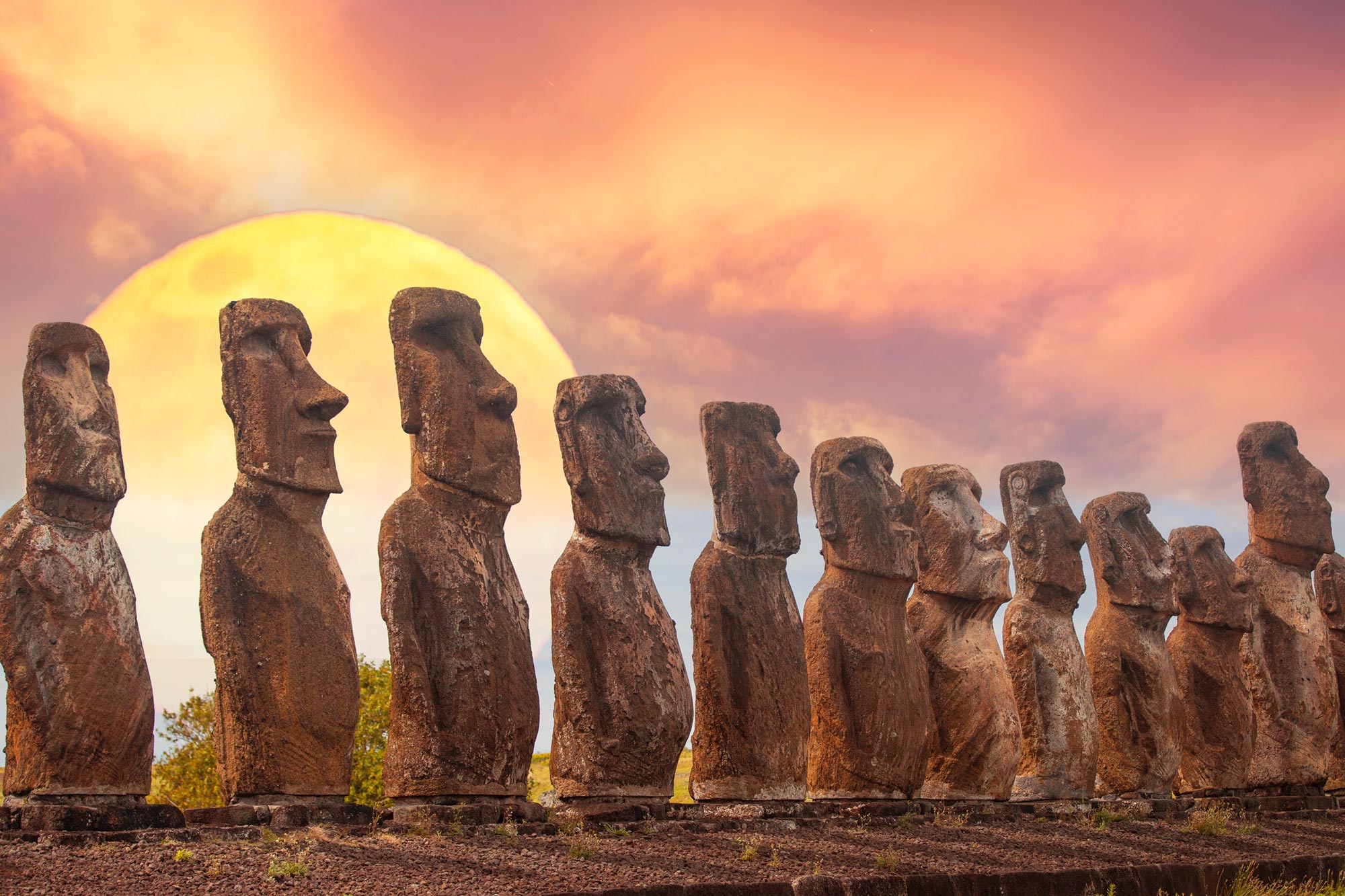
A newly reconstructed rainfall record shows that prolonged drought, not societal collapse, reshaped Rapa Nui’s history.
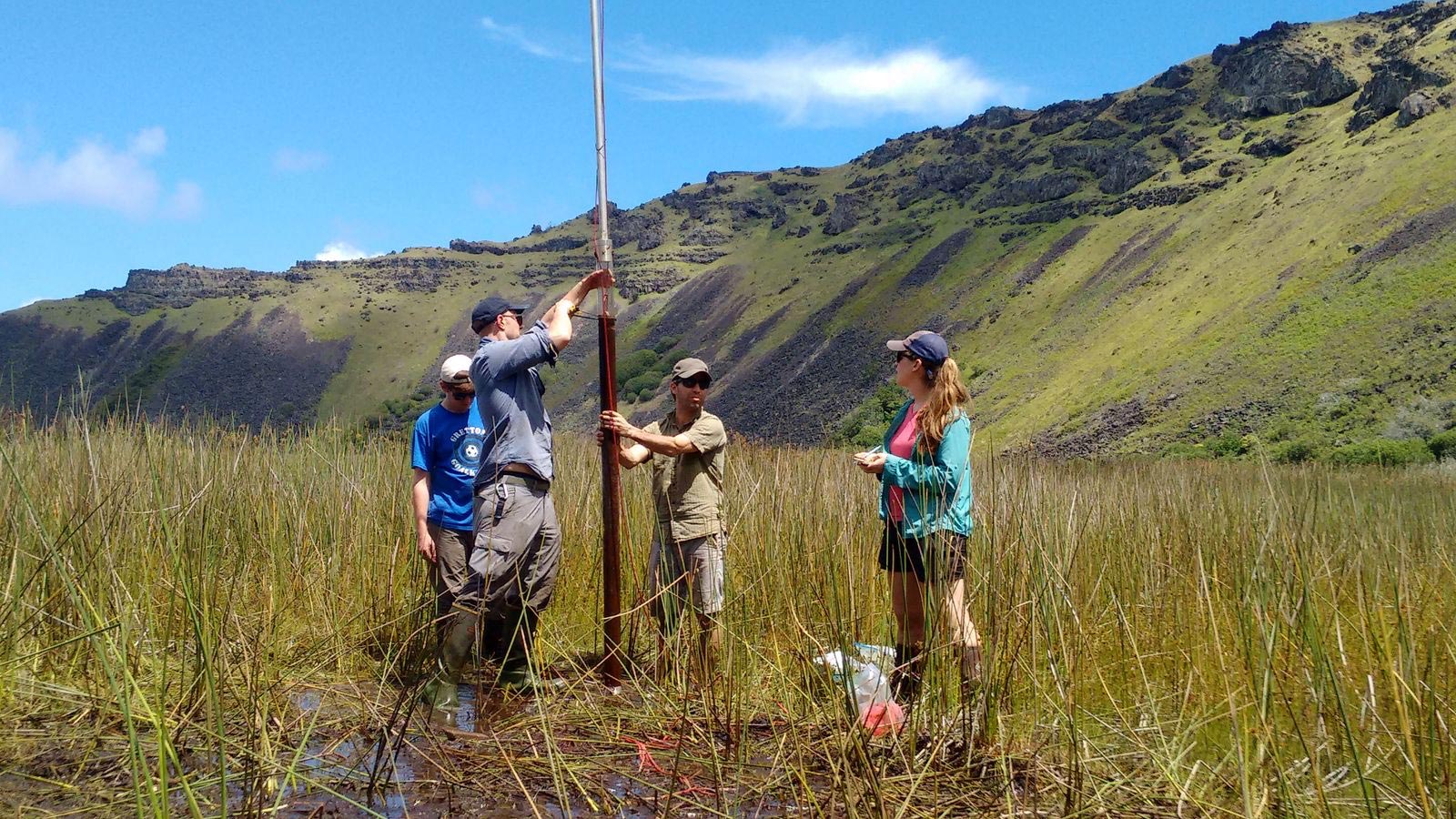
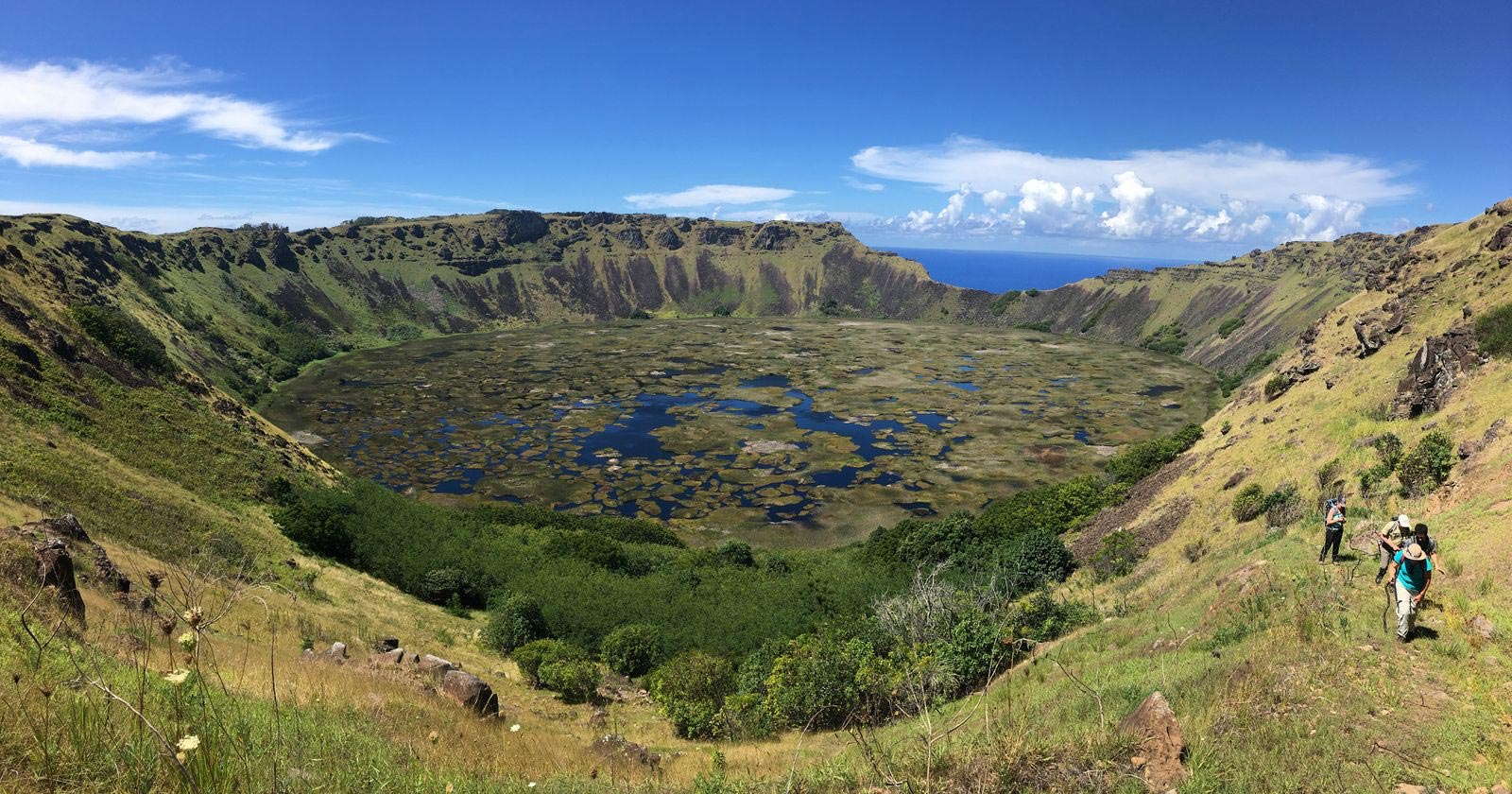
A new study led by scientists at the Lamont-Doherty Earth Observatory provides the strongest evidence so far that a prolonged drought dramatically reshaped life on Rapa Nui (Easter Island) starting around 1550. To uncover this history, the team extracted sediment cores from two of the island’s limited freshwater sites, Rano Aroi, a wetland at high elevation, and Rano Kao, a volcanic crater lake.
By examining hydrogen isotope ratios preserved in plant leaf waxes within these sediments, the researchers reconstructed an uninterrupted record of rainfall spanning roughly 800 years.
Their analysis shows that precipitation dropped sharply and stayed low for more than a century. Rather than supporting ideas of sudden societal “collapse,” the results point to sustained adaptation and resilience among Rapanui communities facing intense environmental pressure. We spoke with lead author Redmond Stein about how the team pieced together this climate record and what it reveals about the relationship between climate and culture.
Reconstructing rainfall from molecular fingerprints
How were you able to reconstruct Rapa Nui’s rainfall from so long ago, using leaf waxes from wetland sediments? What makes this approach more reliable than previous methods for studying Rapa Nui’s climate history?
Sediments that build up in lakes and wetlands do so gradually, preserving a layered archive of past environmental conditions.
Previous studies on Rapa Nui have relied on indicators such as elemental concentrations, pollen, plant remains, and sediment accumulation rates to infer past changes. While these indicators are extremely useful, they often reflect a combination of influences, including temperature, rainfall, and human land use, which can complicate interpretation. Leaf waxes offer a more direct signal.
On Rapa Nui, we believe they primarily record local rainfall and dryness. When we analyze the waxes preserved in wetland sediments, the ratio of “heavy” to “light” hydrogen closely tracks the hydrogen composition of rainwater absorbed by plants. This relationship allowed us, for the first time, to estimate the severity of the drought that affected Rapa Nui during the 16th century.

A centuries-long drought reshapes island society
Your analysis reveals a prolonged drought on Rapa Nui beginning in the mid-16th century and lasting for centuries. How severe was this drought, and how did it coincide with social or cultural shifts on the island?
Using the leaf wax data, we estimate that annual rainfall fell by about 600 to 800 millimeters (24 to 31 inches) compared with the previous three centuries on Rapa Nui.
The onset of this prolonged drying coincides with several major cultural transitions. These include a reduction in the construction of ceremonial “ahu” platforms, the rise of Rano Kao as a key ritual center, and the emergence of a new social system known as “Tangata Manu,” where leadership was determined through athletic competition rather than ancestral ties associated with the moai statues.
Pinpointing the exact timing of these shifts is challenging, and archaeologists continue to debate how Rapanui society evolved between the 16th and 18th centuries. Even so, it is clear that the social and spatial organization of the island during this period differed markedly from what existed in earlier centuries.
Climate stress reframes the ecocide debate
Your research adds to the work of others who have challenged the long-standing “ecocide” narrative about Rapa Nui’s history. How do your findings of a climate-driven shift further challenge this narrative? What do you hope the public takes away from this more nuanced view of the island’s history?
The ecocide narrative suggests that people on Rapa Nui destroyed their island by way of deforestation, eventually leading to a period of societal conflict and population collapse prior to European contact in the 18th century. This story has been popularized as a parable for global overconsumption, presenting the people of Rapa Nui as architects of their own destruction.
Although it’s true Rapa Nui was gradually deforested and that this represented a major ecological transition on the island, many studies have cast doubt on the ecocide hypothesis. Perhaps most importantly, there is no strong evidence of a demographic collapse prior to European arrival.
Our study and others now suggest that the people of Rapa Nui were dealing with drought beginning in the 16th century, which would have significantly impacted life on the already freshwater-poor island. Importantly, our hypothesis is not simply that regional climate changed, and that social and political hierarchies must have shifted in tandem, or that deforestation was unimportant, but rather that climate provides an important context for the human history of Rapa Nui.
The exact mechanism by which a decrease in rainfall could have led to challenging circumstances is still unclear—for example, if this would have exacerbated soil erosion issues, led to a decline in drinking water, pushed people to find new freshwater resources, or impacted the ability of the vegetation to grow. Regardless, our study makes clear the history of Rapa Nui is much more nuanced than the ecocide narrative implies.
Resilience offers lessons, not parables
Are there any lessons from Rapa Nui’s climate shift and the way residents adapted to it that might be relevant for us in the face of current climate change?
The biggest lesson would be that people are resilient. But in the face of current climate change, I think it is most important to listen to the voices of people who are from Rapa Nui and other Pacific islands, who are already dealing with the effects.
Their perspectives and insights will be much more relevant to addressing the problems of today, relative to any that we could glean from this study. Our research is not intended to produce a new parable for the modern times but rather push against the old one.
Next steps
What are the next steps for this research?
We have a much longer leaf wax isotope record from Rano Aroi that covers the last ~50,000 years of sediment deposition, and we are hoping to use this record to better understand how atmospheric circulation in the southeast Pacific responds to climate forcing on much longer timescales. Rapa Nui is located in the heart of the remote, southeast Pacific, over 3,000 kilometers off the coast of Chile and over 1,500 kilometers from the next inhabited island.
It is the only source of terrestrial sediment in the area and therefore offers incredibly unique insight into how regional atmospheric dynamics have changed in the past. Controls on atmospheric circulation over the southeast Pacific are poorly understood and not very well represented in model simulations, so our record could ultimately prove very helpful in understanding regional climate.
Reference: “Prolonged drought on Rapa Nui during the decline of megalithic monument construction” by Redmond Stein, Lorelei Curtin, Nicholas L. Balascio, Raymond S. Bradley, Dorothy M. Peteet, Rafael Rapu, Valentí Rull, Andrea Seelenfreund and William J. D’Andrea, 5 November 2025, Communications Earth & Environment.
DOI: 10.1038/s43247-025-02801-4
Support of the National Science Foundation award EAR-1903676 to WJD and the William & Mary Reves Faculty Fellowship to NLB. Additional contributions from Project GEOBILA (CGL2007-60932/BTE), provided by the Spanish Ministry of Education and Science.
Never miss a breakthrough: Join the SciTechDaily newsletter.
Follow us on Google and Google News.