
Close Menu
    Facebook X (Twitter) Instagram
    SciTechDaily
    • Biology
    • Chemistry
    • Earth
    • Health
    • Physics
    • Science
    • Space
    • Technology
    Facebook X (Twitter) Pinterest YouTube RSS
    SciTechDaily
    Home»Space»When Giants Collide: Unraveling the Mysteries of Supermassive Black Holes
    Space

    When Giants Collide: Unraveling the Mysteries of Supermassive Black Holes

    By Rochester Institute of TechnologyFebruary 23, 2024No Comments3 Mins Read
    Facebook Twitter Pinterest Telegram LinkedIn WhatsApp Email Reddit
    Share
    Facebook Twitter LinkedIn Pinterest Telegram Email Reddit
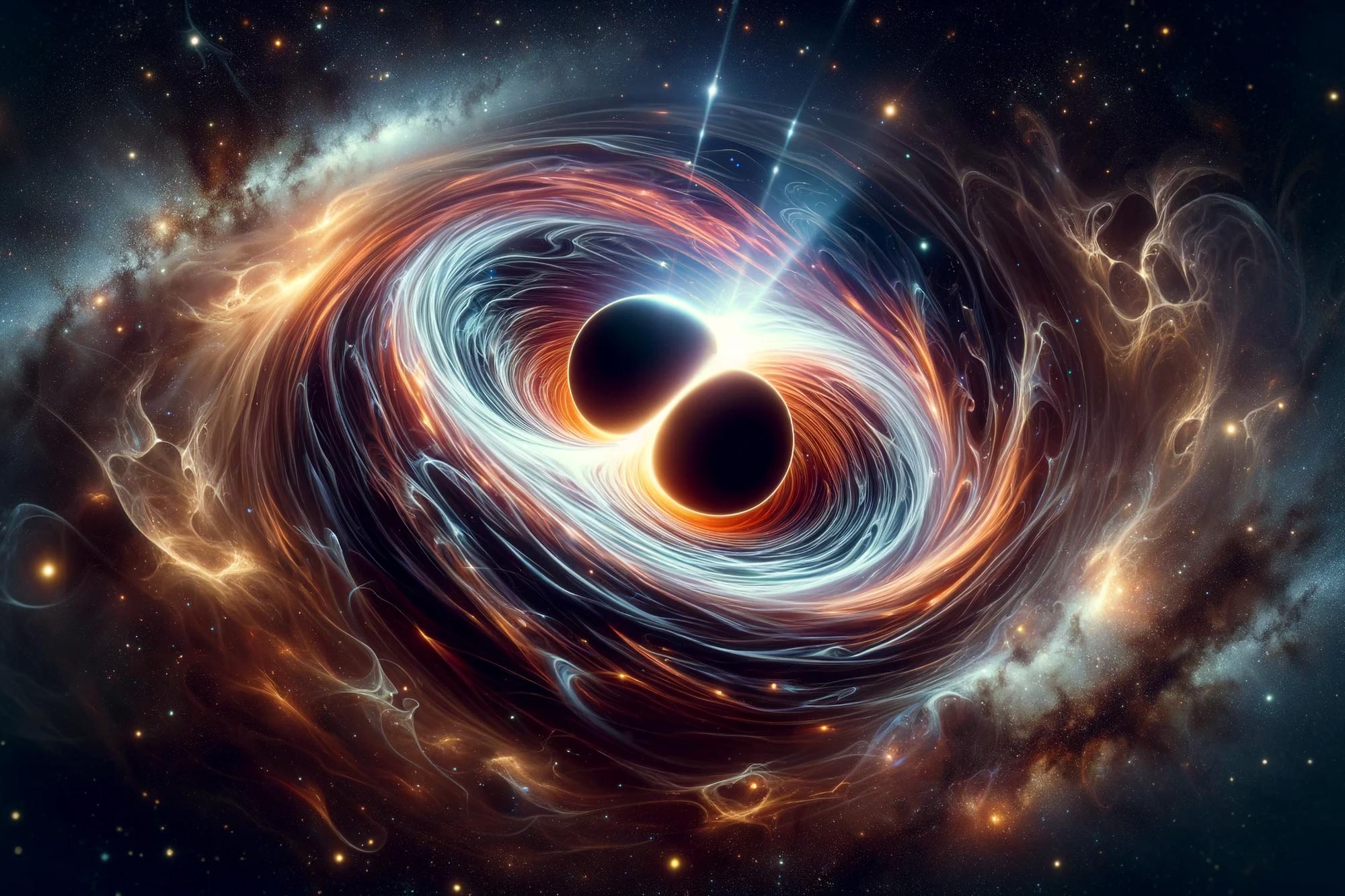
    Binary Black Holes Art Concept
    RIT leads a NASA-funded research project to explore electromagnetic signals from supermassive black hole mergers, aiming to advance our understanding of galaxies’ formation and evolution through high-precision simulations. Credit: SciTechDaily.com

    Manuela Campanelli to lead research team studying electromagnetic signals from merging supermassive black holes.

    Rochester Institute of Technology scientists will be the lead researchers on a $1.8 million NASA grant to study electromagnetic signals from merging supermassive black holes.

    RIT’s Manuela Campanelli, Distinguished Professor in the School of Mathematics and Statistics and director of the Center for Computational Relativity and Gravitation, will lead the collaborative project with help from Yosef Zlochower, professor in the School of Mathematics and Statistics. The project will also include researchers from the University of Idaho, Johns Hopkins University, and the Goddard Space Flight Center.

    The team will combine astrophysical knowledge with state-of-the-art simulations to study the gas flows surrounding binary black hole systems. The main goal of these simulations is to accurately predict the light signatures associated with these binary black holes, which is crucial for identifying and understanding these mysterious cosmic events. The findings will provide valuable insights into the formation and evolution of galaxies and contribute significantly to advancements in astronomy.

    Black Hole Advanced Simulation
    RIT scientists have received a NASA grant to study supermassive black holes by creating advanced simulations that will help identify and understand cosmic events. This visualization is part of the team’s early work. Credit: Lorenzo Ennoggi and Jay Kalinani/RIT

    “This project aims to drive major steps forward in our understanding of supermassive black holes spiraling into one another at the core of a merged galaxy,” explained Campanelli. “The combined expertise of our team will pave the way for new discoveries.”

    The research will have a profound impact on understanding cosmological evolution and will play a critical role in identifying and locating supermassive black hole binaries. Advanced simulations and the world’s largest supercomputers will support the investigations. Lorenzo Ennoggi, an astrophysical sciences and technology Ph.D. student, is also part of the RIT team.

    “We have developed all the necessary tools to perform these very challenging simulations, and we are ready to start our investigations,” said Ennoggi. “This is unexplored territory, so whatever we find will be entirely new.”

    Studying how black holes merge when galaxies collide will help scientists further understand how galaxies form and evolve. By focusing on the behavior of gas and matter as they are drawn into black holes at various stages of the galaxy merger, the research team aims to create the most accurate and realistic predictions of light signals to date.

    Never miss a breakthrough: Join the SciTechDaily newsletter.
    Follow us on Google and Google News.

    Astrophysics Black Hole Rochester Institute of Technology
    Share. Facebook Twitter Pinterest LinkedIn Email Reddit

    Related Articles

    Highly Eccentric Black Hole Merger Detected for the First Time

    New Black Hole Merger Simulations Could Power Next-Gen Gravitational Wave Detectors

    Massive, Spinning Black Holes Could Be the Result of ‘Pac-Man-Like’ Mergers

    Further Evidence That Outskirts of Spiral Galaxies Host Massive Black Holes

    New Simulation Provides First Hints of What Supermassive Black Hole Mergers Will Look Like

    Simulations Re-Create the Complex Dynamics Near a Black Hole

    NASA Study Bridges the Gap Between Theory and Black Hole Observations

    Scientists Convene to Take a Picture of the Supermassive Black Hole at the Center of the Milky Way

    Black Hole Fires Cosmic Bullets of Ionized Gases

    Leave A Reply Cancel Reply

    • Facebook
    • Twitter
    • Pinterest
    • YouTube

    Don't Miss a Discovery

    Subscribe for the Latest in Science & Tech!

    Trending News

    JWST Finds a “Star” 100 Billion Times Brighter Than Any Star Should Be

    Scientists Find a Hidden Biological Link Across Different Forms of Autism

    Astronomers Discover a Ghostly River of Stars That Could Reveal Dark Matter

    Why Is Colorectal Cancer Rising in People Under 50? New Clues Point to the Environment

    Quantum Fluctuations Break a Crystal’s Symmetry Rules

    Why Does an Irregular Heartbeat Strike 40 Years Early in Some People?

    Scientists Reveal How ADHD Could Fuel Creative Thinking

    Scientists Find Just 3 Minutes of Sprinting Can Transform Blood Chemistry

    Follow SciTechDaily
    • Facebook
    • Twitter
    • YouTube
    • Pinterest
    • Newsletter
    • RSS
    SciTech News
    • Biology News
    • Chemistry News
    • Earth News
    • Health News
    • Physics News
    • Science News
    • Space News
    • Technology News
    Recent Posts
    • Breakthrough in a Bizarre Galaxy Could Help Unlock the Mystery of Dark Matter
    • 1 in 3 Middle-Aged Americans Struggle With Basic, “Everyday” Health Tasks
    • Just 4 Minutes of Daily Strength Training Can Quadruple Fitness in Older Adults
    • Almost All Plant-Based Meat Alternatives Contain Mycotoxins, Study Finds
    • Strange Quantum Oscillations Reveal New Physics in an Exotic Material
    Copyright © 1998 - 2026 SciTechDaily. All Rights Reserved.
    • Science News
    • About
    • Contact
    • Editorial Board
    • Privacy Policy
    • Terms of Use

    Type above and press Enter to search. Press Esc to cancel.