
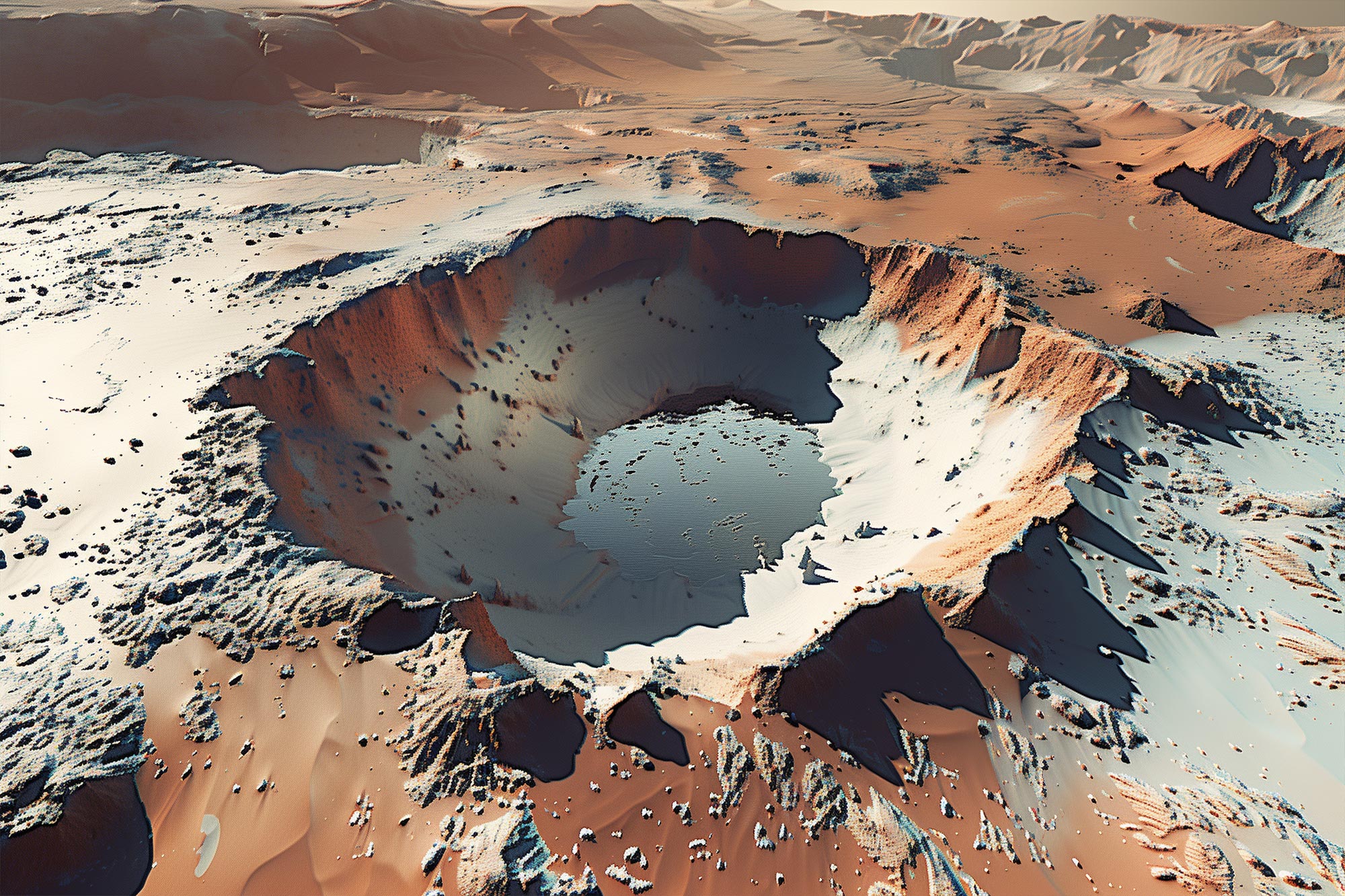
Liquid water is a cornerstone of habitability, but Mars’ frigid temperatures and thin atmosphere make its presence seem almost impossible.
Recent research examines intriguing features like recurring slope lineae and brines but ultimately questions their viability as evidence for water. While the dream of liquid water on Mars persists, new studies reveal the harsh reality of this elusive quest.
Early Theories of Water on Mars
More than a century ago, astronomer Percival Lowell proposed that Mars had canals built to transport water from its polar ice caps to its dry, lower-altitude regions — a theory that implied the existence of intelligent Martians.
Although better telescopes later disproved Lowell’s idea, the search for liquid water on Mars remains a compelling scientific quest. Liquid water is essential for a planet to be considered potentially habitable. However, Mars’ harsh environment — with its low temperatures, thin atmosphere, and minimal water vapor — makes the presence of liquid water highly unlikely, as it would quickly freeze, boil, or evaporate.
Despite these challenges, scientists continue to explore the possibility of liquid water on Mars.
Of particular interest has been the discovery of the “recurring slope lineae,” or RSL, which are dark linear features found on steep slopes in specific regions of Mars. RSL display seasonal changes, appearing in warmer seasons and fading in colder seasons, in a way that is consistent with the behavior of liquid water. Distinct striped and polygonal features in Martian permafrost have also been pointed to as possible evidence of thermal cycles. A further case has also been made for an assortment of potential liquid brines.
Challenges in Confirming Liquid Water
But a new paper published in the Proceedings of the National Academy of Sciences of the United States of America, the official journal of the National Academy of Sciences, throws cold water on the notion that we are likely find liquid water on Mars in RSLs, permafrost or brines anytime soon.
The paper, “The Elusive Nature of Martian Liquid Brines,” was co-authored by Vincent Chevrier, an associate research professor at the University of Arkansas’ Center for Space and Planetary Sciences, and Rachel Slank, a postdoctoral fellow at The Lunar and Planetary Institute in Houston, Texas. Slank earned her Ph.D. at the U of A while working with Chevrier, who has spent the last 20 years studying Mars for signs of liquid water. In short, he’s as invested as anyone in there being liquid water on Mars, but he thinks the evidence just isn’t there yet.
The goal of the paper is to educate the public on the current state of knowledge regarding the existence of liquid water on Mars.
“I wanted to write this paper for a very long time,” Chevrier said, “because I think there is a lot of confusion, a lot of misunderstanding, and a lot of erroneous interpretations of what the research papers are saying about the state of liquid water on Mars.”
The authors suggest that a closer look at RSLs indicates their behavior is consistent with sand and dust flows with no water needed to create them. Nor can available data from Martian orbiters confirm liquid water plays any role in RSL development.

Evaluating Martian Brines as Potential Water Sources
Other researchers think that brines, which are solutions with a high concentration of salts, such as Earth’s oceans, may hold the key to finding liquid water on Mars. Brines can freeze at much lower temperatures, and there is an abundance of salts on Mars. Of those salts, perchlorates would seem to be the most promising, since they have extremely low eutectic temperatures (which is when the melting point of a mixture is lower than any single ingredient). For instance, a calcium perchlorate brine solidifies at -75 degrees Celsius, while Mars has an average surface temperature of -50 C at the equator, theoretically suggesting there could be a zone where calcium perchlorate brine could stay liquid, particularly in the subsurface.
The authors then examine all of the arguments for and against brines potentially forming stable liquids. Ultimately, they concluded that the various limiting factors, including the relatively low amounts of the most promising salts, water vapor pressure and ice location “strongly limit the abundances of brines on the surface or shallow subsurface.” And even if brines did form, they would “remain highly un-habitable by terrestrial standards.”
In the last section of the paper, the authors state: “Despite these drawbacks and limitations, there is always the possibility that Martian life adapted to those brines and some terrestrial organisms could survive in them, which is a consideration for planetary protection because life on Mars might exist today in that case. Hence, detecting brines in situ remains a major objective of the exploration of the red planet.”
Moving forward, the authors suggest the next hurdles will be improving the instruments needed to detect small amounts of brines, doing a better job of identifying the best places to look for them, and being able to conduct more laboratory measurements under Martian conditions.
“Despite our best efforts to prove otherwise,” Chevrier concludes, “Mars still remains a cold, dry and utterly unhabitable desert.”
Reference: “The elusive nature of Martian liquid brines” by Vincent F. Chevrier and Rachel A. Slank, 16 December 2024, Proceedings of the National Academy of Sciences.
DOI: 10.1073/pnas.2321067121
Never miss a breakthrough: Join the SciTechDaily newsletter.
Follow us on Google and Google News.
1 Comment
Can’t wait to see the crazy lot that’s gonna volunteer to go there. Low intelligence will have to be a prerequisite.