

Scientists discovered that the visual brain may secretly “feel” what it sees, turning sight into physical experience and helping make empathy possible.
Working with researchers from institutions around the world, Nicholas Hedger (University of Reading) and Tomas Knapen (Netherlands Institute for Neuroscience & Vrije Universiteit Amsterdam) investigated one of neuroscience’s biggest questions: how humans experience the world around them.
Their research uncovered a remarkable process in which the brain converts visual information into touch-related representations, helping create the rich, physical reality we experience every day. According to Knapen, “This aspect of human experience is a fantastic area for AI development.”
Why Seeing Someone Get Hurt Makes You Flinch
Imagine preparing dinner with a friend when they accidentally cut themselves. Almost instantly, you may grimace, wince, or even jerk your own hand away.
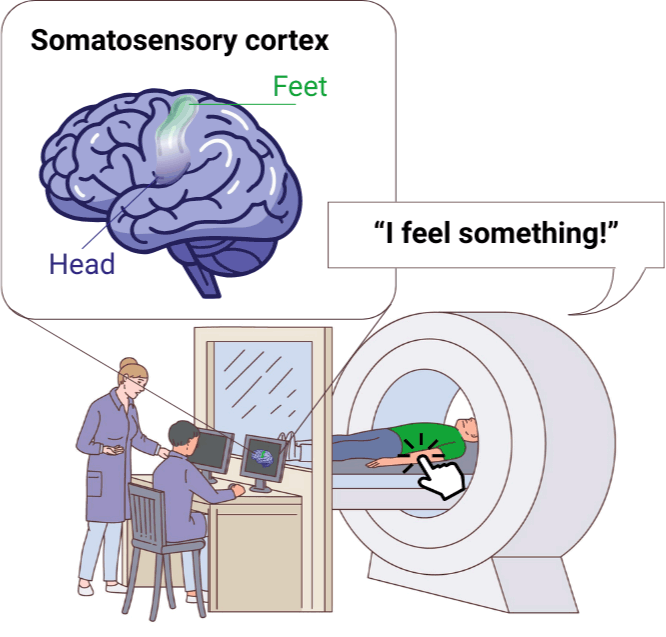
Those reactions happen because the brain’s touch-processing region, known as the somatosensory cortex, becomes active even though nothing physically happened to you.
But how can simply watching another person trigger the brain’s sense of touch?
To investigate, researchers from the UK, USA, and VU, NIN (KNAW) in Amsterdam turned to an unexpected source of data: Hollywood movies.
Using Hollywood Films to Study Human Experience
Tomas Knapen (last author) and Nicholas Hedger (first author) examined a dataset collected from volunteers who watched clips from movies such as The Social Network and Inception while undergoing brain scans.
Their goal was to identify the neural systems that transform visual information into meaningful experiences, allowing people to do more than simply see the world around them.
Hidden Body Maps in the Visual Brain
When neuroscientists refer to “maps” in the brain, they are describing organized patterns that represent information about the body and environment.
One well-known example is found in the somatosensory cortex, where different areas correspond to different body parts. One end of the map processes sensations from the feet, while the opposite end processes sensations from the head. These organized layouts help the brain determine where a sensation originates.
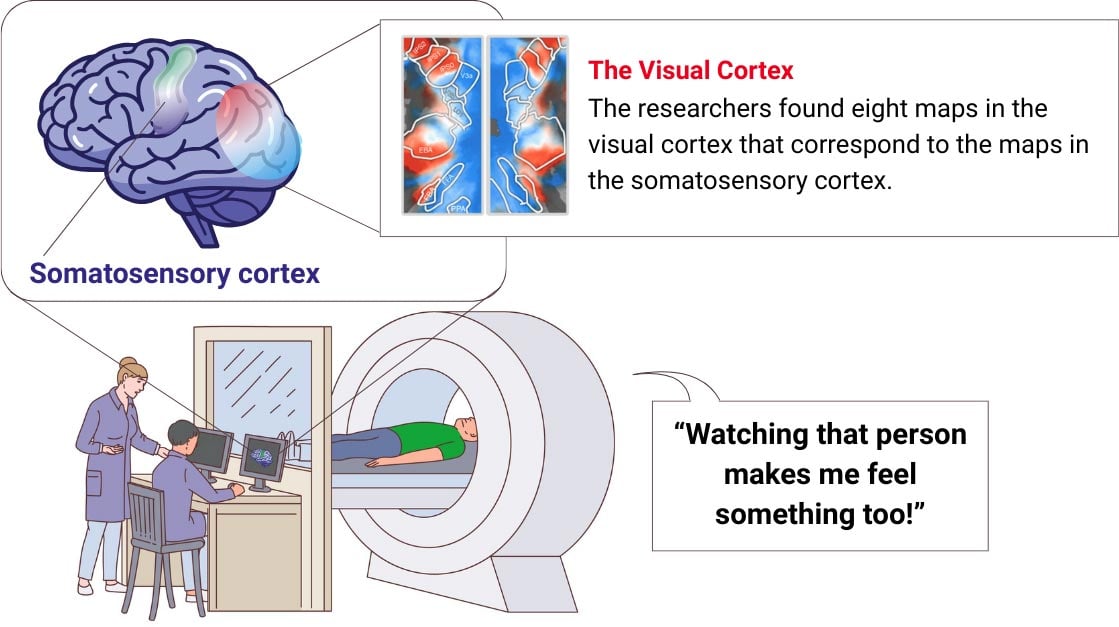
The researchers were surprised to find similar maps within the visual cortex. This suggests that the brain may organize what we see in ways that closely resemble how it processes physical touch.
“We found not one, or two, but eight remarkably similar maps in the visual cortex!” Knapen explains. “Finding so many shows how strongly the visual brain speaks the language of touch.”
These visual maps mirror the body’s arrangement within the somatosensory cortex from head to toe — suggesting that when we observe another person, the brain organizes that visual information using patterns similar to those involved in physical sensation.
Why the Brain Uses Multiple Body Maps
The discovery of eight separate maps raises an obvious question: Why does the brain need so many?
The researchers believe different maps serve different functions. Some appear to specialize in identifying body parts, while others focus more on where those body parts are located in space.
“I think that there are many more purposes, but we just haven’t been able to test them yet,” Knapen adds.
These maps may help people extract different types of information depending on what matters most in a given moment.
“Say you stand up and grab a cup of coffee. If I’m interested in what you’re doing, I will probably focus on your hand grabbing the cup. Now imagine that I’m more interested in your emotional state. In that case, I might focus more on your overall posture or your facial expressions. Every time you look at a person, there are many different bodily translations that need to be conducted visually. We think that these maps are a fundamental ingredient in that exact process.”
Although maintaining several overlapping maps might seem inefficient, Knapen argues that it actually makes the brain more flexible.
“This allows the brain to have many types of information in a single space, and make a translation in any way that is relevant in that moment,” he explains.
Implications for Autism Research and Neurotechnology
The findings open the door to a wide range of future studies.
Because these body maps appear to be involved in emotional processing, they could provide new insights into social psychology and eventually contribute to clinical applications.
“People with autism can struggle with this sort of processing. Having this information could help us better identify effective treatments,” Knapen explains.
The research could also have implications for brain-computer interfaces and other forms of neurotechnology.
“Training sets for brain implants often start off with instructions like ‘try to think of a movement’. If these bodily processes can be activated in much broader ways, then there might be much broader possibilities to train and develop those brain-computer interfaces.”
What This Discovery Could Mean for AI
Knapen believes the work may also help guide future advances in artificial intelligence.
“Our bodies are deeply intertwined with our experiences and understanding of the world. Current AI primarily relies on text and video, lacking this bodily dimension. This aspect of human experience is a fantastic area for AI development. Our work shows the potential for very large, precision brain imaging datasets to fuel this development: a beautiful synergy between neuroscience and AI.”
For Knapen, however, the biggest takeaway is not technological.
“I just want to understand the depths of the human experience, and it really feels like we just found this central ingredient for it.”
Reference: “Vicarious body maps bridge vision and touch in the human brain” by Nicholas Hedger, Thomas Naselaris, Kendrick Kay and Tomas Knapen, 26 November 2025, Nature.
DOI: 10.1038/s41586-025-09796-0
Never miss a breakthrough: Join the SciTechDaily newsletter.
Follow us on Google and Google News.