
Close Menu
    Facebook X (Twitter) Instagram
    SciTechDaily
    • Biology
    • Chemistry
    • Earth
    • Health
    • Physics
    • Science
    • Space
    • Technology
    Facebook X (Twitter) Pinterest YouTube RSS
    SciTechDaily
    Home»Science»AI Predicts Fruit Fly Behavior With Stunning Accuracy
    Science

    AI Predicts Fruit Fly Behavior With Stunning Accuracy

    By Cold Spring Harbor LaboratoryMay 27, 2024No Comments4 Mins Read
    Facebook Twitter Pinterest Telegram LinkedIn WhatsApp Email Reddit
    Share
    Facebook Twitter LinkedIn Pinterest Telegram Email Reddit
    AI Accurately Predicts Fly Behavior
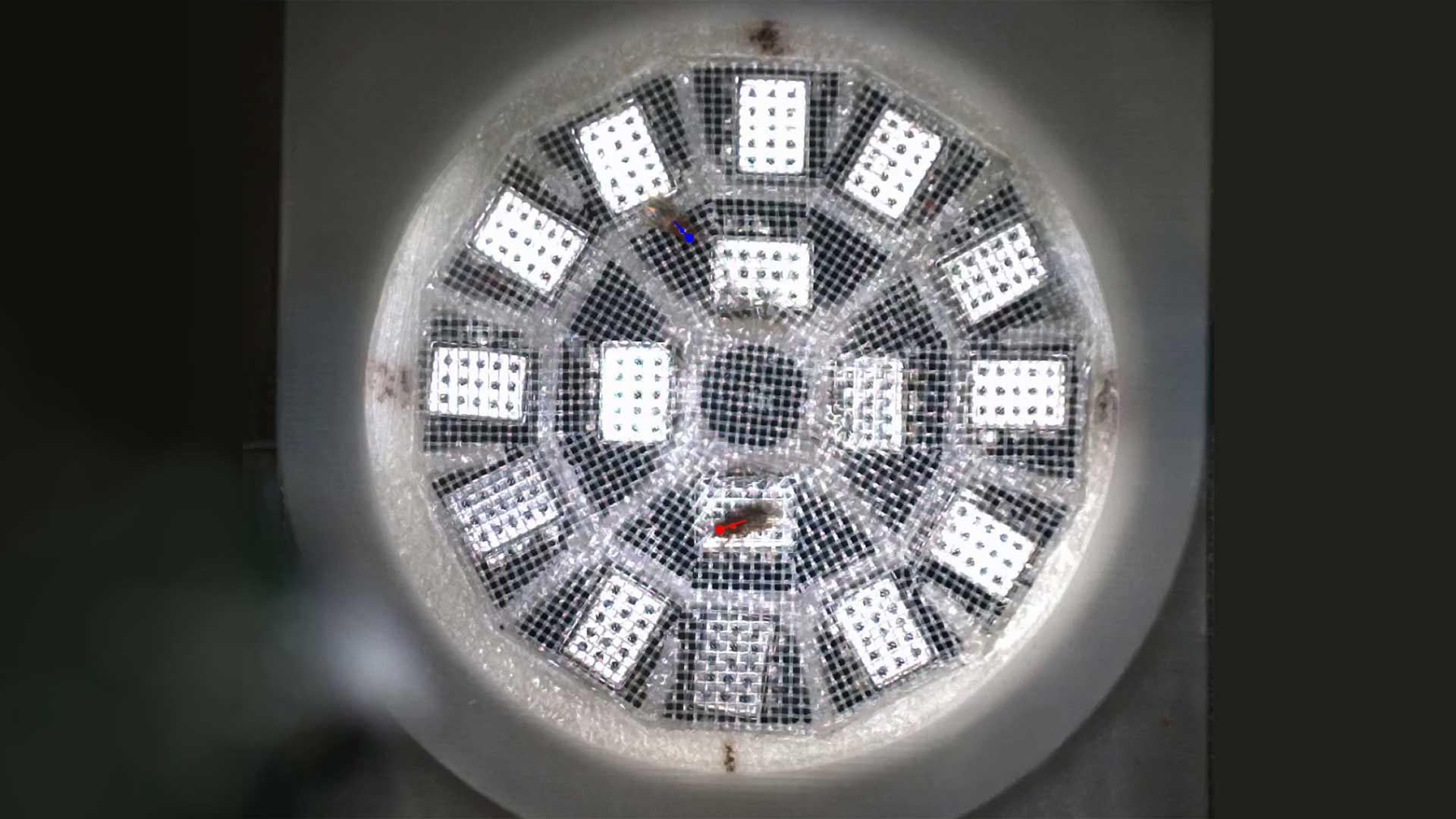
    Cowley’s team recorded the fruit fly courtship process over a series of “dates” in a petri dish, tracking the behavior of the male (blue) in response to any sight of the female (red). Tiny microphones placed below this “arena” captured the songs the male produced by beating its wings. Credit: Cowley Lab/Cold Spring Harbor Laboratory

    Research using AI reveals new insights into how vision influences fruit fly behavior, with implications for human visual research.

    We’ve all heard the saying, “The eyes are the window to the soul.” But remember, windows offer a view in both directions. Our eyes are also our windows to the world. What we see and how we see it help determine how we move through the world. In other words, our vision helps guide our actions, including social behaviors.

    Now, a young scientist at Cold Spring Harbor Laboratory (CSHL) has uncovered a major clue into how this works. He did it by building a special AI model of the common fruit fly brain.
    Male Fruit Fly Courts Female Companion
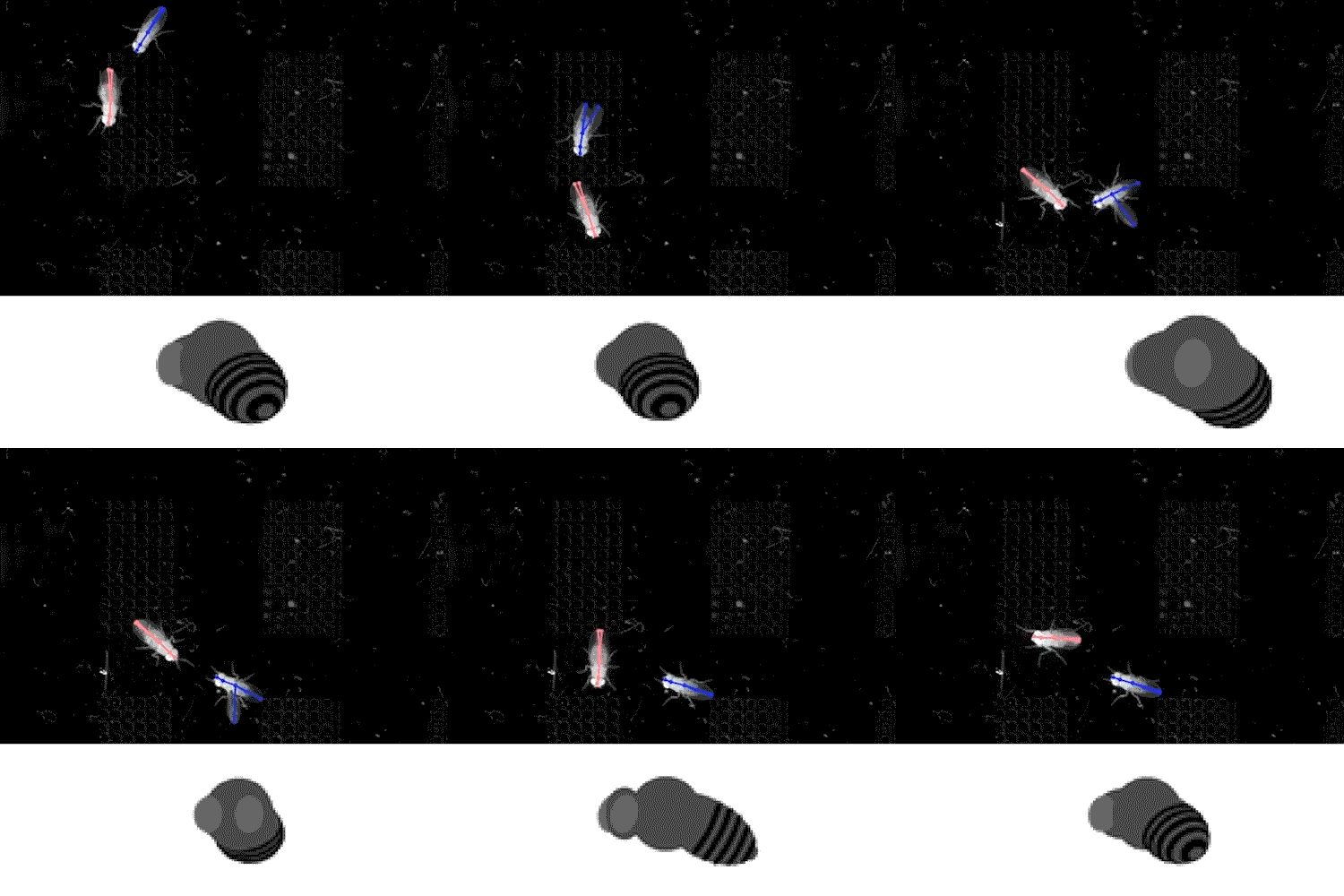
    Watch as the male fruit fly (blue) courts a female companion (red). The corresponding animation captures the male fly’s point of view. Credit: CSHL

    AI and Fruit Fly Behavior

    CSHL Assistant Professor Benjamin Cowley and his team honed their AI model through a technique they developed called “knockout training.” First, they recorded a male fruit fly’s courtship behavior—chasing and singing to a female. Next, they genetically silenced specific types of visual neurons in the male fly and trained their AI to detect any changes in behavior. By repeating this process with many different visual neuron types, they were able to get the AI to accurately predict how the real fruit fly would act in response to any sight of the female.

    “We can actually predict neural activity computationally and ask how specific neurons contribute to behavior,” Cowley says. “This is something we couldn’t do before.”

    Decoding Neural Pathways

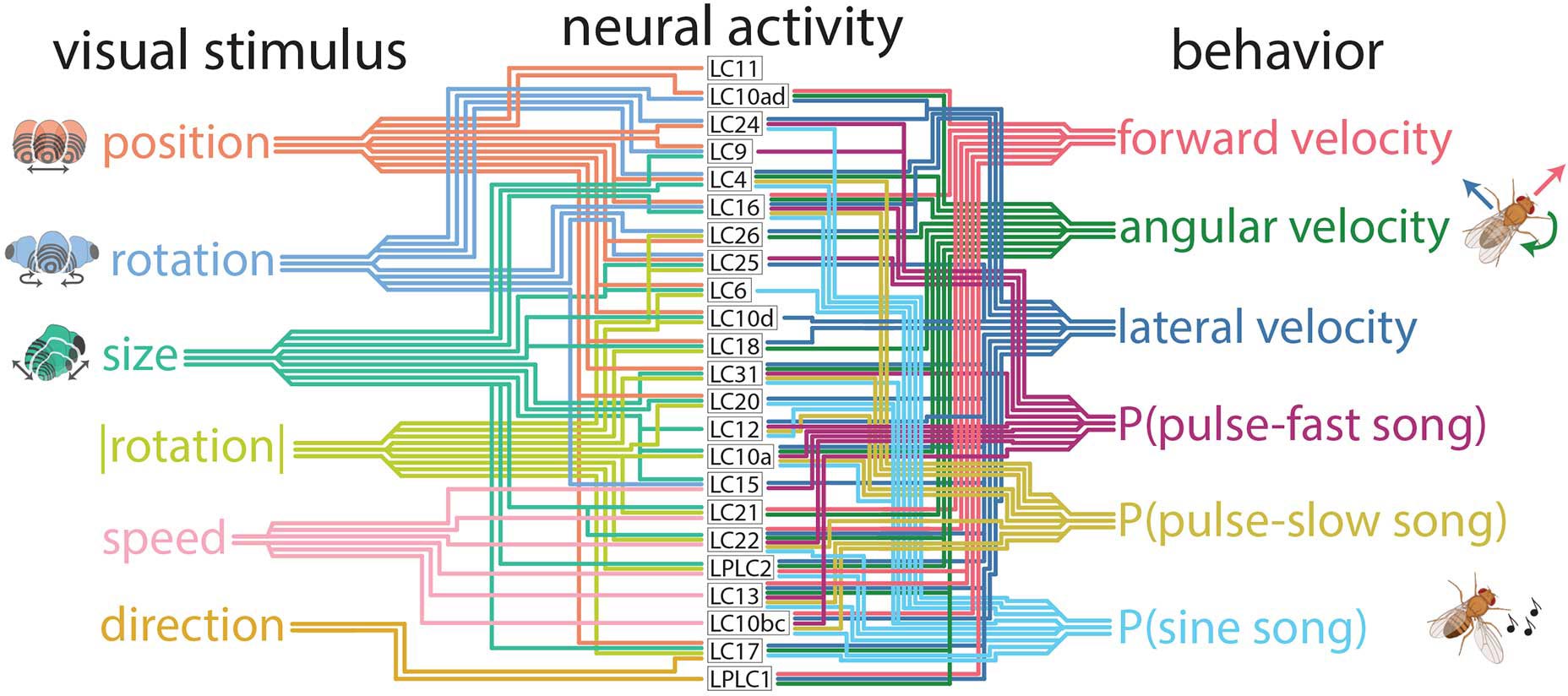
    With their new AI, Cowley’s team discovered that the fruit fly brain uses a “population code” to process visual data. Instead of one neuron type linking each visual feature to one action, as previously assumed, many combinations of neurons were needed to sculpt behavior. A chart of these neural pathways looks like an incredibly complex subway map and will take years to decipher. Still, it gets us where we need to go. It enables Cowley’s AI to predict how a real-life fruit fly will behave when presented with visual stimuli.
    Fruit Fly Subway Map
    With this schematic in hand, Cowley’s team can now turn their attention to interrogating their AI model instead of running costly experiments on real fruit flies. Credit: Cowley lab/Cold Spring Harbor Laboratory

    Implications for Human Brain Research

    Does this mean AI could someday predict human behavior? Not so fast. Fruit fly brains contain about 100,000 neurons. The human brain has almost 100 billion. Referring to the subway map, Cowley says:

    “This is what it’s like for the fruit fly. You can imagine what our visual system is like.”

    Still, Cowley hopes his AI model will someday help us decode the computations underlying the human visual system. He says:

    “This is going to be decades of work. But if we can figure this out, we’re ahead of the game. By learning [fly] computations, we can build a better artificial visual system. More importantly, we’re going to understand disorders of the visual system in much better detail.”

    How much better? You’ll have to see it to believe it.

    Reference: “Mapping model units to visual neurons reveals population code for social behaviour” by Benjamin R. Cowley, Adam J. Calhoun, Nivedita Rangarajan, Elise Ireland, Maxwell H. Turner, Jonathan W. Pillow and Mala Murthy, 22 May 2024, Nature.
    DOI: 10.1038/s41586-024-07451-8

    Starr Foundation, Simons Collaboration on the Global Brain, National Institutes of Health, NIH BRAIN Initiative, Howard Hughes Medical Institute, National Institute of Neurological Disorders and Stroke

    Never miss a breakthrough: Join the SciTechDaily newsletter.
    Follow us on Google and Google News.

    Artificial Intelligence Cold Spring Harbor Laboratory Drosophila Machine Learning Neuroscience Perception
    Share. Facebook Twitter Pinterest LinkedIn Email Reddit

    Related Articles

    Where Did That Sound Come From? MIT Neuroscientists Can Answer That Question

    Is What I See, What I Imagine? Neural Overlap Discovered Between Vision and Imagination

    The Science of a Hit Song – Unlocking the Secrets of Musical Pleasure

    AI Predicts Where and When Lightning Will Strike – Can Even Issue Alerts Before Storm Has Formed

    Artificial Intelligence Model Shows in Striking Detail What Makes Some Images Stick in Our Minds

    Neuroscientist: Animal Brains Key for Next Generation of Artificial Intelligence

    New Chip Reduces Neural Networks’ Power Consumption by 95 Percent

    Engineers Develop Automated Process for Discovering Optimal Structure for Metamaterials

    MIT Launches Intelligence Quest To Advance Human and Machine Intelligence Research

    Leave A Reply Cancel Reply

    • Facebook
    • Twitter
    • Pinterest
    • YouTube

    Don't Miss a Discovery

    Subscribe for the Latest in Science & Tech!

    Trending News

    Breakthrough Bowel Cancer Trial Leaves Patients Cancer-Free for Nearly 3 Years

    Natural Compound Shows Powerful Potential Against Rheumatoid Arthritis

    100,000-Year-Old Neanderthal Fossils in Poland Reveal Unexpected Genetic Connections

    Simple “Gut Reset” May Prevent Weight Gain After Ozempic or Wegovy

    2.8 Days to Disaster: Scientists Warn Low Earth Orbit Could Suddenly Collapse

    Common Food Compound Shows Surprising Power Against Superbugs

    5 Simple Ways To Remember More and Forget Less

    The Atomic Gap That Could Cost the Semiconductor Industry Billions

    Follow SciTechDaily
    • Facebook
    • Twitter
    • YouTube
    • Pinterest
    • Newsletter
    • RSS
    SciTech News
    • Biology News
    • Chemistry News
    • Earth News
    • Health News
    • Physics News
    • Science News
    • Space News
    • Technology News
    Recent Posts
    • Scientists Discover Stem Cells That Could Regrow Teeth and Bone
    • Scientists Discover Natural Molecule That Stops Alzheimer’s Protein Clumps From Forming
    • Early Cannabis Use May Stall Key Brain Skills in Teens
    • Popular Vitamin D Supplement Has “Previously Unknown” Negative Effect, Study Finds
    • Powerful Antioxidant Found To Play a Key Role in Proper Protein Folding
    Copyright © 1998 - 2026 SciTechDaily. All Rights Reserved.
    • Science News
    • About
    • Contact
    • Editorial Board
    • Privacy Policy
    • Terms of Use

    Type above and press Enter to search. Press Esc to cancel.