
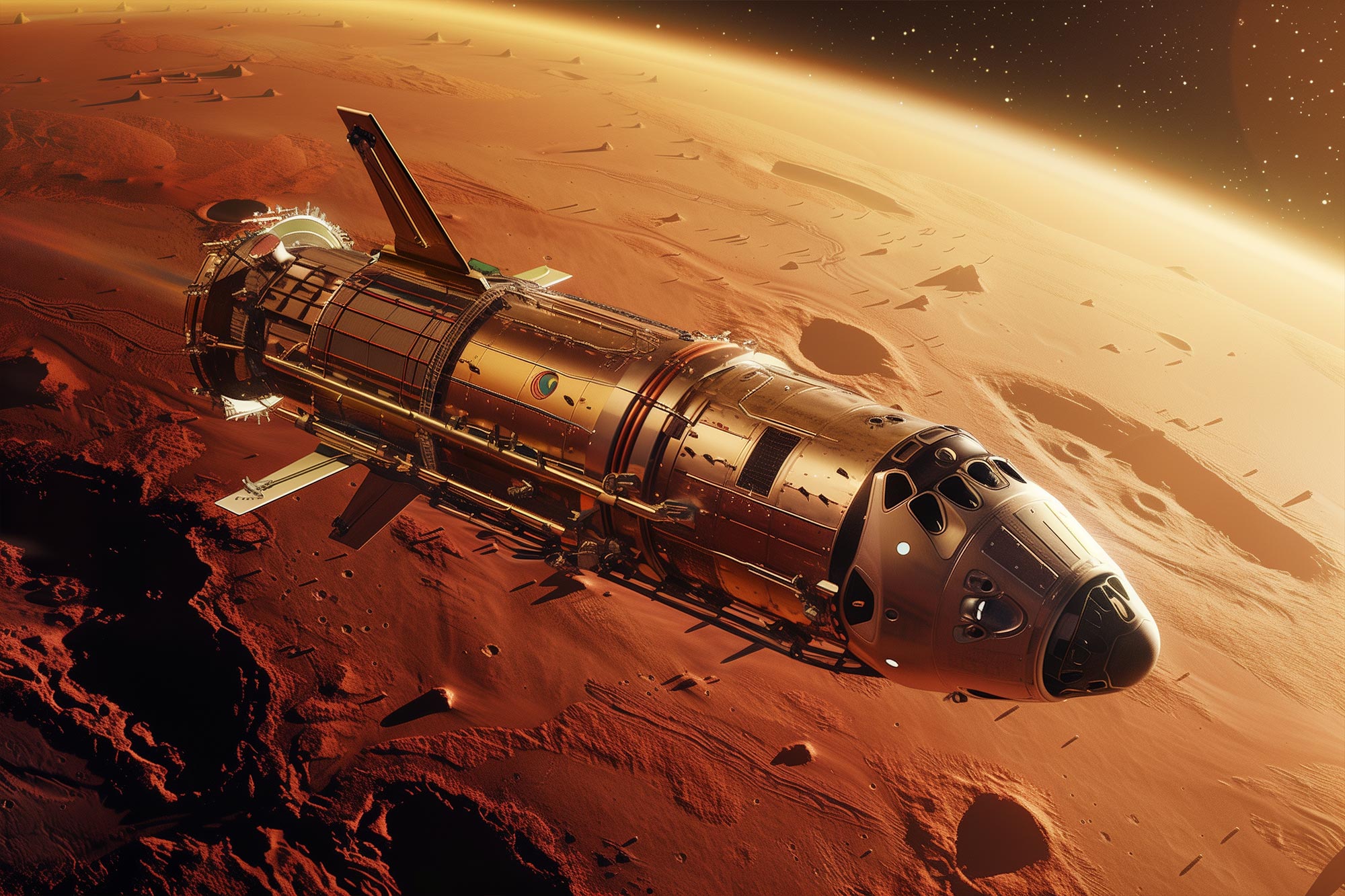
Medications commonly used by astronauts aboard the International Space Station might be ineffective or harmful on a multi-year mission to Mars.
A Duke Health study suggests more than half of space-stored medications could expire during a three-year Mars mission. The study highlights the importance of finding ways to extend drug lifespans or accepting the risks of expired medications, as space conditions may also affect their potency.
Medication Challenges in Space Exploration
Medications used by astronauts on the International Space Station might not be good enough for a three-year journey to Mars.
A new study led by Duke Health shows that over half of the medicines stocked in space — staples such as pain relievers, antibiotics, allergy medicines, and sleep aids — would expire before astronauts could return to Earth.
Effectiveness of Medications Beyond Earth
Astronauts could end up relying on ineffective or even harmful drugs, according to the study appearing July 23 in npj Microgravity, a Nature journal.
“It doesn’t necessarily mean the medicines won’t work, but in the same way you shouldn’t take expired medications you have lying around at home, space exploration agencies will need to plan on expired medications being less effective,” said senior study author Daniel Buckland, M.D., Ph.D., an assistant professor of emergency medicine at Duke University School of Medicine and an aerospace medicine researcher.
Stability of Space Pharmaceuticals
Expired medications can lose their strength by a little – or a lot. The actual stability and potency of medications in space compared to Earth remain largely unknown. The harsh space environment, including radiation, could reduce the effectiveness of medications.
Buckland and co-author Thomas E. Diaz, a pharmacy resident at The Johns Hopkins Hospital, noted that expired medications could pose a challenge as space agencies plan for long-duration missions to Mars and beyond.
Diaz used a Freedom of Information Act Request to obtain information about the space station formulary, assuming NASA would use similar medications for a Mars mission.
Planning for Long-Duration Space Missions
Using a database of international drug expiration dates, the researchers determined that 54 of the 91 medications had a shelf-life of 36 months or less.
Using the most optimistic estimates, about 60% of these medications would expire before a Mars mission concludes. Under more conservative assumptions, the figure jumps to 98%.
The study did not assume accelerated degradation but focused on the inability to resupply a Mars mission with newer medicines. This lack of resupply affects not only medications but also other critical supplies, such as food.
Increasing the number of medications brought on board could also help compensate for lowered efficacy of expired meds, authors said.
“Those responsible for the health of space flight crews will have to find ways to extend the expiration of medications to complete a Mars mission duration of three years, select medications with longer shelf-lives, or accept the elevated risk associated with administering expired medication,” Diaz said.
“Prior experience and research show astronauts do get ill on the International Space Station, but there is real-time communication with the ground and a well-stocked pharmacy that is regularly resupplied, which prevents small injuries or minor illnesses from turning into issues that affect the mission,” Buckland said.
Reference: “Expiration analysis of the International Space Station formulary for exploration mission planning” by Thomas E. Diaz, Emma C. Ives, Diana I. Lazare and Daniel M. Buckland, 23 July 2024, npj Microgravity.
DOI: 10.1038/s41526-024-00414-3
Additional authors include Emma Ives and Diana I. Lazare. The study received no external funding.
Never miss a breakthrough: Join the SciTechDaily newsletter.
Follow us on Google and Google News.
3 Comments
The expiration dates for medications are almost certainly very conservative to account for differences in storage conditions for the medications by the general public. Also, encouraging the disposal of ‘old’ medications encourages the continuation of sales. Different kinds of medications will degrade at different rates, so using the broad brush of “medicine” is a poor way to discuss the potential problem. In general, chemical reactions slow down with decreased temperatures. Keeping medications at extremely low temperatures isn’t a problem in space. Another problem is oxidation. That can be solved either by using the vacuum of space or packaging medicines susceptible to oxidation in an inert atmosphere like helium or argon.
If it is possible to keep survival foods edible for decades, certainly it should be possible to keep at least most medications viable for less than a decade.
The issue shouldn’t be ignored by mission planners, but I don’t think that it is as big a problem as suggested.
Indeed, the expiration date on medications is a rather new concept. When I graduated from pharmacy school in 1971 there were no expiration dates on medications. We knew which medications were unstable and potentially dangerous. The typical 1 year expiration pharmacist put on their labels is dictated by state boards of pharmacy in most cases. Manufacturers seldom test their products for stability or potency beyond a year or possibly 2 years. They have no incentive to say they are good longer than that and it increases sales if the dating is shorter. Those doing this study have made some major assumptions about expiration dating that are inaccurate at best.
Just force them to use risky medication like you forced people to vaxx with a risky vaccine.
Jokes aside, until you get a viable way to even get to Mars – which is never – you don’t have to worry about no meds.