
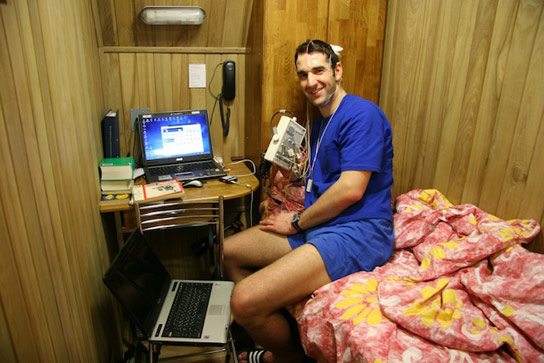
A newly published study found that astronauts going to Mars could have trouble sleeping, become lethargic, and have problems with mental tasks over the course of a long mission.
The Mars 520-d experiment is an international test run by the Russian Academy of Science, in conjunction with the ESA and the Chinese space agency. The experiment placed a six-man crew in a simulated spaceship en route to Mars for 520 consecutive days between 2010 and 2011.
The goal of this experiment was to find out how astronauts would fare physiologically and psychologically under such isolated conditions. The volunteers were thoroughly monitored by daily blood and urine sampling, as well as having their sleep patterns monitored.
There were large individual differences with how the crew responded to such isolation. The scientists published their findings in the journal Proceedings of the National Academy of Sciences. Four of them showed at least one issue that could have led to severe adverse effects during a Mars mission.
Similar experiments have been done in the past on isolated groups, like crews overwintering in Antarctica, but Mars 520-d was the first detailed simulation of circumstances that could arise during a manned Mars mission.
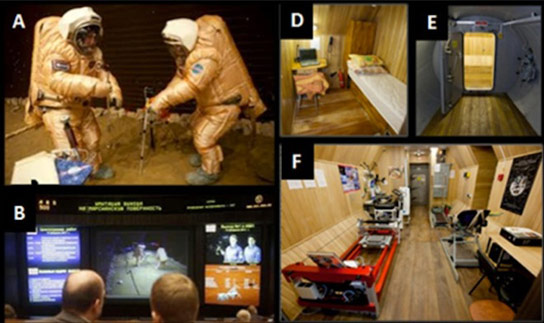
While two of the participants fared well, all members reacted differently. Most crewmembers stayed on a 24-hour sleep cycle schedule, but one fell into a 25-hour day. 20% of the time, he was the only crewmember awake or asleep. Such detachment would likely have to be counteracted in a real deep space mission.
The scientists also observed that all the volunteers slept much more than usual, possibly because they had ample time to do nothing. Most people in modern society have sleep deficits that they never make up because lifestyles encourage constant work activity and caffeine use. Given enough sleep, the participants saw increased cognitive performance overall.
The other side of this was that crewmembers often succumbed to boredom and monotony. The volunteers became sedentary, reduced their movements while awake, and spent more time sleeping and resting.
The Martian day is slightly longer than one on Earth, about 24.65 hours. Other researchers would have liked to see this addressed. Astronauts living on the surface of Mars might have trouble with their circadian rhythm, getting out of sync with actual day and night cycles. The actual effects might be considerably worse than the ones seen in this simulation.
Scientists will have to be able to screen possible astronauts and identify key markers that could predict which individuals might experience which types of sleep of mood problems. The problems showed up fairly early in the Mars 520-d mission, it’s hoped that future crew selection could include similar but shorter simulations to find out who will be affected and who won’t.
One way to sync up crews would be to adjust the proportion of blue light that astronauts see at different points of the day. The human retina has the pigment melanopsin, which is sensitive to blue wavelengths and provides a direct relay to the hypothalamus, the primary pacemaker for circadian systems in the brain.
Reference: “Mars 520-d mission simulation reveals protracted crew hypokinesis and alterations of sleep duration and timing” by Mathias Basner, David F. Dinges, Daniel Mollicone, Adrian Ecker, Christopher W. Jones, Eric C. Hyder, Adrian Di Antonio, Igor Savelev, Kevin Kan, Namni Goel, Boris V. Morukov and Jeffrey P. Sutton, 7 January 2013, Proceedings of the National Academy of Sciences.
DOI: 10.1073/pnas.1212646110
Never miss a breakthrough: Join the SciTechDaily newsletter.
Follow us on Google and Google News.
2 Comments
You have got small typo with pigment. There is photopigment melanopsin, not melanospin. Thank you for your outstanding work with that website.
Fixed it. Thanks.