

Fragranced products and cooking generate harmful nanoscale pollutants indoors, posing potential health risks. Purdue researchers emphasize the need for better air quality awareness and regulation.
When you walk through a pine forest, one of the first things you notice is its crisp, fresh scent.
However, bringing that pine scent, or other aromas, indoors using chemical products such as air fresheners, wax melts, floor cleaners, and deodorants quickly fills the air with nanoscale particles small enough to penetrate deep into your lungs, according to a series of studies by Purdue University engineers.
These nanoparticles form when fragrances interact with ozone, which enters buildings through ventilation systems, triggering chemical reactions that generate new airborne pollutants.
“A forest is a pristine environment, but if you’re using cleaning and aromatherapy products full of chemically manufactured scents to recreate a forest in your home, you’re actually creating a tremendous amount of indoor air pollution that you shouldn’t be breathing in,” said Nusrat Jung, an assistant professor in Purdue’s Lyles School of Civil and Construction Engineering.

Nanoparticles just a few nanometers in size can penetrate deep into the respiratory system and spread to other organs. Jung and fellow civil engineering professor Brandon Boor have been the first to study nanoscale airborne particle formation indoors and compare it to outdoor atmospheric processes.
“To understand how airborne particles form indoors, you need to measure the smallest nanoparticles — down to a single nanometer. At this scale, we can observe the earliest stages of new particle formation, where fragrances react with ozone to form tiny molecular clusters. These clusters then rapidly evolve, growing and transforming in the air around us,” said Boor, Purdue’s Dr. Margery E. Hoffman Associate Professor in Civil Engineering.
In a “tiny house lab” — a dedicated residential lab space for indoor air quality research — Jung and Boor are using the latest industry-developed air quality instruments to track how household products emit chemicals that evaporate easily, called volatile chemicals, and generate the tiniest airborne nanoparticles.
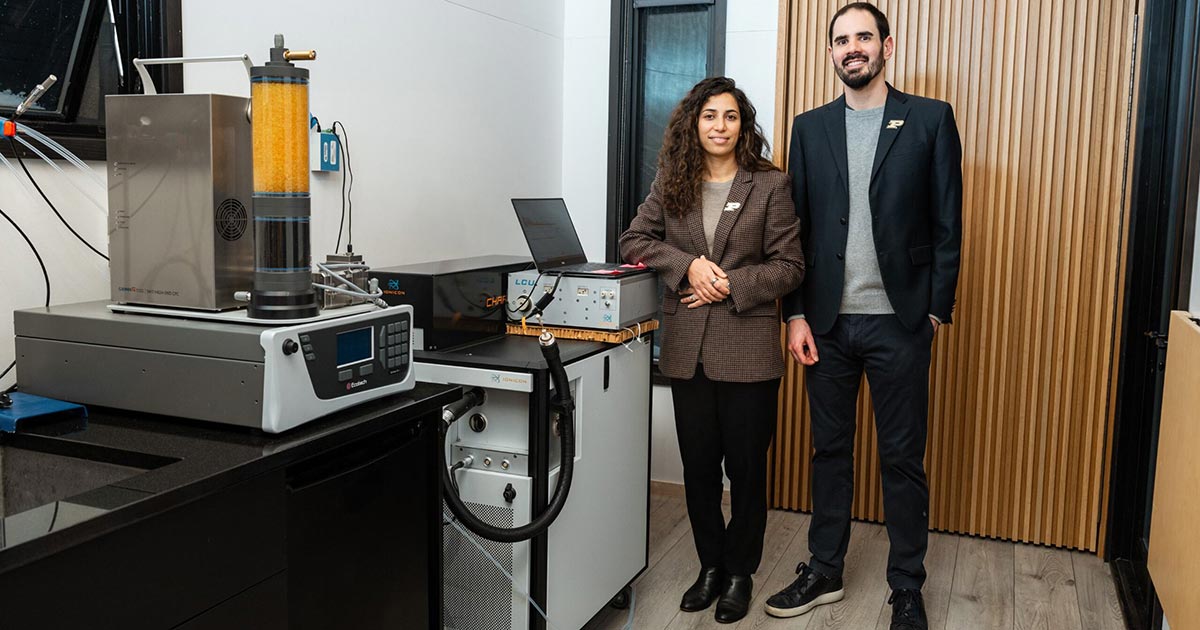
Called the Purdue zero Energy Design Guidance for Engineers (zEDGE) lab, the tiny house has all the features of a typical home but is equipped with sensors for closely monitoring the impact of everyday activities on a home’s air quality. Jung led the design of the lab, which was built in 2020 as the first of its kind.
With this unprecedented level of detail and accuracy, Jung and Boor have made discoveries suggesting that many everyday household products used indoors may not be as safe as previously assumed.
Even though it’s yet to be determined how breathing in volatile chemicals from these products impacts your health, the two have repeatedly found that when fragrances are released indoors, they quickly react with ozone to form nanoparticles. These newly formed nanoparticles are particularly concerning because they can reach very high concentrations, potentially posing risks to respiratory health.
Jung and Boor believe these findings highlight the need for further research into indoor nanoparticle formation triggered by heavily scented chemical products.
“Our research shows that fragranced products are not just passive sources of pleasant scents — they actively alter indoor air chemistry, leading to the formation of nanoparticles at concentrations that could have significant health implications,” Jung said. “These processes should be considered in the design and operation of buildings and their HVAC systems to reduce our exposures.”
Pleasant scents from chemical products create air pollution inside your home
In a recently published paper, the pair found that scented wax melts, typically advertised as nontoxic because they are flame-free, actually pollute indoor air at least as much as candles.
Wax melts and other scented products release terpenes, the chemical compounds responsible for their scents. Since wax melts contain a higher concentration of fragrance oils than many candles, they emit more terpenes into indoor air.

It’s the terpenes in these products that rapidly react with ozone, triggering significant nanoparticle formation. In fact, the nanoparticle pollution from wax melts rivals that of candles, despite the absence of combustion. These findings highlight the need to study non-combustion sources of nanoscale particles, such as fragranced chemical products. Jung and Boor found in another study that essential oil diffusers, disinfectants, air fresheners, and other scented sprays also generate a significant number of nanoscale particles.
But it’s not just scented products contributing to indoor nanoparticle pollution: A study led by Boor found that cooking on a gas stove also emits nanoparticles in large quantities.
Just 1 kilogram of cooking fuel emits 10 quadrillion particles smaller than 3 nanometers, which matches or exceeds what’s emitted from cars with internal combustion engines. At that rate, you might be inhaling 10-100 times more of these sub-3 nanometer particles from cooking on a gas stove indoors than you would from car exhaust while standing on a busy street.
Still, scented chemical products match or surpass gas stoves and car engines in the generation of nanoparticles smaller than 3 nanometers, called nanocluster aerosol. Between 100 billion and 10 trillion of these particles could deposit in your respiratory system within just 20 minutes of exposure to scented products.
Future work in the only lab of its kind
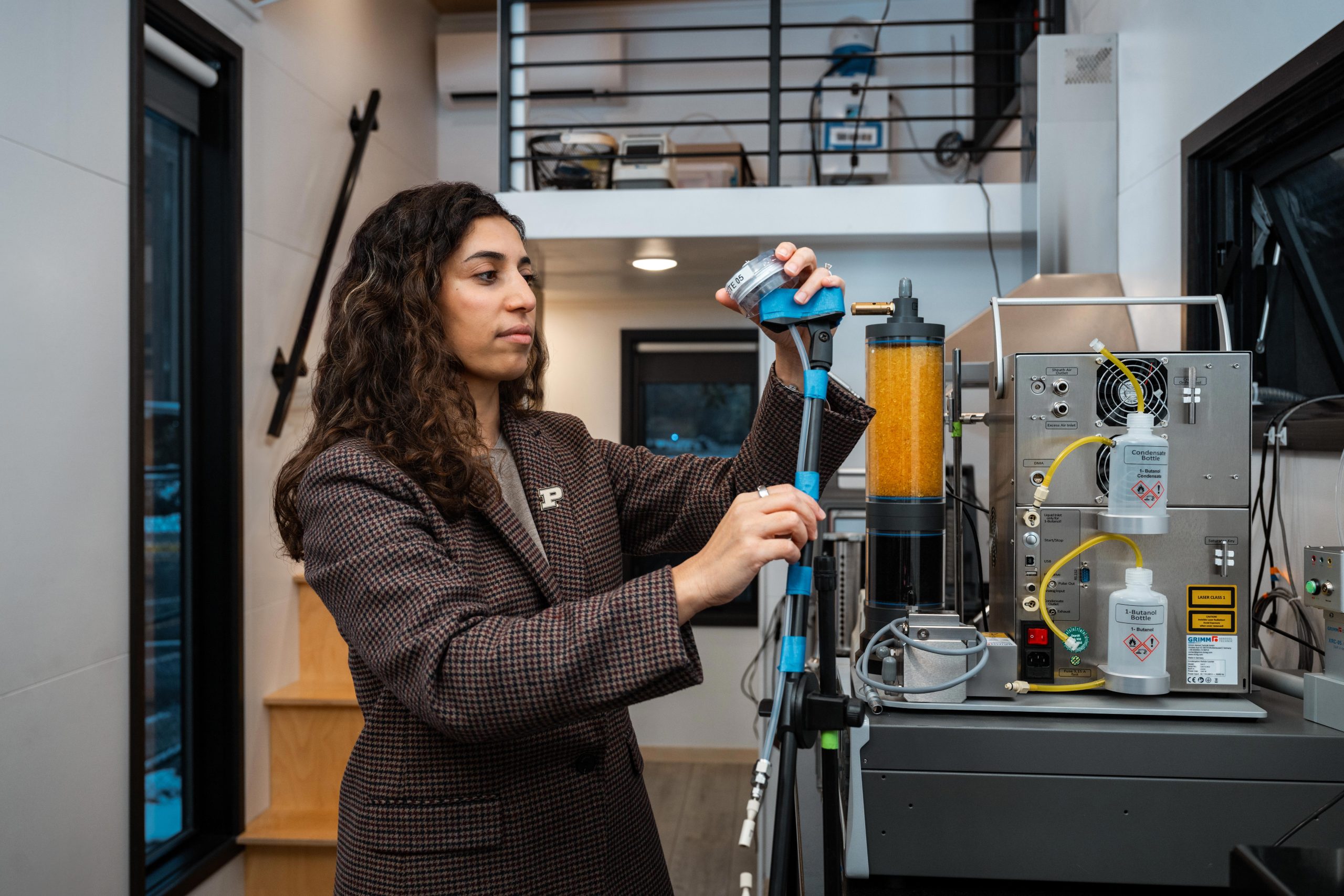
To continue learning more about chemical emissions and nanoparticle formation indoors, Jung and Boor are working with industry partners to test new air quality measurement instruments in Purdue’s tiny house lab before they are put on the market. Companies have been drawn to this lab because it’s a more realistic setting than chamber environments typically used for indoor air quality research and developing new products.
“When companies see top-tier research coming out of Purdue, they want to be part of it,” Jung said. “And if they have an innovative product, they want experts to push it to its limits.”
One of those instruments is a particle size magnifier—scanning mobility particle sizer (PSMPS) developed by GRIMM AEROSOL TECHNIK, a DURAG GROUP company. With this cutting-edge instrument, Jung and Boor can measure nanoparticles as small as a single nanometer as soon as they start to form.
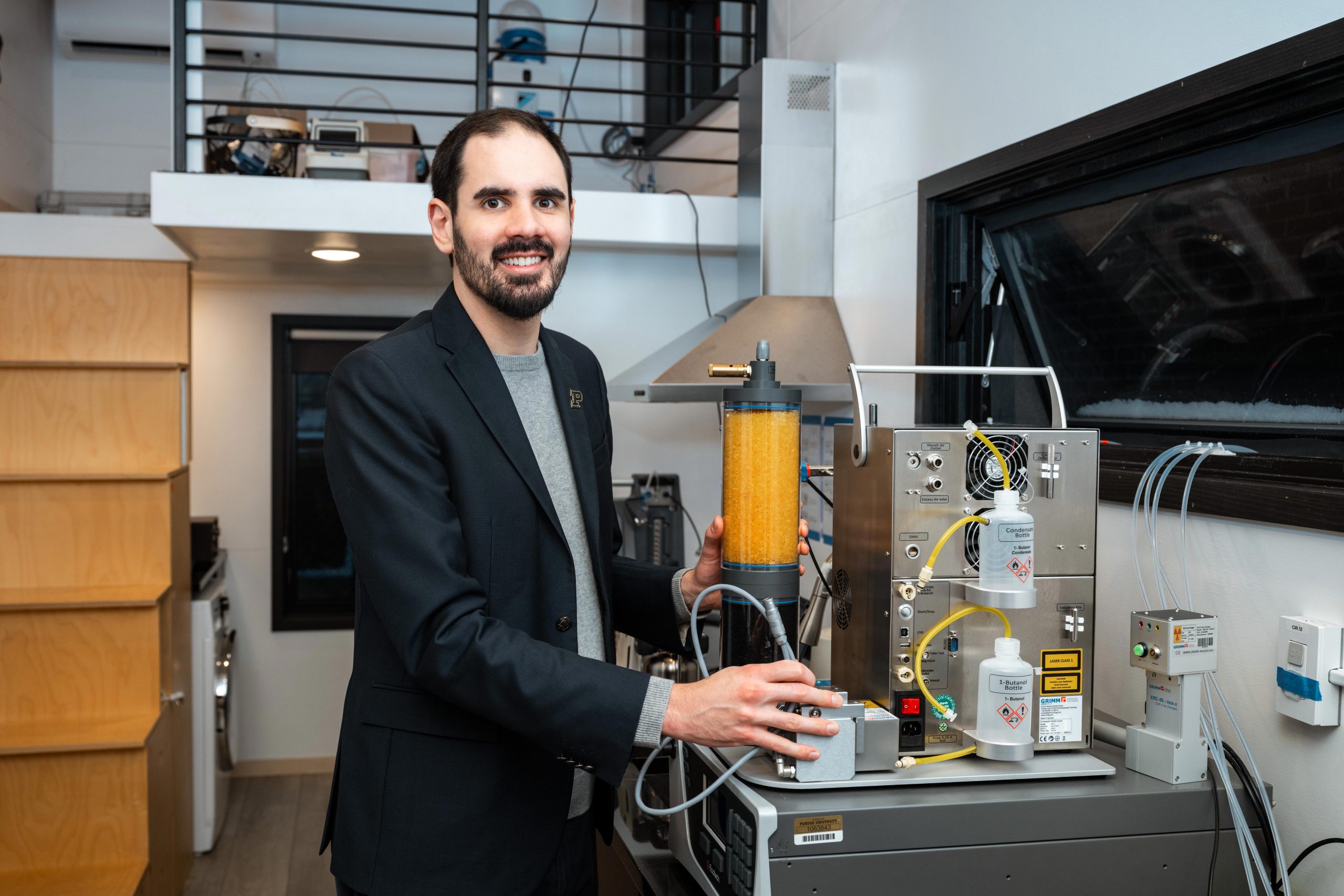
Having a way to collect high-resolution data on the rate of new particle formation and growth indoors has allowed the pair to publish breakthrough studies comparing nanoscale particle emissions between indoor and outdoor atmospheric environments. Since indoor air quality is largely unregulated and less studied than outdoor air, these comparisons are important for understanding pollutant exposures and improving indoor environments.
Jung and Boor also use the tiny house lab to study how a range of other everyday household activities could impact a home’s air quality, such as hair care routines. Jung and her students have found that several chemicals, particularly cyclic volatile methyl siloxanes — which are ubiquitous in hair care products — linger in the air in surprising amounts during and after use. In a single hair care session at home, a person can inhale a cumulative mass of 1-17 milligrams of these chemicals.
Toxicologists will need to build upon these studies to find out exactly how harmful it could be to inhale complex mixtures of volatile chemicals and nanoscale particles indoors. As their research continues, Jung and Boor also hope their findings will improve how indoor air quality is monitored, controlled, and regulated.
“Indoor air quality is often overlooked in the design and management of the buildings we live and work in, yet it has a direct impact on our health every day,” Boor said. “With data from the tiny house lab, we aim to bridge that gap — transforming fundamental research into real-world solutions for healthier indoor environments for everyone.”
References: “Flame-Free Candles Are Not Pollution-Free: Scented Wax Melts as a Significant Source of Atmospheric Nanoparticles” by Satya S. Patra, Jinglin Jiang, Jianghui Liu, Gerhard Steiner, Nusrat Jung and Brandon E. Boor, 3 February 2025, Environmental Science & Technology Letters.
DOI: 10.1021/acs.estlett.4c00986
“Real-time evaluation of terpene emissions and exposures during the use of scented wax products in residential buildings with PTR-TOF-MS” by Jianghui Liu, Jinglin Jiang, Xiaosu Ding, Satya S. Patra, Jordan N. Cross, Chunxu Huang, Vinay Kumar, Paige Price, Emily K. Reidy, Antonios Tasoglou, Heinz Huber, Philip S. Stevens, Brandon E. Boor and Nusrat Jung, 16 February 2024, Building and Environment.
DOI: 10.1016/j.buildenv.2024.111314
“Rapid Nucleation and Growth of Indoor Atmospheric Nanocluster Aerosol during the Use of Scented Volatile Chemical Products in Residential Buildings” by Satya S. Patra, Jianghui Liu, Jinglin Jiang, Xiaosu Ding, Chunxu Huang, Connor Keech, Gerhard Steiner, Philip S. Stevens, Nusrat Jung and Brandon E. Boor, 24 September 2024, ACS ES&T Air.
DOI: 10.1021/acsestair.4c00118
Jung and Boor’s air quality research is largely funded by the National Science Foundation, the U.S. Environmental Protection Agency and the Alfred P. Sloan Foundation Chemistry of Indoor Environments program.
Never miss a breakthrough: Join the SciTechDaily newsletter.
Follow us on Google and Google News.
6 Comments
That nice crispy pine scent one obtains from a walk in a pine forest isn’t healthy either, the phrase, “the Smokey Mountains”, itself refers to the dense air pollution caused by those released terepines reacting with their photo induced oxidation; pretty, but deadly, it’s a pet peeve of mine that when pollution levels are announced, that no distinction is made as to how much of that is caused by nature, how much by agriculture, and how much by transportation, industry, etcetera. My guess is that choice by the EPA, to not make a distinction is a political one, as it might negatively effect environmental industry field; but, obviously, with Trump in office it finally has caught up with them, for reasons like the one that I just indirectly referred to.
How’s that maga Kool aid?
I’m not surprised in a bit. Those car “fresheners” always give me nausea.
All the over hyped nonsense. Every Odor detected albeit cooking, air scent devices, natural woodlot or grassland and flowers release are, have been and shall remain Particulates. No particulates no warning scents as to gas leaks or potential danger as well pleasant things. Some things are bad some less bad than depicted.
Finally research showing manufactured fragrance is unhealthy. The vast majority of cleaning and personal care products have fragrance as added to them. It causes debilitating migraines for me, in which I can not get out of bed for 3 weeks straight, including daily vomiting and often require urgent medical care. Unfortunately, I am now pretty much homebound and isolated from all except a few people who try to remain fragrance free.
Even outside, I get blasted by toxic fragranced chemicals from neighbors’ laundry dryer vents spewing the chemicals into the air that I have a right to breathe but can’t without getting extremely ill.
Product marketing has completely brainwashed consumers into believing fragrance is necessary.
Flame retardant that’s applied to your car seats outgas harmful chemicals. The more heat they are exposed to the worse the outgassing. You should roll down your windows and ventilate your car if possible every time you use your car to be safe. If it’s been sitting in the sun you should definitely do it.