
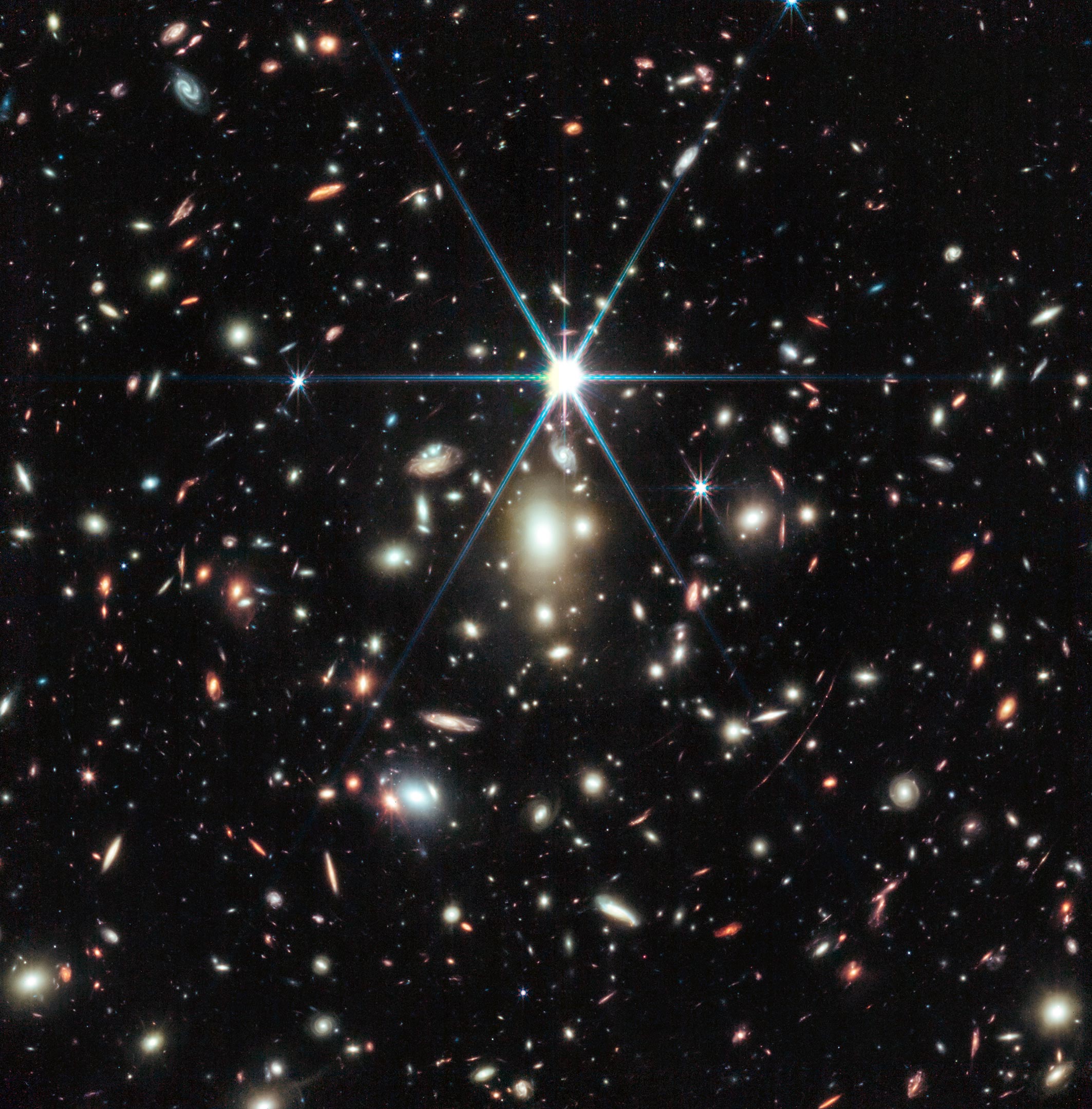
In this image, the Sunrise Arc appears just below the diffraction spike at the 5 o’clock position. The fuzzier, white galaxies at the center of the image are part of the galaxy cluster bound together by gravity. The various redder, curved galaxies are background galaxies picked up by Webb’s sensitive mirror.
Credit: NASA, ESA, CSA, Dan Coe (STScI/AURA for ESA, JHU), Brian Welch (NASA-GSFC, UMD), Zolt G. Levay
Observations Hint That Earendel Has Companion Star
Detecting extremely distant stars, or those closest in time to the big bang, can provide insights into the first few chapters of the history of our universe. In 2022, the Hubble Space Telescope broke its own record, and spotted the most distant star yet. This star, nicknamed Earendel, emitted its light within the universe’s first billion years.
Spotting, and confirming, the distance of the star is just the beginning, though. That’s where NASA’s James Webb Space Telescope comes in. Webb’s initial observations of Earendel have revealed insights into the star’s type, and even the galaxy surrounding the star. Future analysis of Webb spectroscopic observations of Earendel and its host galaxy, the Sunrise Arc, could also reveal information about brightness, temperature, and composition.
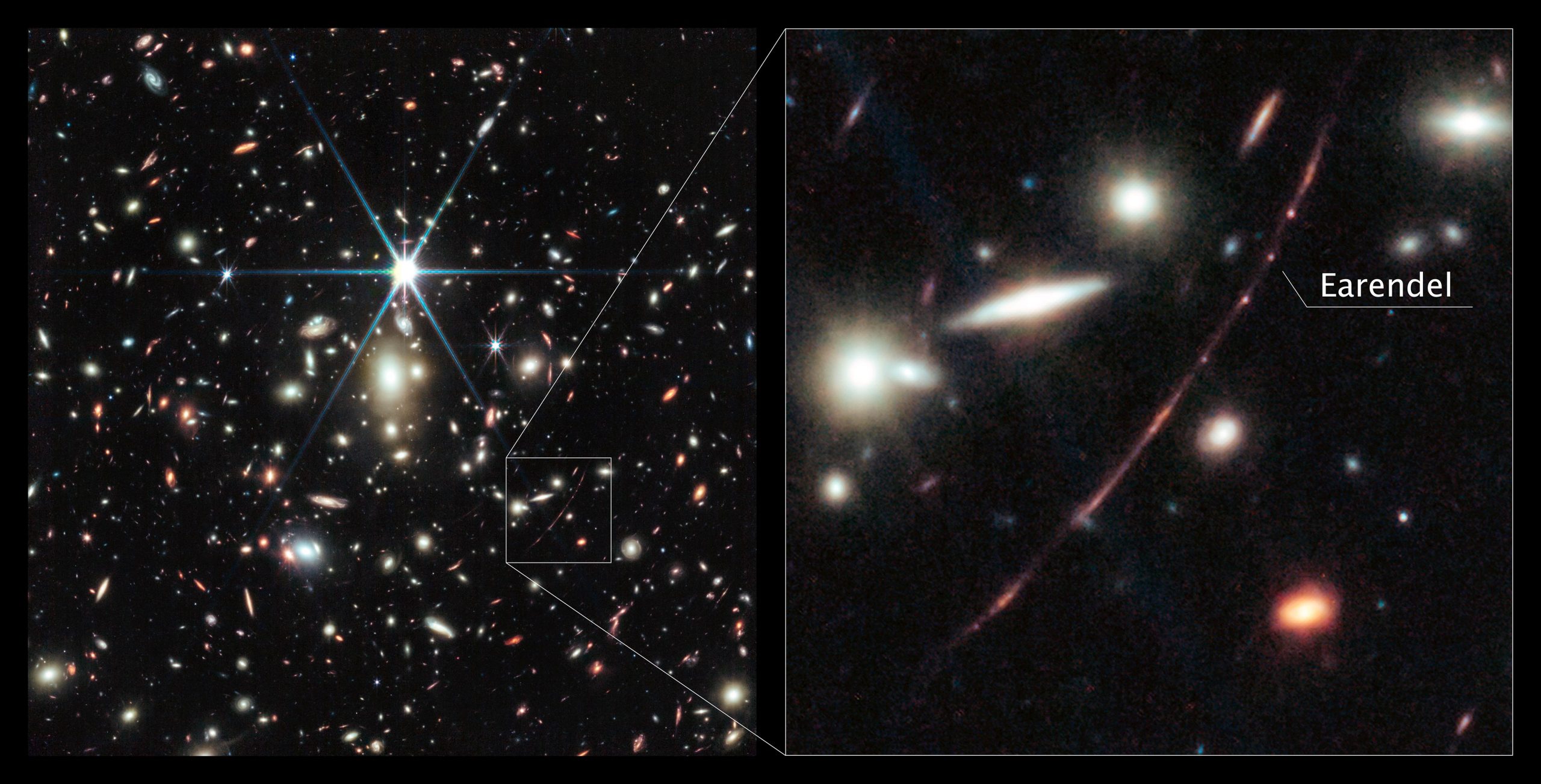
Webb’s NIRCam (Near-Infrared Camera) instrument reveals the star, nicknamed Earendel, to be a massive B-type star more than twice as hot as our Sun, and about a million times more luminous. Stars of this mass often have companions. Astronomers did not expect Webb to reveal any companions of Earendel since they would be so close together and indistinguishable on the sky. However, based solely on the colors of Earendel detected by Webb, astronomers think they see hints of a cooler companion star.
Credit: NASA, ESA, CSA, Dan Coe (STScI/AURA for ESA, JHU), Brian Welch (NASA-GSFC, UMD), Zolt G. Levay
Webb Space Telescope Reveals Colors of Earendel
NASA’s James Webb Space Telescope has followed up on observations by the Hubble Space Telescope of the farthest star ever detected in the very distant universe, within the first billion years after the big bang. Webb’s NIRCam (Near-Infrared Camera) instrument reveals the star to be a massive B-type star more than twice as hot as our Sun, and about a million times more luminous.
Discovery and Observation
The star, which the research team has dubbed Earendel, is located in the Sunrise Arc galaxy and is detectable only due to the combined power of human technology and nature via an effect called gravitational lensing. Both Hubble and Webb were able to detect Earendel due to its lucky alignment behind a wrinkle in space-time created by the massive galaxy cluster WHL0137-08. The galaxy cluster, located between us and Earendel, is so massive that it warps the fabric of space itself, which produces a magnifying effect, allowing astronomers to look through the cluster like a magnifying glass.
Travel to the massive galaxy cluster called WHL0137-08, which contains the most strongly magnified galaxy known in the universe’s first billion years: the Sunrise Arc, and within that galaxy, the most distant star ever detected. The journey begins with a ground-based image by astrophotographer Akira Fujii, then transitions into a plate from the Digitized Sky Survey. Next, an image from the Dark Energy Camera on the Victor M. Blanco observatory appears, and then finally the video arrives at the James Webb Space Telescope’s image of the galaxy cluster.
Magnification and Record
While other features in the galaxy appear multiple times due to the gravitational lensing, Earendel only appears as a single point of light even in Webb’s high-resolution infrared imaging. Based on this, astronomers determine the object is magnified by a factor of at least 4,000, and thus is extremely small – the most distant star ever detected, observed 1 billion years after the big bang. The previous record-holder for the most distant star was detected by Hubble and observed around 4 billion years after the big bang. Another research team using Webb recently identified a gravitationally lensed star they nicknamed Quyllur, a red giant star observed 3 billion years after the big bang.
Characteristics and Companions
Stars as massive as Earendel often have companions. Astronomers did not expect Webb to reveal any companions of Earendel since they would be so close together and indistinguishable on the sky. However, based solely on the colors of Earendel, astronomers think they see hints of a cooler, redder companion star. This light has been stretched by the expansion of the universe to wavelengths longer than Hubble’s instruments can detect, and so was only detectable with Webb.
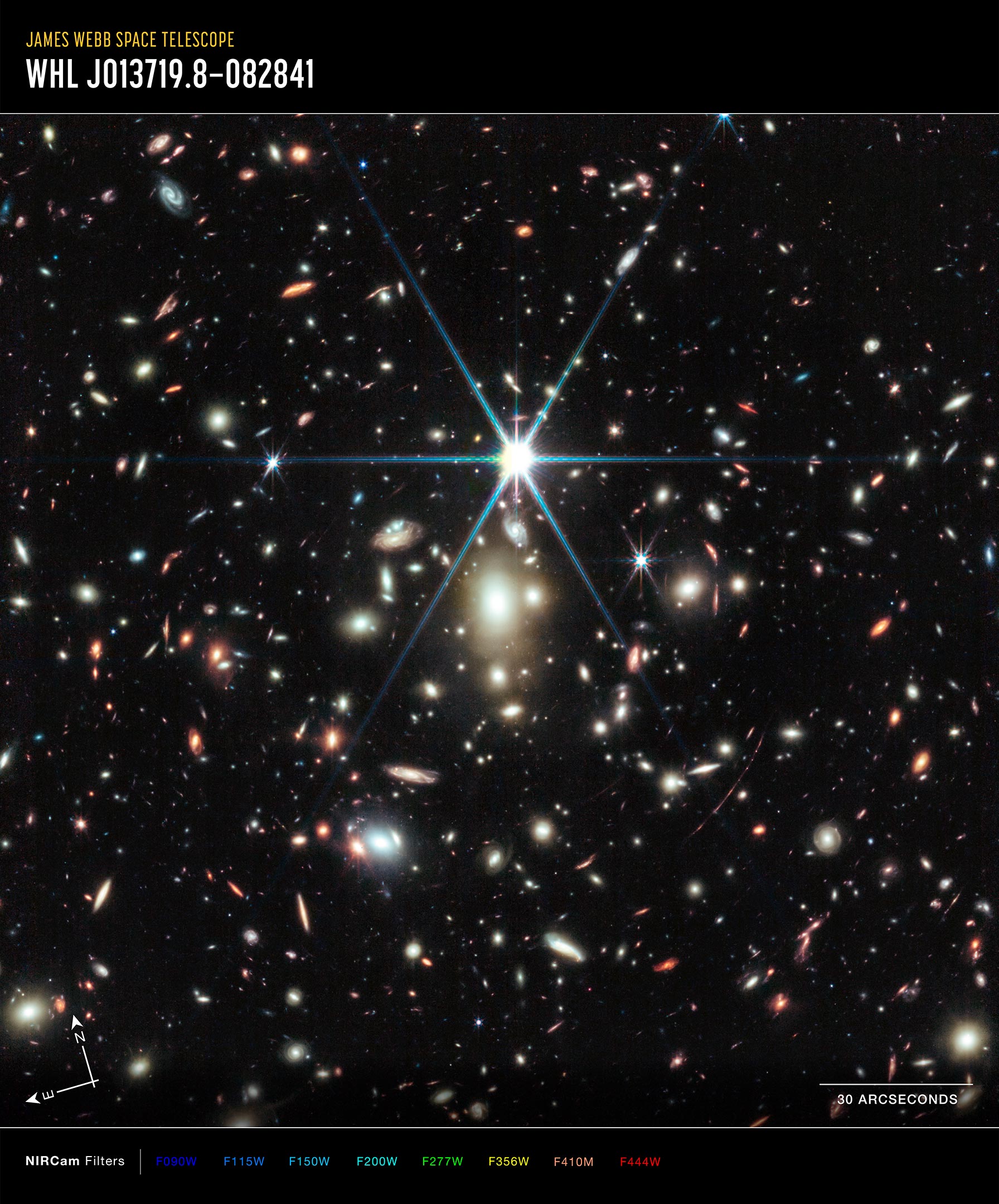
This image shows invisible near-infrared wavelengths of light that have been translated into visible-light colors. The color key shows which NIRCam (Near-Infrared Camera) filters were used when collecting the light. The color of each filter name is the visible light color used to represent the infrared light that passes through that filter. Below the image is a color key showing which NIRCam filters were used to create the image and which visible-light color is assigned to each filter.
Credit: NASA, ESA, CSA, Dan Coe (STScI/AURA for ESA, JHU), Brian Welch (NASA-GSFC, UMD), Zolt G. Levay
Features of Sunrise Arc
Webb’s NIRCam also shows other notable details in the Sunrise Arc, which is the most highly magnified galaxy yet detected in the universe’s first billion years. Features include both young star-forming regions and older established star clusters as small as 10 light-years across. On either side of the wrinkle of maximum magnification, which runs right through Earendel, these features are mirrored by the distortion of the gravitational lens. The region forming stars appears elongated, and is estimated to be less than 5 million years old. Smaller dots on either side of Earendel are two images of one older, more established star cluster, estimated to be at least 10 million years old. Astronomers determined this star cluster is gravitationally bound and likely to persist until the present day. This shows us how the globular clusters in our own Milky Way might have looked when they formed 13 billion years ago.
Ongoing Analysis and Future Discoveries
Astronomers are currently analyzing data from Webb’s NIRSpec (Near-Infrared Spectrograph) instrument observations of the Sunrise Arc galaxy and Earendel, which will provide precise composition and distance measurements for the galaxy.
Since Hubble’s discovery of Earendel, Webb has detected other very distant stars using this technique, though none quite as far as Earendel. The discoveries have opened a new realm of the universe to stellar physics, and new subject matter to scientists studying the early universe, where once galaxies were the smallest detectable cosmic objects. The research team has cautious hope that this could be a step toward the eventual detection of one of the very first generation of stars, composed only of the raw ingredients of the universe created in the big bang – hydrogen and helium.
The James Webb Space Telescope is the world’s premier space science observatory. Webb is solving mysteries in our solar system, looking beyond to distant worlds around other stars, and probing the mysterious structures and origins of our universe and our place in it. Webb is an international program led by NASA with its partners, ESA (European Space Agency) and the Canadian Space Agency.
Never miss a breakthrough: Join the SciTechDaily newsletter.
Follow us on Google and Google News.
2 Comments
Wonderful. SO what benefit does this bring to anyone?
You mean, for idiots like you? Nothing.