
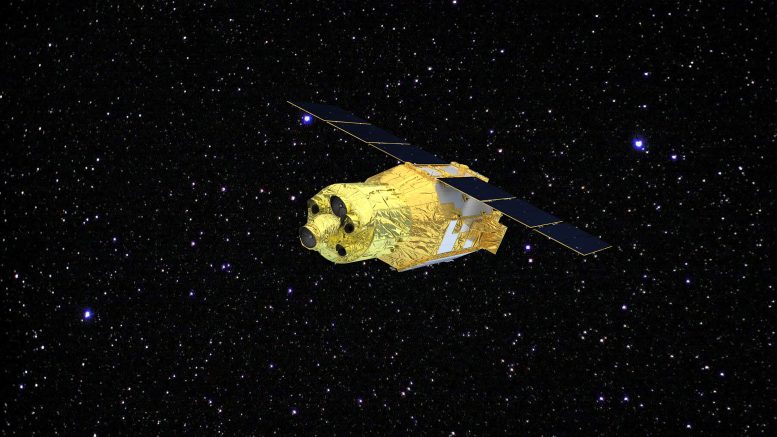
The XRISM satellite, a collaborative effort between JAXA, NASA, and ESA, aims to offer unprecedented insights into the X-ray universe, exploring stellar phenomena and black hole activities. Launching alongside JAXA’s SLIM, its instruments, Resolve and Xtend, promise advanced X-ray detection and analysis.
A powerful satellite called XRISM (X-ray Imaging and Spectroscopy Mission) is set to provide astronomers with a revolutionary look at the X-ray sky.
XRISM, led by JAXA (Japan Aerospace Exploration Agency) in collaboration with NASA and with contributions from ESA (European Space Agency), is scheduled to launch on an H-IIA rocket from Japan’s Tanegashima Space Center at 8:26 p.m. EDT on Sunday, August 27 (9:26 a.m. on Monday, August 28, in Japan). JAXA will stream the launch live on YouTube, with a broadcast in both English and Japanese starting at 7:55 p.m. EDT.
Watch this video to learn more about XRISM (X-ray Imaging and Spectroscopy Mission), a collaboration between JAXA (Japan Aerospace Exploration Agency) and NASA. Credit: NASA’s Goddard Space Flight Center
“Some of the things we hope to study with XRISM include the aftermath of stellar explosions and near-light-speed particle jets launched by supermassive black holes in the centers of galaxies,” said Richard Kelley, NASA’s XRISM principal investigator at NASA’s Goddard Space Flight Center in Greenbelt, Maryland. “But of course, we’re most excited about all the unexpected phenomena XRISM will discover as it observes our cosmos.”
Companion Launch and XRISM’s Capabilities
Also on this launch is JAXA’s SLIM (Smart Lander for Investigating Moon), designed to demonstrate accurate, “pinpoint” lunar landing techniques by a small explorer. NASA provided a laser retroreflector array for SLIM, as both agencies cooperate in the international effort to further explore the Moon and, ultimately, human exploration of Mars.
XRISM detects X-rays with energies ranging from 400 to 12,000 electron volts. (For comparison, the energy of visible light is 2 to 3 electron volts.)
This range will provide astrophysicists with new information about some of the universe’s hottest regions, largest structures, and objects with the strongest gravity.
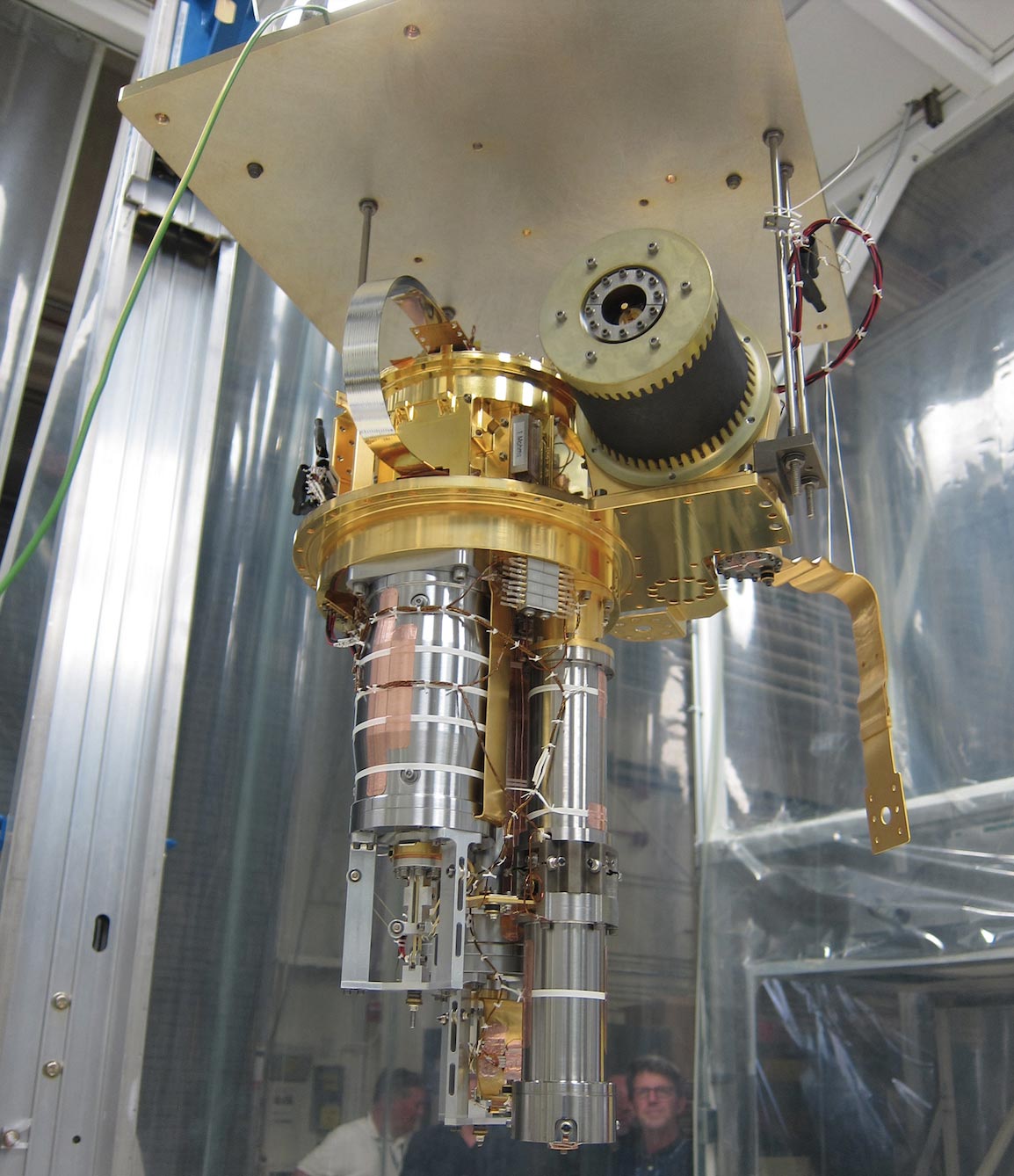
Instruments Onboard XRISM
The mission has two instruments, Resolve and Xtend.
Resolve is a microcalorimeter spectrometer developed in collaboration between JAXA and NASA. When an X-ray hits Resolve’s 6-by-6-pixel detector, its energy causes a tiny increase in temperature. By measuring each individual X-ray’s energy, the instrument provides information about the source, such as its composition, motion, and physical state.
To detect these tiny temperature changes, Resolve must operate at just a fraction of a degree above absolute zero. It reaches this state in orbit after a multistage mechanical cooling process inside a refrigerator-sized container of liquid helium.
“Resolve leverages technologies developed for previous X-ray missions like Suzaku and Hitomi,” said Lillian Reichenthal, NASA’s XRISM project manager at Goddard. “It represents the culmination of years of collaborative work between JAXA, NASA, and other partners from around the globe.”
XRISM’s second instrument, Xtend, was developed by JAXA. It will give XRISM one of the largest fields of view of any X-ray imaging satellite flown to date, observing an area about 60% larger than the average apparent size of the full moon. The images it collects will complement the data collected by Resolve.

XRISM’s Unique X-ray Imaging
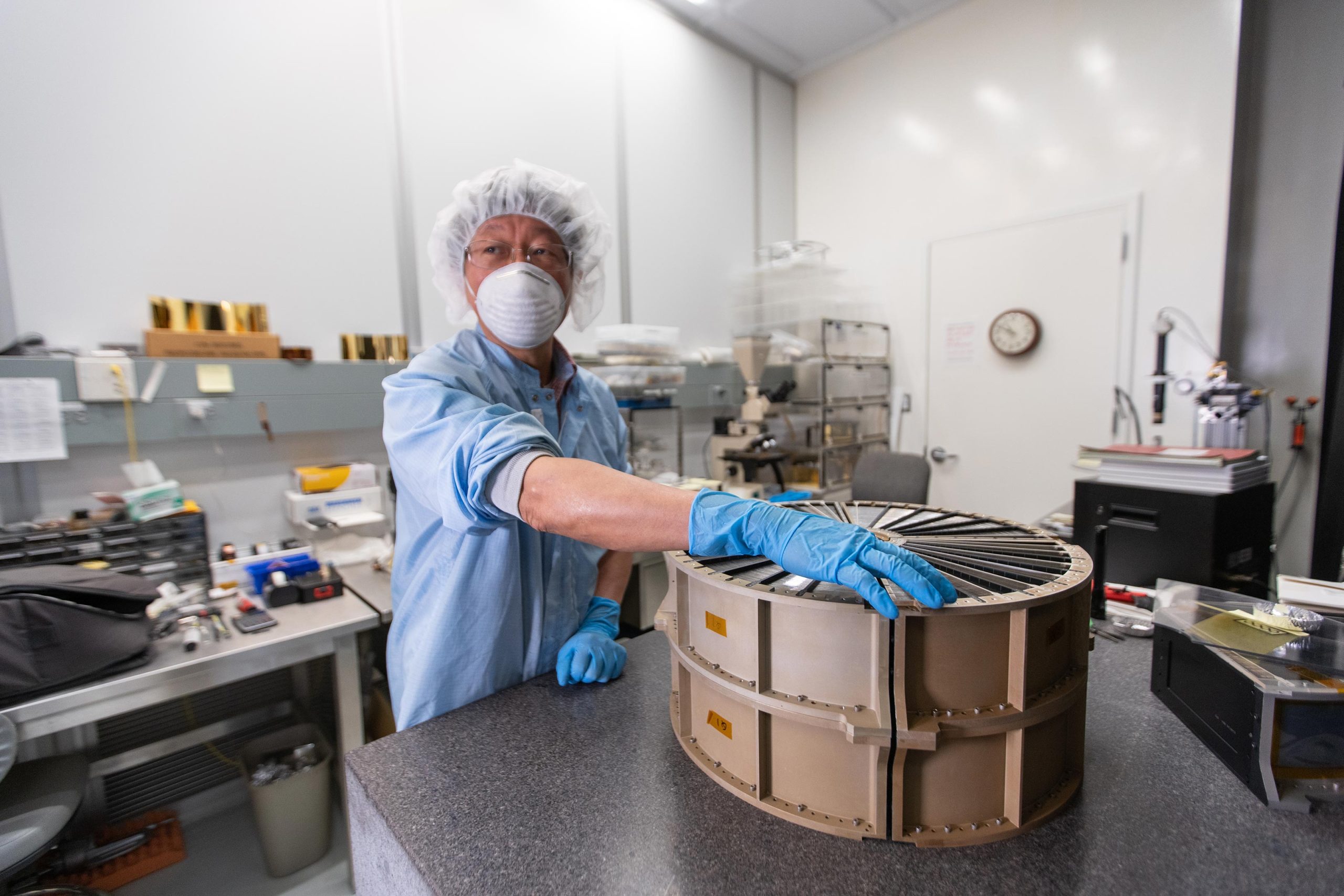
Each instrument is at the focus of an XMA (X-ray Mirror Assembly) designed and developed at Goddard.
X-ray wavelengths are so short, they can pass straight between the atoms of the dish-shaped mirrors used to capture visible, infrared, and ultraviolet light.
Instead, X-ray astronomers use nested curved mirrors turned on their sides. The X-rays skip off the surfaces like stones across a pond and into the detectors.
Each of XRISM’s XMAs houses hundreds of concentric, precisely shaped aluminum shells built in quadrants and assembled into a circle. In all, there are over 3,200 individual mirror segments in the two mirror assemblies.
After launch, XRISM will begin a months-long calibration phase, during which Resolve will reach its operating temperature.
“Once XRISM begins collecting data, scientists will have the opportunity to propose sources for the mission to study,” said Mihoko Yukita, an astrophysicist at Goddard and Johns Hopkins University in Baltimore who works for NASA’s Guest Observer Facility for XRISM. “Researchers from around the world will have access to the cutting-edge work XRISM will be doing.”
XRISM is a collaborative mission between JAXA and NASA, with participation by ESA. NASA’s contribution includes science participation from the Canadian Space Agency.
Never miss a breakthrough: Join the SciTechDaily newsletter.
Follow us on Google and Google News.