
Close Menu
    Facebook X (Twitter) Instagram
    SciTechDaily
    • Biology
    • Chemistry
    • Earth
    • Health
    • Physics
    • Science
    • Space
    • Technology
    Facebook X (Twitter) Pinterest YouTube RSS
    SciTechDaily
    Home»Biology»Yale Study Details Recent Shifts in Occurrence, Cause, and Magnitude of Mass Animal Die-Offs
    Biology

    Yale Study Details Recent Shifts in Occurrence, Cause, and Magnitude of Mass Animal Die-Offs

    By Bill Hathaway, Yale UniversityJanuary 13, 2015No Comments3 Mins Read
    Facebook Twitter Pinterest Telegram LinkedIn WhatsApp Email Reddit
    Share
    Facebook Twitter LinkedIn Pinterest Telegram Email Reddit
    New Research Shows Mass Animal Die-Offs May Be Increasing
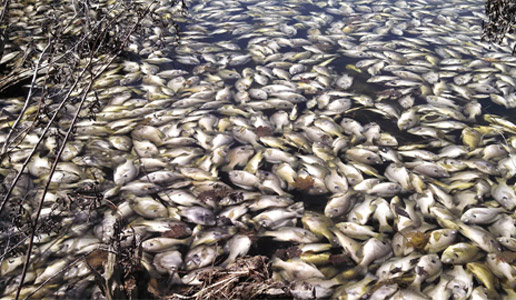
    Large numbers of dead sunfish and largemouth bass in April 2014 following a severe winter on Wintergreen Lake, Kalamazoo County, Michigan. Credit: G. Mittelbach

    A newly published study from Yale University shows that an increase in mass animal die-offs appears to be associated with a rise in disease emergence, biotoxicity, and multiple interacting stressors.

    Mass die-offs of animals may be increasing in frequency and — for birds, fishes, and marine invertebrates — in severity as well, according to a study of 727 mass mortality events since 1940.

    Despite the ecological importance of individual mass mortality events, in which a larger than normal number of individuals die within a population, little research has been conducted on patterns across mass mortality events. The new study will help researchers better assess trends in mass mortality events and their causes, according to the authors of the paper in the January 12 issue of the Proceedings of the National Academy of Sciences.

    “The initial patterns are surprising, in terms of the documented changes to frequencies of occurrences, magnitudes of each event, and the causes of mass mortality,” said Samuel Fey, a postdoctoral fellow in the Department of Ecology and Evolutionary Biology at Yale and co-lead author of the paper. “These data also show that we have a lot of room to improve how we document and study these types of rare events.”

    Fey, along with fellow researchers at the University of San Diego and University of California-Berkeley, report that the magnitude of the die-offs has increased in birds, fishes, and marine invertebrates, held steady among mammals, and decreased in frogs and amphibians. The authors recognized that more scientific research has been done on mass mortality events in the last few decades but said even accounting for this “discovery bias” does not explain all of the increase in such events. The increase in mass mortality events appears to be associated with a rise in disease emergence, biotoxicity, and multiple interacting stressors, they note.

    Overall, disease was the primary culprit, accounting for 26% of the mass die-offs. The impacts of direct human activity, primarily from environmental contamination, caused 19% of such events. Another major cause was biotoxicity triggered by events such as algae blooms, rapid increases of algae in water systems. Processes directly influenced by climate — such as weather extremes, thermal stress, oxygen stress, or starvation — also accounted collectively for about 25% of mass mortality events.

    The most severe events were those with multiple causes, the paper shows.

    “This study should improve our understanding of the continuum of mortality patterns and processes that exist between background mortality levels and species-level extinctions,” Fey said.

    Adam M. Siepielski of the University of San Diego was co-lead author of the paper. Stephanie M. Carlson of the University of California-Berkeley was senior author. Fey began working on this research while a graduate student at Dartmouth College.

    Reference: “Recent shifts in the occurrence, cause, and magnitude of animal mass mortality events” by Samuel B. Fey, Adam M. Siepielski, Sébastien Nusslé, Kristina Cervantes-Yoshida, Jason L. Hwan, Eric R. Huber, Maxfield J. Fey, Alessandro Catenazzi and Stephanie M. Carlson, 12 January 2015, PNAS.
    DOI: 10.1073/pnas.1414894112


    Never miss a breakthrough: Join the SciTechDaily newsletter.
    Follow us on Google and Google News.

    Animals Ecology Evolutionary Biology Yale University
    Share. Facebook Twitter Pinterest LinkedIn Email Reddit

    Related Articles

    Yale Study Shows Gradual Environmental Change is an Ally to Viral Pathogens

    Study Projects How Climate Change Will Affect the Functions Birds in Ecosystems Worldwide

    Barb Geometry of Asymmetrical Feathers Sheds Light on Evolution of Flight

    Scientists Detail the Evolutionary Success of Spiny-Rayed Fishes

    Antibiotics Might Contribute to the Health Problems of the Bee Colonies

    Genetic Analysis Reveals New Family Tree for Ray-Finned Fish

    Extinctions Due to Habitat Loss are Proportional to the Area Destroyed

    Evolution Shapes Ecology of Dammed Connecticut Lakes

    “Map of Life” to Illustrate All Living Things Geographically

    Leave A Reply Cancel Reply

    • Facebook
    • Twitter
    • Pinterest
    • YouTube

    Don't Miss a Discovery

    Subscribe for the Latest in Science & Tech!

    Trending News

    The Universe Is Expanding Too Fast and Scientists Can’t Explain Why

    “Like Liquid Metal”: Scientists Create Strange Shape-Shifting Material

    Early Warning Signals of Esophageal Cancer May Be Hiding in Plain Sight

    Common Blood Pressure Drug Shows Surprising Power Against Deadly Antibiotic-Resistant Superbug

    Scientists Uncover Dangerous Connection Between Serotonin and Heart Valve Disease

    Scientists Discover a “Protector” Protein That Could Help Reverse Hair Loss

    Bone-Strengthening Discovery Could Reverse Osteoporosis

    Scientists Uncover Hidden Trigger Behind Stem Cell Aging

    Follow SciTechDaily
    • Facebook
    • Twitter
    • YouTube
    • Pinterest
    • Newsletter
    • RSS
    SciTech News
    • Biology News
    • Chemistry News
    • Earth News
    • Health News
    • Physics News
    • Science News
    • Space News
    • Technology News
    Recent Posts
    • Scientists Crack Alfalfa’s Chromosome Mystery After Decades of Debate
    • Ancient Ant-Plant Alliance Collapses As Predatory Wasps Move In
    • Scientists Discover Tiny New Spider That Hunts Prey 6x Its Size
    • Natural Component From Licorice Shows Promise for Treating Inflammatory Bowel Disease
    • New Research Finds Shocking Link Between Chili Peppers and Cancer
    Copyright © 1998 - 2026 SciTechDaily. All Rights Reserved.
    • Science News
    • About
    • Contact
    • Editorial Board
    • Privacy Policy
    • Terms of Use

    Type above and press Enter to search. Press Esc to cancel.