
Close Menu
    Facebook X (Twitter) Instagram
    SciTechDaily
    • Biology
    • Chemistry
    • Earth
    • Health
    • Physics
    • Science
    • Space
    • Technology
    Facebook X (Twitter) Pinterest YouTube RSS
    SciTechDaily
    Home»Biology»Yale Study Shows PUM1 and PUM2 Help Older Brains Gain New Cells
    Biology

    Yale Study Shows PUM1 and PUM2 Help Older Brains Gain New Cells

    By Yale UniversityAugust 10, 2017No Comments3 Mins Read
    Facebook Twitter Pinterest Telegram LinkedIn WhatsApp Email Reddit
    Share
    Facebook Twitter LinkedIn Pinterest Telegram Email Reddit
    Yale Researchers Use Two Genes Help Older Brains Gain New Cells
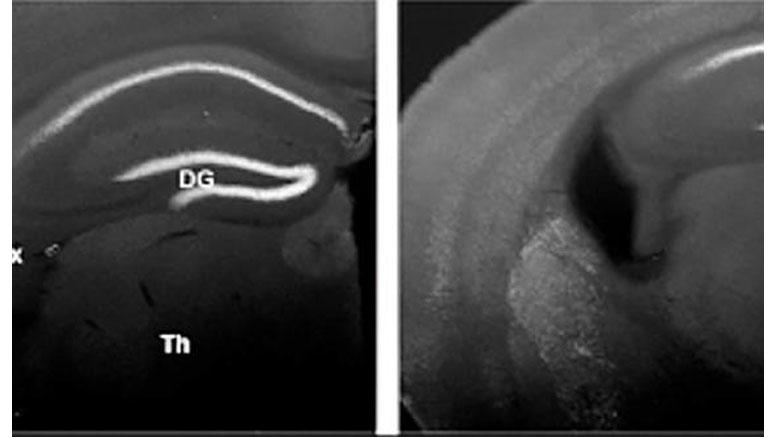
    The absence of two key genes dramatically shrinks the number of neural stem cells (right). Credit: Yale University

    A newly published study from Yale University identified two genes that are crucial to the creation of neurons in the brain region responsible for learning and memory.

    Two genes act as molecular midwives to the birth of neurons in adult mammals and when inactivated in mice cause symptoms of Fragile X Syndrome, a major cause of mental retardation, a new Yale University study has shown.

    In humans as well as mice, most neurons are created prior to birth and few new brain cells are produced as adults. The new study identified two genes that are crucial to the creation of neurons in the brain region responsible for learning and memory. When the two Pumilio genes — PUM1 and PUM2 — are knocked out in mice, few neural stem cells are created in this region, which becomes very small. The mice can no longer navigate mazes and exhibit the same pathology as humans with Fragile X Syndrome.

    The genes control whether RNA that has already been transcribed actually goes on to create proteins, a little studied step of gene regulation with major biological implications, said senior author Haifan Lin, the Eugene Higgins Professor of Cell Biology, and professor of genetics and of obstetrics, gynecology, and reproductive sciences as well as director of the Yale Stem Cell Center.

    Meng Zhang, a graduate student in the Lin lab, was the lead author of the study published on August 15 in Genes & Development.

    Reference: “Post-transcriptional regulation of mouse neurogenesis by Pumilio proteins” by Meng Zhang, Dong Chen, Jing Xia, Wenqi Han, Xiekui Cui, Nils Neuenkirchen, Gretchen Hermes, Nenad Sestan and Haifan Lin, 15 August 2017, Genes & Development.
    DOI: 10.1101/gad.298752.117

    Abstract: Despite extensive studies on mammalian neurogenesis, its post-transcriptional regulation remains under-explored. Here we report that neural-specific inactivation of two murine post-transcriptional regulators, Pumilio 1 (Pum1) and Pum2, severely reduced the number of neural stem cells (NSCs) in the postnatal dentate gyrus (DG), drastically increased perinatal apoptosis, altered DG cell composition, and impaired learning and memory. Consistently, the mutant DG neurospheres generated fewer NSCs with defects in proliferation, survival, and differentiation, supporting a major role of Pum1 and Pum2 in hippocampal neurogenesis and function. Cross-linking immunoprecipitation revealed that Pum1 and Pum2 bind to thousands of mRNAs, with at least 694 common targets in multiple neurogenic pathways. Depleting Pum1 and/or Pum2 did not change the abundance of most target mRNAs but up-regulated their proteins, indicating that Pum1 and Pum2 regulate the translation of their target mRNAs. Moreover, Pum1 and Pum2 display RNA-dependent interaction with fragile X mental retardation protein (FMRP) and bind to one another’s mRNA. This indicates that Pum proteins might form collaborative networks with FMRP and possibly other post-transcriptional regulators to regulate neurogenesis.

    Never miss a breakthrough: Join the SciTechDaily newsletter.
    Follow us on Google and Google News.

    Cell Biology Neurology Yale University
    Share. Facebook Twitter Pinterest LinkedIn Email Reddit

    Related Articles

    Laminin Alpha 5 is Crucial to Adolescent Brain Maturation

    Study Shows Lysosomes Greatly Accelerate Formation of Amyloid Plaques

    Key Process in Brain Development Identified

    Understanding How Cells Package Fat

    Neurologists Repair Neurons Associated With Traumatic Nerve Injury Pain

    GATA1 Plays a Role in the Loss of Connections Between Neurons and in Symptoms of Depression

    Optogenetics Regulates Metabolic Activity in the Membranes of Cells

    Researchers Identify BAD as Key Seizure-Suppressing Protein

    Yale Neurologists Discover the Source of Diabetic Neuropathy Pain

    Leave A Reply Cancel Reply

    • Facebook
    • Twitter
    • Pinterest
    • YouTube

    Don't Miss a Discovery

    Subscribe for the Latest in Science & Tech!

    Trending News

    Could Low Vitamin D Be Making Your Pain Worse?

    Scientists Discover Once-Weekly Workout That Melts Belly Fat Surprisingly Effectively

    Scientists Just Tested a Thruster Powerful Enough for Human Missions to Mars

    Doctors Say Your Ice Pack Might Be Making Injuries Worse

    Scientists Discover 43-Foot Sea Reptile Twice the Size of a Great White Shark

    Bees and Birds Are Drinking Alcohol From Flowers

    Scientists Discover How Obesity May Trigger Alzheimer’s Disease

    Scientists Confirm Alcohol Causes Widespread Health Damage

    Follow SciTechDaily
    • Facebook
    • Twitter
    • YouTube
    • Pinterest
    • Newsletter
    • RSS
    SciTech News
    • Biology News
    • Chemistry News
    • Earth News
    • Health News
    • Physics News
    • Science News
    • Space News
    • Technology News
    Recent Posts
    • Simple Family Routines May Be the Secret to a Smoother Start at School
    • Brain Study Overturns Long-Held Beliefs About How Humans Learn Speech
    • Ancient Goose Fossil Challenges Long-Held Theories About New Zealand Birds
    • A Tiny Bright-Blue Octopus Found in the Galápagos Is Completely New to Science
    • Scientists Stop Pancreatic Cancer Before It Starts in Landmark Preclinical Study
    Copyright © 1998 - 2026 SciTechDaily. All Rights Reserved.
    • Science News
    • About
    • Contact
    • Editorial Board
    • Privacy Policy
    • Terms of Use

    Type above and press Enter to search. Press Esc to cancel.