

Researchers found that the prefrontal cortex customizes its signals to the brain’s visual and motor systems, shaping perception based on arousal and movement. Two key regions balance each other to sharpen or suppress visual information as needed.
How Brain State and Behavior Shape What Mice See
Vision guides how animals behave, and new work from MIT neuroscientists shows that the reverse is also true: behavior and internal states influence how visual information is processed. In research published today (November 25) in Neuron, the team reports that in mice, specific circuits allow the brain’s executive hub, the prefrontal cortex, to send customized signals to areas involved in vision and movement. These messages help adjust how those regions operate based on conditions such as the mouse’s arousal level or whether it is actively moving.
“That’s the major conclusion of this paper: There are targeted projections for targeted impact,” said senior author Mriganka Sur, Paul and Lilah Newton Professor in The Picower Institute for Learning and Memory and MIT’s Department of Brain and Cognitive Sciences.
Exploring How the Prefrontal Cortex Communicates
Scientists have long suspected, including Sur’s colleague Earl K. Miller next door at MIT, that the prefrontal cortex influences how more posterior cortical areas handle information. Anatomical evidence has supported this view. The new study, led by postdoctoral researcher Sofie Ährlund-Richter in the Sur Lab, set out to determine whether the prefrontal cortex sends a single broad signal or instead tailors its output for different downstream targets. She also aimed to reexamine which specific neurons these signals reach and how this input affects each region’s function.
Distinct Prefrontal Regions Deliver Specialized Signals
Ährlund-Richter and Sur’s group identified several new insights. They found that two prefrontal areas of interest, the orbitofrontal cortex (ORB) and the anterior cingulate area (ACA), selectively transmit information about arousal and motion to two downstream targets, the primary visual cortex (VISp) and the primary motor cortex (MOp). These selective messages appear to serve different roles. For example, higher arousal levels caused ACA to encourage VISp to produce a more refined representation of visual information, while ORB contributed only when arousal became very high and then appeared to decrease the precision of the encoding. Ährlund-Richter suggests that as arousal rises, ACA may help the visual cortex focus on potentially meaningful details, while ORB may act to limit attention to distracting stimuli.
“These two PFC subregions are kind of balancing each other,” Ährlund-Richter said. “While one will enhance stimuli that might be more uncertain or more difficult to detect, the other one kind of dampens strong stimuli that might be irrelevant.”
Mapping Connections and Measuring Neural Activity
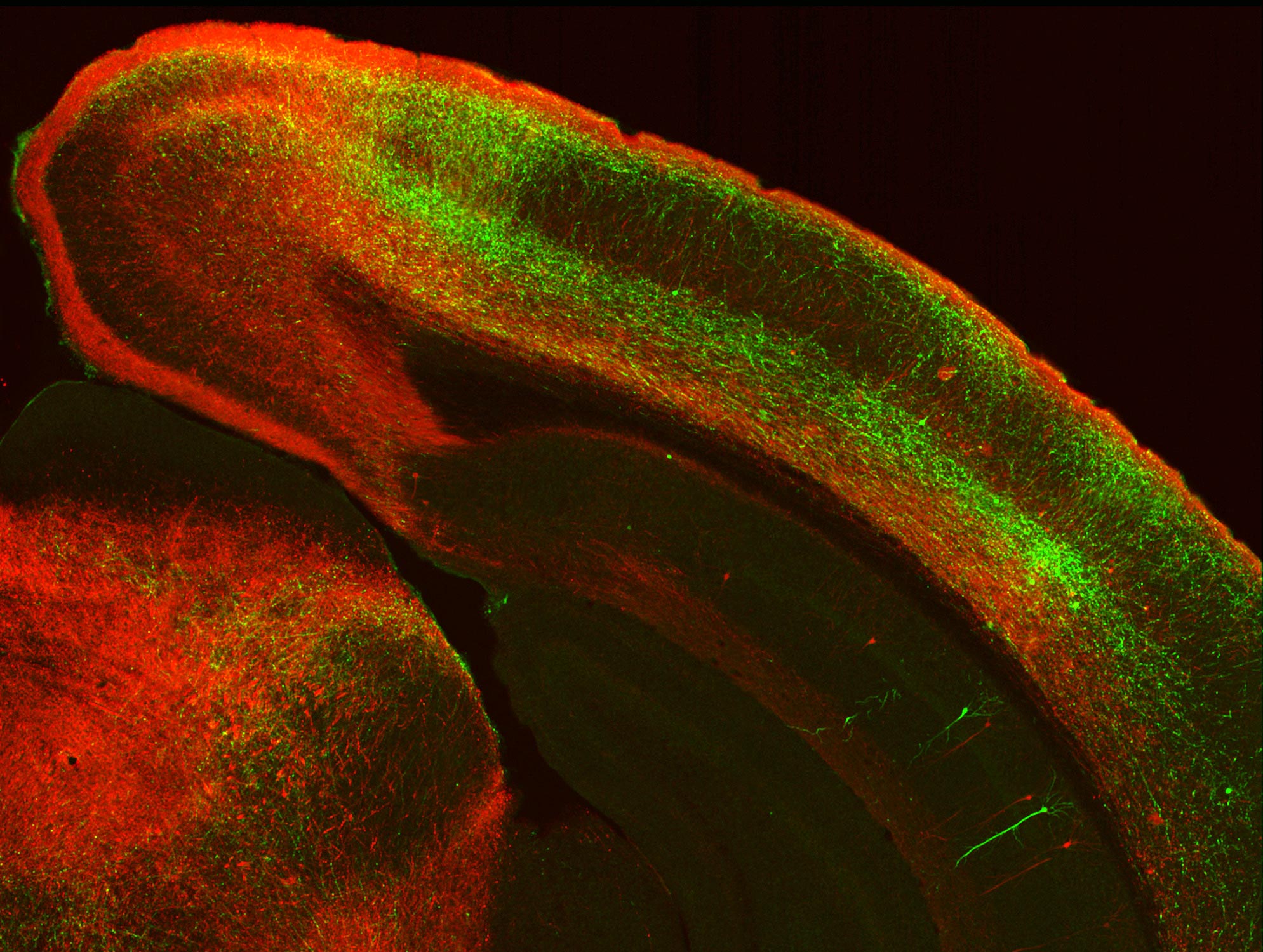
In the study, Ährlund-Richter used detailed anatomical tracing to chart how ACA and ORB connect with VISp and MOp. Additional experiments allowed mice to run on a wheel while viewing either structured images or naturalistic movie scenes presented at different contrast levels. At times, the mice received small air puffs that increased their arousal. Throughout these conditions, the researchers recorded activity in ACA, ORB, VISp and MOp. A key focus was monitoring the information carried by the neural projections (or “axons”) extending from the prefrontal cortex to the posterior areas.
The anatomical tracing confirmed that, similar to some prior findings, both ACA and ORB communicate with multiple cell types in their target regions rather than one specific class. Their connections, however, follow different spatial patterns. In VISp, for example, ACA communicated mainly with layer 6, while ORB targeted layer 5.
How Arousal and Movement Shape Neural Messages
When the team analyzed the content of the signals and the activity patterns, several trends emerged. ACA neurons transmitted more visual information than ORB neurons and responded more strongly to contrast changes. ACA activity also tracked with changes in arousal, whereas ORB showed sensitivity only when arousal exceeded a high threshold. When interacting with MOp, both prefrontal regions conveyed information about running speed, but their communications with VISp indicated only whether the mouse was moving or still. ACA and ORB also sent information about arousal and a small amount of visual detail to MOp.
To determine the functional consequences of this communication, the researchers occasionally blocked the pathways from ACA and ORB to VISp. This allowed them to observe how removing these inputs altered the activity of VISp neurons. Blocking the pathways revealed that ACA and ORB influenced visual encoding in distinct and opposing ways depending on the mouse’s movement and arousal level.
A Model of Highly Specialized Prefrontal Feedback
“Our data support a model of PFC feedback that is specialized at both the level of PFC subregions and their targets, enabling each region to selectively shape target-specific cortical activity rather than modulating it globally,” the authors wrote in Neuron.
Reference: “Distinct roles of prefrontal subregion feedback to the primary visual cortex across behavioral states” 25 November 2025, Neuron.
DOI: 10.1016/j.neuron.2025.10.037
In addition to Sur and Ährlund-Richter, the paper’s other authors are Yuma Osako, Kyle R. Jenks, Emma Odom, Haoyang Huang, and Don B. Arnold.
Funding for the study came from a Wenner-Gren foundations Postdoctoral Fellowship, the National Institutes of Health, and the Freedom Together Foundation.
Never miss a breakthrough: Join the SciTechDaily newsletter.
Follow us on Google and Google News.