
Close Menu
    Facebook X (Twitter) Instagram
    SciTechDaily
    • Biology
    • Chemistry
    • Earth
    • Health
    • Physics
    • Science
    • Space
    • Technology
    Facebook X (Twitter) Pinterest YouTube RSS
    SciTechDaily
    Home»Space»12 Billion-Year Old Supernova Discovered by Astronomers
    Space

    12 Billion-Year Old Supernova Discovered by Astronomers

    By SciTechDailyNovember 6, 2012No Comments2 Mins Read
    Facebook Twitter Pinterest Telegram LinkedIn WhatsApp Email Reddit
    Share
    Facebook Twitter LinkedIn Pinterest Telegram Email Reddit
    superluminous-supernova
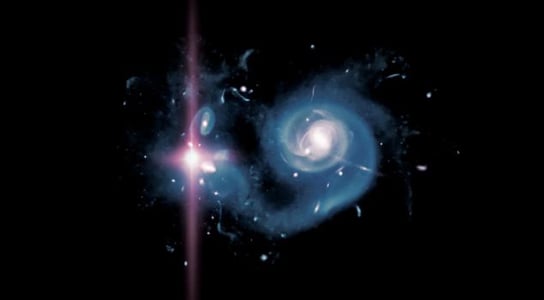
    Simulation of an early galaxy hosting a superluminous supernova. Credit: Adrian Malec and Marie Martig (Swinburne University)

    Astronomers have discovered a pair of superluminous supernovae, which are more than 10 billion years old. The Universe was only 3.75 billion years old back then. Of the pair, one is more remote and ranks as the most distant supernova ever discovered.

    Astronomers used two telescopes atop Mauna Kea in Hawaii to find these supernovae, and they were able to spot them only because of the extreme luminosity of the supernovae. The blasts might have signaled the death of stars 100 times as massive as Sol. Although such superluminous explosions have been spotted relatively nearby universe, they ought to be more common in the early universe, when there were more supermassive stars.
    superluminous-supernova-fermi
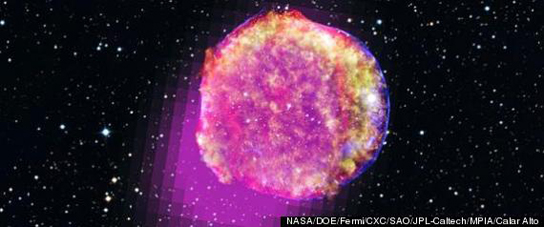
    Credit: NASA/Fermi

    The researchers published their findings in the journal Nature. Jeff Cooke, from the Swinburne University of Technology in Australia, and his colleagues made the discovery. The supernovae pair, which have been designated as SN 2213-1745 and SN 1000+0216, were identified from deep sky images taken at the 3.6-meter (12-foot) Canada-France-Hawaii telescope between 2003 and 2008.

    After the supernovae were identified, the researchers used the 10-meter Keck I telescope to make spectral measurements of the galaxies where the supernovae were discovered. SN 2213-1745 has a redshift of 2.05, implying that the supernova’s progenitor exploded 10.4 billion years ago. Its extreme brightness and slow fading match up with the expected properties of pair-instability supernova, when the death of a massive star is brought on by energetic gamma rays giving off pairs of matter and antimatter particles. The researchers estimate that this star may have been as massive as 250 suns.

    SN 1000+0216 lies at a redshift of 3.9, implying that it occurred some 12 billion years ago. The data on this supernova is too limited to determine the exact mechanism behind it.

    Reference: “Superluminous supernovae at redshifts of 2.05 and 3.90” by Jeff Cooke, Mark Sullivan, Avishay Gal-Yam, Elizabeth J. Barton, Raymond G. Carlberg, Emma V. Ryan-Weber, Chuck Horst, Yuuki Omori and C. Gonzalo Díaz, 31 October 2012, Nature.
    DOI: 10.1038/nature11521

    Never miss a breakthrough: Join the SciTechDaily newsletter.
    Follow us on Google and Google News.

    Astronomy Astrophysics Cosmology Popular Supernova
    Share. Facebook Twitter Pinterest LinkedIn Email Reddit

    Related Articles

    Twin Supernovae Open Up New Possibilities for Precision Cosmology

    Hypernova Observations Reveal the Death of the Massive Stars

    Scientists Find Evidence of ‘Orphan’ Gamma-Ray Bursts

    “Living Dead” Star Is Like Nothing Ever Seen Before

    New ALMA Observations Show Stellar Explosion in Unprecedented Detail

    Cloud of Hydrogen and Helium Plunging Toward the Galactic Center

    Astronomers Detect X-rays From the Remains of Supernova SN 1957D

    Links Between Core Collapse Supernovae and Star Formation Established

    The Bolshoi Simulation: Boxing the Universe

    Leave A Reply Cancel Reply

    • Facebook
    • Twitter
    • Pinterest
    • YouTube

    Don't Miss a Discovery

    Subscribe for the Latest in Science & Tech!

    Trending News

    Largest-Ever Study Finds Medicinal Cannabis Ineffective for Anxiety, Depression, PTSD

    250-Million-Year-Old Egg Solves One of Evolution’s Biggest Mysteries

    Living With Roommates Might Be Changing Your Gut Microbiome Without You Knowing

    Century-Old Cleaning Chemical Linked to 500% Increased Risk of Parkinson’s Disease

    What if Your Memories Never Happened? Physicists Take a New Look at the Boltzmann Brain Paradox

    One of the Universe’s Largest Stars May Be Getting Ready To Explode

    Scientists Discover Enzyme That Could Supercharge Ozempic-Like Weight Loss Drugs

    Popular Sweetener Linked to DNA Damage – “It’s Something You Should Not Be Eating”

    Follow SciTechDaily
    • Facebook
    • Twitter
    • YouTube
    • Pinterest
    • Newsletter
    • RSS
    SciTech News
    • Biology News
    • Chemistry News
    • Earth News
    • Health News
    • Physics News
    • Science News
    • Space News
    • Technology News
    Recent Posts
    • Scientists Prove There Are Just Six Degrees of Separation in a Social Network
    • Bee Bacteria Could Fix a Major Flaw in Plant-Based Milk
    • Scientists Discover a Surprising Way To Make Bread Healthier and More Nutritious
    • Natural Compounds Boost Bone Implant Success While Killing Bacteria and Cancer Cells
    • After 60 Years, Scientists Uncover Unexpected Brain Effects of Popular Diabetes Drug Metformin
    Copyright © 1998 - 2026 SciTechDaily. All Rights Reserved.
    • Science News
    • About
    • Contact
    • Editorial Board
    • Privacy Policy
    • Terms of Use

    Type above and press Enter to search. Press Esc to cancel.