
Close Menu
    Facebook X (Twitter) Instagram
    SciTechDaily
    • Biology
    • Chemistry
    • Earth
    • Health
    • Physics
    • Science
    • Space
    • Technology
    Facebook X (Twitter) Pinterest YouTube RSS
    SciTechDaily
    Home»Biology»Orangutans Learn Tool Use Through Social Observation
    Biology

    Orangutans Learn Tool Use Through Social Observation

    By SciTechDailyDecember 27, 2012No Comments2 Mins Read
    Facebook Twitter Pinterest Telegram LinkedIn WhatsApp Email Reddit
    Share
    Facebook Twitter LinkedIn Pinterest Telegram Email Reddit
    Orangutans Learn Using Tools Through Social Observation
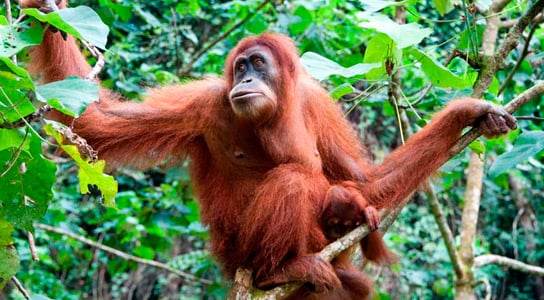
    Sumatran orangutans may form ideas about tools long before using them. Credit: iStockphoto/Thinkstock

    A new study concludes that even very young Sumatran orangutans (Pongo abelii) start forming ideas about their world, and how and when to use certain tools. Ape cultural traditions might not be very different from the cultural traditions of humans.

    The scientists published their findings in the journal Current Biology. Orangutans have behavioral traditions that vary by regions. Orangutans in one area might use tools and others in another don’t. On the island of Sumatra in western Indonesia, orangutans by age 6 or 7 use sticks to probe logs for honey in the swampy regions west of the Alas River. Researchers have never observed this behavior in orangutans in coastal areas east of the river.

    Experts think that social learning is the key difference. The ape figures out how to honey-dip by watching others. But that isn’t always easy to prove and some researchers still believe that wild apes could be influenced by their environment more than by social learning.

    Deforestation has caused large numbers of orangutan orphans, many of whom come from both sides of the river. They wind up at the Batu Mbelin shelter in northern Sumatra. The team gave the orangutans two stick-based challenges. They involved raking food into their cages and dipping for honey. Apes from both sides of the river picked up the raking behavior quickly. This indicates that all the animals could understand using sticks as tools. Nine of the 13 west-side apes knew how to honey-dip while only two of the 10 east-side apes did. The west-side apes were just 4 years old on average, which is too young to have begun honey-dipping on their own in the wild. The researchers believe that this learned behavior came from observing their elders performing this task.

    The researchers call such mental representations of stick use cultural ideas. The behavioral differences among apes are closer to the ones between humans, which also often stem from ideas. The study isn’t conclusive about when orangutans start developing stick skills in the wild.

    Reference: “Sumatran Orangutans Differ in Their Cultural Knowledge but Not in Their Cognitive Abilities” by Thibaud Gruber, Ian Singleton and Carel van Schaik, 8 November 2012, Current Biology.
    DOI: 10.1016/j.cub.2012.09.041

    Never miss a breakthrough: Join the SciTechDaily newsletter.
    Follow us on Google and Google News.

    Behavioral Science Ecology Primatology
    Share. Facebook Twitter Pinterest LinkedIn Email Reddit

    Related Articles

    Birdsongs Elicit “Emotional” Response From Birds

    Darcin in Mice Urine Attracts Other Mice

    Homosexual Behavior Among Fish Increases Attractiveness to Females

    European Catfish Learn to Catch Pigeons

    Urban Birds Use Cigarette Butts to Get Rid of Pests

    Eurasian Jays Aware When Others Are Listening

    Humans Are a Greater Disturbance to Elk Than Natural Predators

    Survey Shows Great Apes Also Have Mid-Life Crisis

    Bonobo Great Apes Are Domesticating Themselves

    Leave A Reply Cancel Reply

    • Facebook
    • Twitter
    • Pinterest
    • YouTube

    Don't Miss a Discovery

    Subscribe for the Latest in Science & Tech!

    Trending News

    Scientists Recreate a Nuclear Fireball and Uncover Fallout’s Hidden Chemistry

    These Tiny Gut Particles Could Be Accelerating Aging Throughout the Body

    Doctors Changed One Thing and Weight Gain Stopped

    Magnetic Fields May Solve a Longstanding Binary Star Mystery

    The Probiotic Breakthrough for Natural Anxiety Relief and Better Mental Health

    Animal vs. Plant Protein: Scientists Found a Surprising Nutritional Difference

    According to Scientists, This Simple Dietary Change Is Linked to Lower Depression Scores

    Researchers Discover a Hidden Vitamin D Problem That Persists Year-Round

    Follow SciTechDaily
    • Facebook
    • Twitter
    • YouTube
    • Pinterest
    • Newsletter
    • RSS
    SciTech News
    • Biology News
    • Chemistry News
    • Earth News
    • Health News
    • Physics News
    • Science News
    • Space News
    • Technology News
    Recent Posts
    • Scientists Uncover Why Walking Gets Slower and More Exhausting As We Age
    • 24 Hours Without Sleep Changes Your Saliva in Measurable Ways
    • A Major Update Just Hit Cholesterol Guidelines – Here’s What Every Adult Needs To Know
    • Scientists Tracked 4,500 Animals During COVID – What They Discovered Was Surprising
    • Hidden Phase of Matter Finally Captured After Decades of Predictions
    Copyright © 1998 - 2026 SciTechDaily. All Rights Reserved.
    • Science News
    • About
    • Contact
    • Editorial Board
    • Privacy Policy
    • Terms of Use

    Type above and press Enter to search. Press Esc to cancel.