
Close Menu
    Facebook X (Twitter) Instagram
    SciTechDaily
    • Biology
    • Chemistry
    • Earth
    • Health
    • Physics
    • Science
    • Space
    • Technology
    Facebook X (Twitter) Pinterest YouTube RSS
    SciTechDaily
    Home»Space»Astronomers Study Textured Dust Storms on Mars
    Space

    Astronomers Study Textured Dust Storms on Mars

    By Harvard-Smithsonian Center for AstrophysicsAugust 21, 2015No Comments3 Mins Read
    Facebook Twitter Pinterest Telegram LinkedIn WhatsApp Email Reddit
    Share
    Facebook Twitter LinkedIn Pinterest Telegram Email Reddit
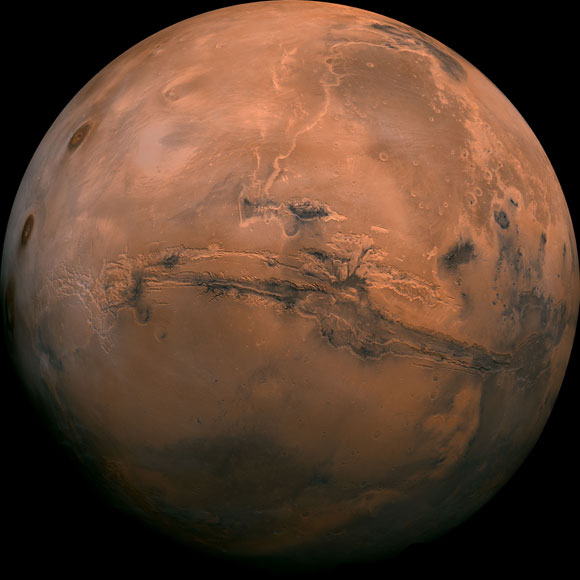
    Dust Storms on Mars
    Dust storms on Mars.

    A new analysis of textured dust storms from the Harvard-Smithsonian Center for Astrophysics examines data over eight years of MGS observations and finds that such storms account for about half of all the dust in the Martian atmosphere.

    In 1870 astronomers first noted the presence of yellow clouds on the surface of Mars and suggested they were caused by windblown dust. Today, dust storms on Mars are well known and those that display visible structures are called “textured dust storms.” Textured dust storms actively lift dust into the atmosphere, and can result from a range of meteorological effects including strong winds. Besides obscuring views of the Martian surface, dust in these storms affects atmospheric heating, and accumulation of dust on the surface can alter the surface albedo (reflectivity). These dust storms, despite being studied for more than a century, remain rather mysterious. It is not understood, for example, how textured storms are distributed over the surface of the planet, when their frequency peaks, or how much dust is actually swept up.
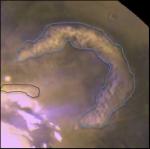
    Mars Orbiter Views Dust Storms on Mars
    An image of a Martian textured dust storm taken with the Mars Global Surveyor (MGS) mission. The colored contours indicate the confidence level of the identifications. Credit: NASA/MGS; Guzewich et al. 2015

    CfA astronomer Huiqun Wang and his three collaborators used data from the Mars Global Surveyor (MGS) mission and its suite of instruments to study textured dust storms. MGS was launched in 1999 and has been observing Mars almost continuously since then; subsequent missions like the Mars Reconnaissance Orbiter (launched in 2005) added to the database. The scientists examined a complete record of MGS daily global maps to study the climatology of dust storms that exhibit non-smooth textures, and relate these observations to the surface dust distribution and atmospheric effects.

    The astronomers found that textured dust storms are seasonally clustered: they occur mostly at the equinoxes (the “spring” and “fall” seasons of Mars) and not the solstices (the “summer” and “winter” seasons). They also occur most frequently in the north-polar region above mid-latitudes. They are able to quantify the relative importance of textured dust storms to dust in the atmosphere, and find that they can account for about half, the rest coming from local “dust devils” or other small-scale disturbances. Not least, they report that the dust in textured dust storms is mixed globally on a timescale of weeks. The new research, which analyzed eight years of spacecraft observations, uses the most complete set of data to date to obtain the most recent understanding of Martian dust storms.

    Reference: “Mars Orbiter Camera climatology of textured dust storms” by Scott D. Guzewich, Anthony D. Toigo, Laura Kulowski and Huiqun Wang, 23 June 2015, Icarus.
    DOI: 10.1016/j.icarus.2015.06.023

    Never miss a breakthrough: Join the SciTechDaily newsletter.
    Follow us on Google and Google News.

    Astronomy Climatology Harvard-Smithsonian Center for Astrophysics Mars Mars Global Surveyor Mission Planetary Science
    Share. Facebook Twitter Pinterest LinkedIn Email Reddit

    Related Articles

    Martian Dust Storms Can Regenerate and Sustain Themselves

    Mars Global Surveyor Observes Textured Dust Storms

    NASA Spacecraft Map Gravity on Mars, Give Best View Yet Inside Mars

    Curiosity’s ChemCam Laser Yields Good Results

    NASA’s Curiosity Readies for First Drive on Mars

    Color HiRISE Image of Curiosity Rover on Mars

    First 360-Degree Color Panorama From NASA’s Curiosity Mars Rover

    A Connection Between Volatiles in the Subsurface of Mars and the Impact Process

    Near Miss Asteroid – An Opportunity To Test a Rapid Response Program

    Leave A Reply Cancel Reply

    • Facebook
    • Twitter
    • Pinterest
    • YouTube

    Don't Miss a Discovery

    Subscribe for the Latest in Science & Tech!

    Trending News

    Popular Sugar-Free Sweetener Linked to Liver Disease, Study Warns

    What Is Hantavirus? The Deadly Disease Raising Alarm Worldwide

    Scientists Just Discovered How the Universe Builds Monster Black Holes

    Scientists Unveil New Treatment Strategy That Could Outsmart Cancer

    A Simple Vitamin May Hold the Key to Treating Rare Genetic Diseases

    Scientists Think the Real Fountain of Youth May Be Hiding in Your Gut

    Ravens Don’t Follow Wolves, They Predict Them

    This Common Knee Surgery May Be Doing More Harm Than Good

    Follow SciTechDaily
    • Facebook
    • Twitter
    • YouTube
    • Pinterest
    • Newsletter
    • RSS
    SciTech News
    • Biology News
    • Chemistry News
    • Earth News
    • Health News
    • Physics News
    • Science News
    • Space News
    • Technology News
    Recent Posts
    • A Strange Quantum Effect May Explain One of Biology’s Greatest Mysteries
    • NASA’s Psyche Spacecraft Is About To Fly Shockingly Close to Mars
    • This Mars Rock Refused To Let Go of NASA’s Curiosity Rover
    • James Webb Telescope Reveals the Universe’s Hidden Cosmic Web in Stunning Detail
    • Scientists Build a Living AI Device Using Real Brain Cells
    Copyright © 1998 - 2026 SciTechDaily. All Rights Reserved.
    • Science News
    • About
    • Contact
    • Editorial Board
    • Privacy Policy
    • Terms of Use

    Type above and press Enter to search. Press Esc to cancel.