
Scientists have used slight orbital fluctuations to map the gravity field of Mars, providing fresh insights into its crustal thickness, deep interior, and seasonal variations of dry ice at the poles. The new gravity map will also help to put future spacecraft into orbit more precisely, ensuring that the Mars fleet continues to return a massive trove of data.
A new map of Mars’ gravity made with three NASA spacecraft is the most detailed to date, providing a revealing glimpse into the hidden interior of the Red Planet.
“Gravity maps allow us to see inside a planet, just as a doctor uses an X-ray to see inside a patient,” said Antonio Genova of the Massachusetts Institute of Technology (MIT), Cambridge, Massachusetts. “The new gravity map will be helpful for future Mars exploration because better knowledge of the planet’s gravity anomalies helps mission controllers insert spacecraft more precisely into orbit about Mars. Furthermore, the improved resolution of our gravity map will help us understand the still-mysterious formation of specific regions of the planet.” Genova, who is affiliated with MIT but is located at NASA’s Goddard Space Flight Center in Greenbelt, Maryland, is the lead author of a paper on this research published online in the journal Icarus.
Scientists have used small fluctuations in the orbits of three NASA spacecraft to map the gravity field of Mars. Credit: NASA/GSFC/Scientific Visualization Studio
The improved resolution of the new gravity map suggests a new explanation for how some features formed across the boundary that divides the relatively smooth northern lowlands from heavily cratered southern highlands. Also, the team confirmed that Mars has a liquid outer core of molten rock by analyzing tides in the Martian crust and mantle caused by the gravitational pull of the sun and the two moons of Mars. Finally, by observing how Mars’ gravity changed over 11 years – the period of an entire cycle of solar activity — the team inferred the massive amount of carbon dioxide that freezes out of the atmosphere onto a Martian polar ice cap when it experiences winter. They also observed how that mass moves between the south pole and the north pole with the change of season in each hemisphere.
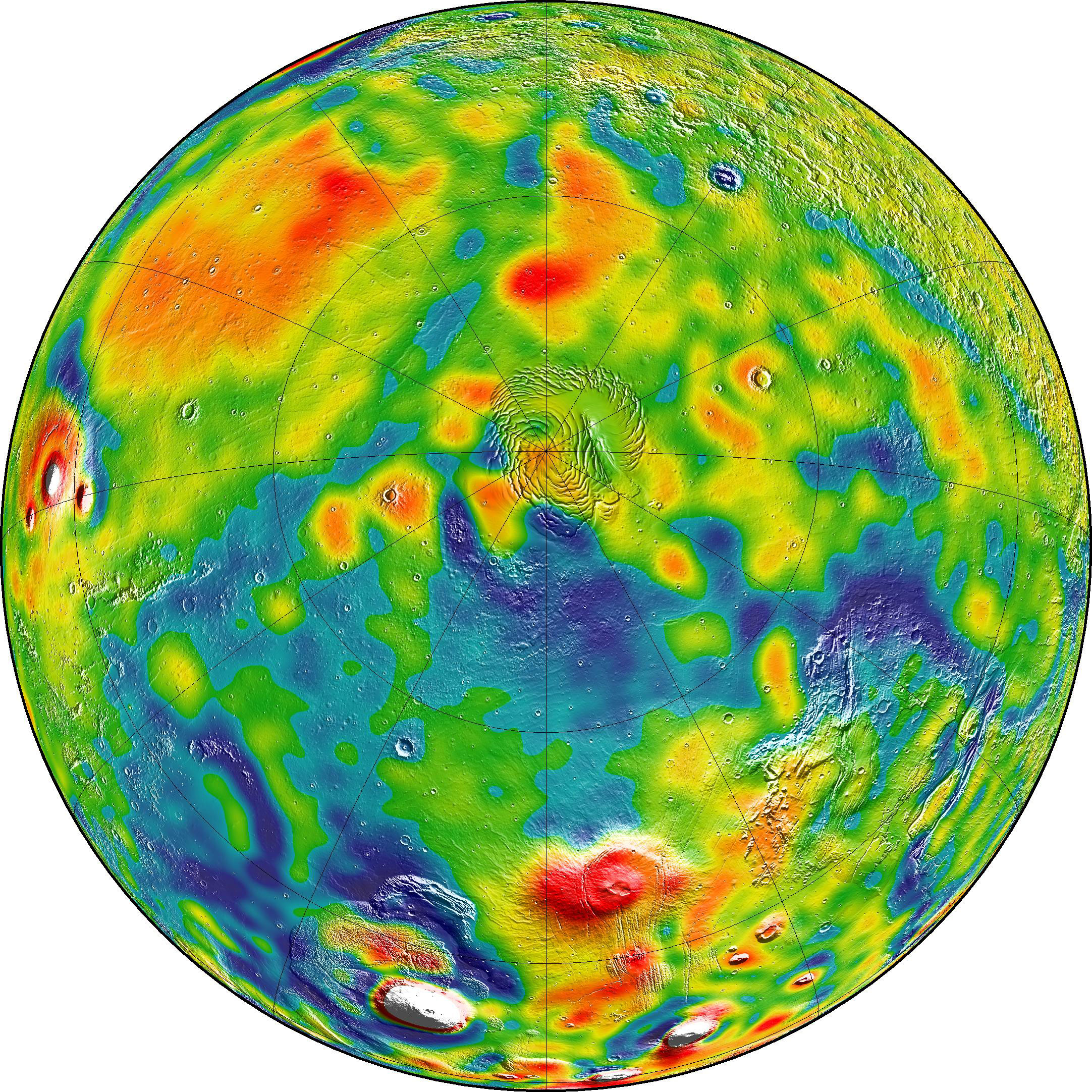
The map was derived using Doppler and range tracking data collected by NASA’s Deep Space Network from three NASA spacecraft in orbit around Mars: Mars Global Surveyor (MGS), Mars Odyssey (ODY), and the Mars Reconnaissance Orbiter (MRO). Like all planets, Mars is lumpy, which causes the gravitational pull felt by spacecraft in orbit around it to change. For example, the pull will be a bit stronger over a mountain, and slightly weaker over a canyon.
Slight differences in Mars’ gravity changed the trajectory of the NASA spacecraft orbiting the planet, which altered the signal being sent from the spacecraft to the Deep Space Network. These small fluctuations in the orbital data were used to build a map of the Martian gravity field.
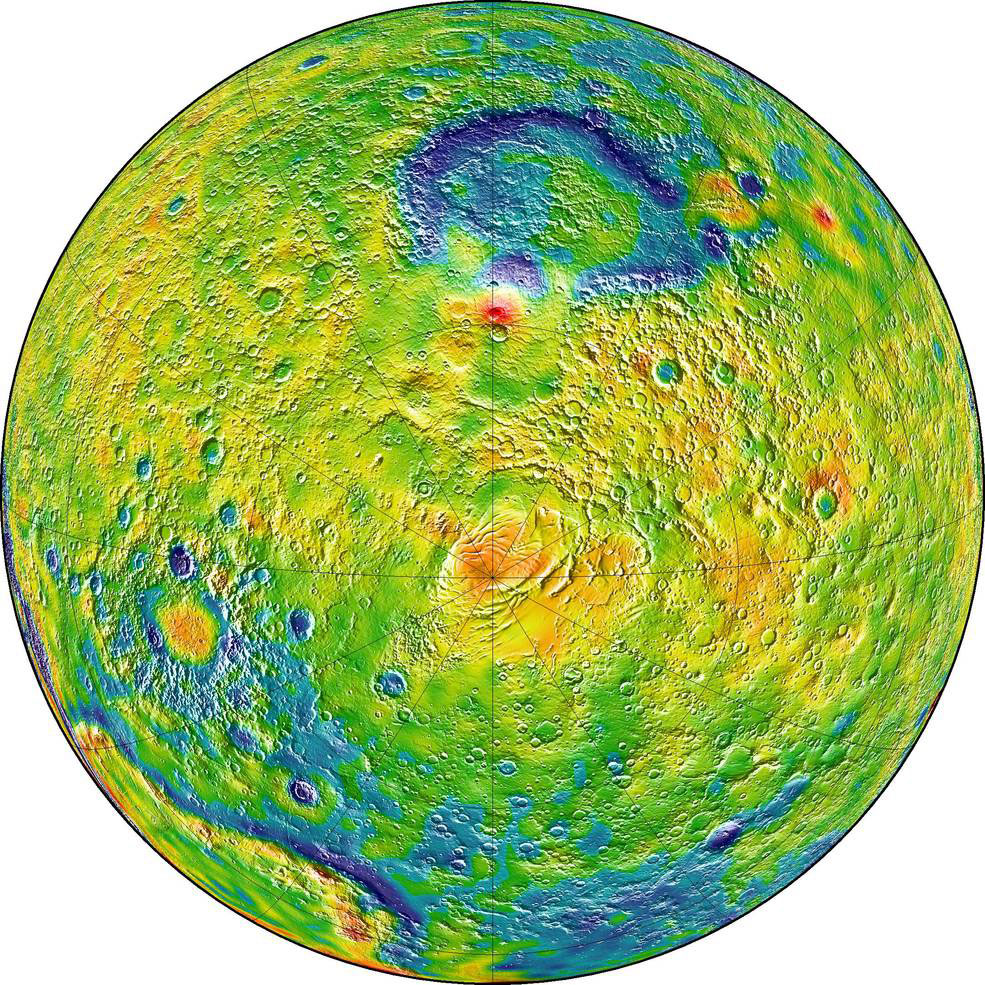
The gravity field was recovered using about 16 years of data that were continuously collected in orbit around Mars. However, orbital changes from uneven gravity are tiny, and other forces that can perturb the motion of the spacecraft had to be carefully accounted for, such as the force of sunlight on the spacecraft’s solar panels and drag from the Red Planet’s thin upper atmosphere. It took two years of analysis and computer modeling to remove the motion not caused by gravity.
“With this new map, we’ve been able to see gravity anomalies as small as about 100 kilometers (about 62 miles) across, and we’ve determined the crustal thickness of Mars with a resolution of around 120 kilometers (almost 75 miles),” said Genova. “The better resolution of the new map helps interpret how the crust of the planet changed over Mars’ history in many regions.”
For example, an area of lower gravity between Acidalia Planitia and Tempe Terra was interpreted before as a system of buried channels that delivered water and sediments from Mars’ southern highlands into the northern lowlands billions of years ago when the Martian climate was wetter than it is today. The new map reveals that this low gravity anomaly is definitely larger and follows the boundary between the highlands and the lowlands. This system of gravity troughs is unlikely to be only due to buried channels because in places the region is elevated above the surrounding plains. The new gravity map shows that some of these features run perpendicular to the local topography slope, against what would have been the natural downhill flow of water.
An alternative explanation is that this anomaly may be a consequence of a flexure or bending of the lithosphere — the strong, outermost layer of the planet — due to the formation of the Tharsis region. Tharsis is a volcanic plateau on Mars thousands of miles across with the largest volcanoes in the solar system. As the Tharsis volcanoes grew, the surrounding lithosphere buckled under their immense weight.
The new gravity field also allowed the team to confirm indications from previous gravity solutions that Mars has a liquid outer core of molten rock. The new gravity solution improved the measurement of the Martian tides, which will be used by geophysicists to improve the model of Mars’ interior.
Changes in Martian gravity over time have been previously measured using the MGS and ODY missions to monitor the polar ice caps. For the first time, the team used MRO data to continue monitoring their mass. The team has determined that when one hemisphere experiences winter, approximately 3 trillion to 4 trillion tons of carbon dioxide freezes out of the atmosphere onto the northern and southern polar caps, respectively. This is about 12 to 16 percent of the mass of the entire Martian atmosphere. NASA’s Viking missions first observed this massive seasonal precipitation of carbon dioxide. The new observation confirms numerical predictions from the Mars Global Reference Atmospheric Model – 2010.
Reference: “Seasonal and static gravity field of Mars from MGS, Mars Odyssey and MRO radio science” by Antonio Genova, Sander Goossens, Frank G. Lemoine, Erwan Mazarico, Gregory A. Neumann, David E. Smith and Maria T. Zuber, 1 July 2016, Icarus.
DOI: 10.1016/j.icarus.2016.02.050
The research was funded by grants from NASA’s Mars Reconnaissance Orbiter mission and NASA’s Mars Data Analysis Program.
Never miss a breakthrough: Join the SciTechDaily newsletter.
Follow us on Google and Google News.