
A new study systematically measures the number of neurons in the brains of birds, revealing that they have significantly more neurons packed into their small brains than are stuffed into mammalian and even primate brains of the same mass.
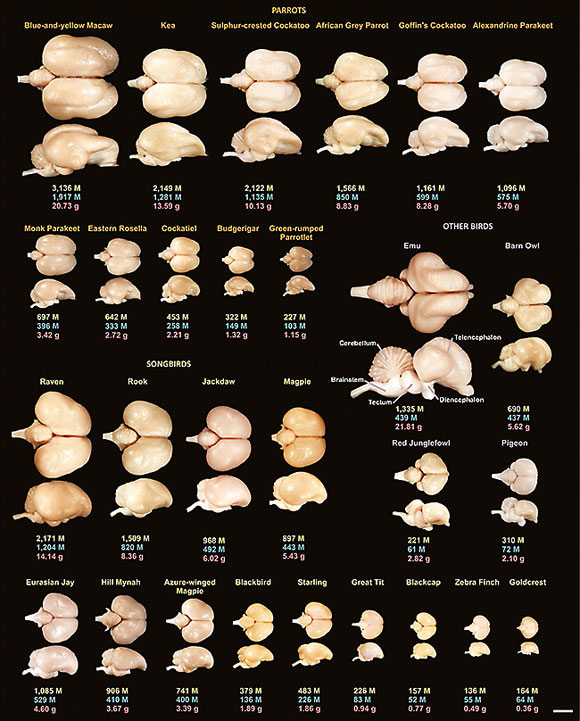
The macaw has a brain the size of an unshelled walnut, while the macaque monkey has a brain about the size of a lemon. Nevertheless, the macaw has more neurons in its forebrain – the portion of the brain associated with intelligent behavior – than the macaque.
That is one of the surprising results of the first study to systematically measure the number of neurons in the brains of more than two dozen species of birds ranging in size from the tiny zebra finch to the six-foot-tall emu, which found that they consistently have more neurons packed into their small brains than are stuffed into mammalian or even primate brains of the same mass.
The study results were published online in a paper titled “Birds have primate-like numbers of neurons in the forebrain” in the Proceedings of the National Academy of Sciences early edition on the week of June 13.
“For a long time having a ‘bird brain’ was considered to be a bad thing: Now it turns out that it should be a compliment,” said Vanderbilt University neuroscientist Suzana Herculano-Houzel, senior author of the paper with Pavel Němec at the Charles University in Prague.
The study provides a straightforward answer to a puzzle that comparative neuroanatomists have been wrestling with for more than a decade: how can birds with their small brains perform complicated cognitive behaviors?
The conundrum was created by a series of studies beginning in the previous decade that directly compared the cognitive abilities of parrots and crows with those of primates. The studies found that the birds could manufacture and use tools, use insight to solve problems, make inferences about cause-effect relationships, recognize themselves in a mirror, and plan for future needs, among other cognitive skills previously considered the exclusive domain of primates.
Scientists were left with a generally unsatisfactory fallback position: Avian brains must simply be wired in a completely different fashion from primate brains. Two years ago, even this hypothesis was knocked down by a detailed study of pigeon brains, which concluded that they are, in fact, organized along quite similar lines to those of primates.
The new study provides a more plausible explanation: Birds can perform these complex behaviors because birds’ forebrains contain a lot more neurons than anyone had previously thought – as many as in mid-sized primates.
“We found that birds, especially songbirds and parrots, have surprisingly large numbers of neurons in their pallium: the part of the brain that corresponds to the cerebral cortex, which supports higher cognition functions such as planning for the future or finding patterns. That explains why they exhibit levels of cognition at least as complex as primates,” said Herculano-Houzel, who recently joined the Vanderbilt psychology department.
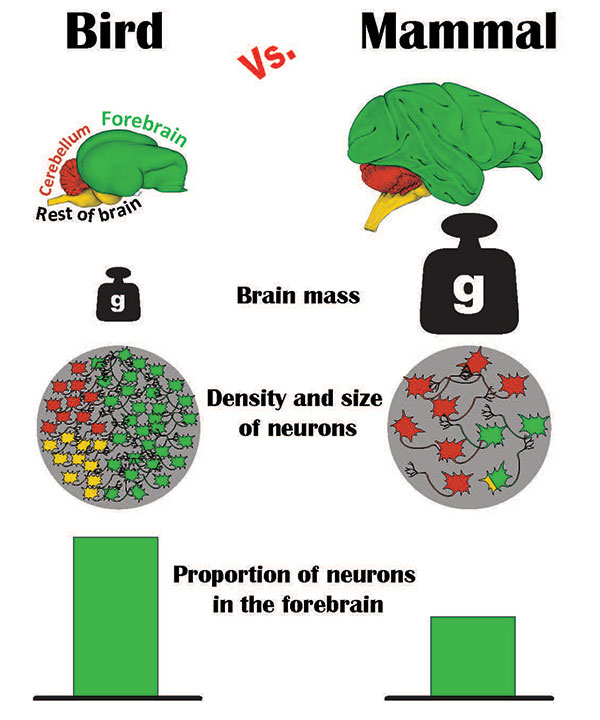
That is possible because the neurons in avian brains are much smaller and more densely packed than those in mammalian brains, the study found. Parrot and songbird brains, for example, contain about twice as many neurons as primate brains of the same mass and two to four times as many neurons as equivalent rodent brains.
Not only are neurons packed into the brains of parrots and crows at a much higher density than in primate brains, but the proportion of neurons in the forebrain is also significantly higher, the study found.
“In designing brains, nature has two parameters it can play with: the size and number of neurons and the distribution of neurons across different brain centers,” said Herculano-Houzel, “and in birds we find that nature has used both of them.”
Reference: “Birds have primate-like numbers of neurons in the forebrain” by Seweryn Olkowicz, Martin Kocourek, Radek K. Lučan, Michal Porteš, W. Tecumseh Fitch, Suzana Herculano-Houzel and Pavel Němec, 13 June 2016, PNAS.
DOI: 10.1073/pnas.1517131113
Never miss a breakthrough: Join the SciTechDaily newsletter.
Follow us on Google and Google News.
1 Comment
… one would ask if the number of neurons is only thing…