
Close Menu
    Facebook X (Twitter) Instagram
    SciTechDaily
    • Biology
    • Chemistry
    • Earth
    • Health
    • Physics
    • Science
    • Space
    • Technology
    Facebook X (Twitter) Pinterest YouTube RSS
    SciTechDaily
    Home»Technology»DARPA’s Legged Squad Support System (LS3) To Ease Physical Load on Troops
    Technology

    DARPA’s Legged Squad Support System (LS3) To Ease Physical Load on Troops

    By DARPAFebruary 8, 2012No Comments3 Mins Read
    Facebook Twitter Pinterest Telegram LinkedIn WhatsApp Email Reddit
    Share
    Facebook Twitter LinkedIn Pinterest Telegram Email Reddit
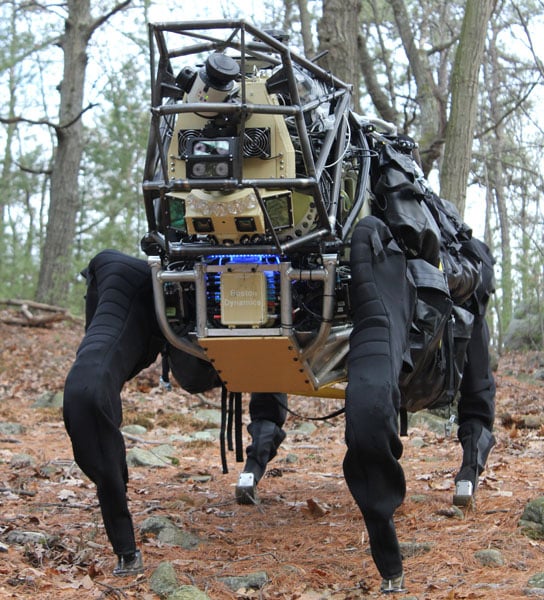
    DARPA prototype LS3 robotic pack mule
    Prototype robotic “pack mule” stands up, lies down, and follows the leader carrying 400 lbs. of squad’s gear. Credit: DARPA

    To help carry gear, DARPA is continuing research into developing a highly mobile, semi-autonomous legged robot to integrate with a squad of Marines or Soldiers. As seen in the video, a recent prototype underwent a series of outdoor tests and DARPA plans to continue refinements over the next 18 months.

    Today’s dismounted warfighter can be saddled with more than 100 pounds of gear, resulting in physical strain, fatigue, and degraded performance. Reducing the load on dismounted warfighters has become a major point of emphasis for defense research and development, because the increasing weight of individual equipment has a negative impact on warfighter readiness. The Army has identified physical overburden as one of its top five science and technology challenges. To help alleviate physical weight on troops, DARPA is developing a highly mobile, semi-autonomous legged robot, the Legged Squad Support System (LS3), to integrate with a squad of Marines or Soldiers.

    Recently the LS3 prototype underwent its first outdoor exercise, demonstrating the ability to follow a person using its “eyes”—sensors that allow the robot to distinguish between trees, rocks, terrain obstacles, and people. Over the course of the next 18 months, DARPA plans to complete development of and refine key capabilities to ensure LS3 is able to support dismounted squads of warfighters.

    Features to be tested and validated include the ability to carry 400 lb (180 kg) on a 20-mile (32-kilometer) trek in 24 hours without being refueled, and refinement of LS3’s vision sensors to track a specific individual or object, observe obstacles in its path, and to autonomously make course corrections as needed. Also planned is the addition of “hearing” technology, enabling squad members to speak commands to LS3 such as “stop,” “sit” or “come here.” The robot also serves as a mobile auxiliary power source— troops may recharge batteries for radios and handheld devices while on patrol.

    DARPA seeks to demonstrate that an LS3 can carry a considerable load from dismounted squad members, follow them through rugged terrain and interact with them in a natural way, similar to the way a trained animal and its handler interact.

    “If successful, this could provide real value to a squad while addressing the military’s concern for unburdening troops,” said Army Lt. Col. Joe Hitt, DARPA program manager. “LS3 seeks to have the responsiveness of a trained animal and the carrying capacity of a mule.”

    The 18-month platform-refinement test cycle, with Marine and Army involvement, kicks off this summer. The tests culminate in a planned capstone exercise where LS3 will embed with Marines conducting field exercises.

    LS3 is based on mobility technology advanced by DARPA’s Big Dog technology demonstrator, as well other DARPA robotics programs which developed the perception technology for LS3’s “eyes” and planned “ears.”

    The DARPA LS3 performer is Boston Dynamics of Waltham, Massachusetts.

    Never miss a breakthrough: Join the SciTechDaily newsletter.
    Follow us on Google and Google News.

    DARPA Robotics
    Share. Facebook Twitter Pinterest LinkedIn Email Reddit

    Related Articles

    One Giant Leap for MIT’s Robotic Mini Cheetah

    DARPA Underground Autonomous Robot Navigation Challenge

    Ape-Like RoboSimian Robot in Development

    DARPA’s New Pet-Proto Robot Navigates Obstacles

    Robotic Tentacles Have a Soft Enough Touch to Pick Up Flowers

    Boston Dynamics Robotic Cheetah Clocked At 28.3 MPH

    DARPA & Harvard’s Soft, Self-Camouflaging Robot

    “Cheetah” Sets Legged Robot Land Speed Record

    Elastomeric “Soft” Robots Running on Pneumatic Actuators

    Leave A Reply Cancel Reply

    • Facebook
    • Twitter
    • Pinterest
    • YouTube

    Don't Miss a Discovery

    Subscribe for the Latest in Science & Tech!

    Trending News

    Scientists Discover How Coffee Impacts Memory, Mood, and Gut Health

    Why Did the Neanderthals Disappear? Scientists Reveal Humans Had a Hidden Advantage

    Physicists Propose Strange Experiment Where Time Goes Quantum

    Magnesium Magic: New Drug Melts Fat Even on a High-Fat, High-Sugar Diet

    Weight-Loss Drugs Like Ozempic May Come With an Unexpected Cost

    Mezcal “Worm” in a Bottle Mystery: DNA Testing Reveals a Surprise

    New Research Reveals That Your Morning Coffee Activates an Ancient Longevity Switch

    This Is What Makes You Irresistible to Mosquitoes

    Follow SciTechDaily
    • Facebook
    • Twitter
    • YouTube
    • Pinterest
    • Newsletter
    • RSS
    SciTech News
    • Biology News
    • Chemistry News
    • Earth News
    • Health News
    • Physics News
    • Science News
    • Space News
    • Technology News
    Recent Posts
    • Harvard Scientists Reveal Secret Structure Behind How You Smell
    • Scientists Just Discovered the Hidden Trick That Keeps Your Cells Alive
    • This Simple Movement Could Be Secretly Cleaning Your Brain
    • Male Birth Control Breakthrough: Scientists Find Way To Turn Sperm Production Off and Back On
    • A Common Vitamin Could Hold the Key to Treating Fatty Liver Disease
    Copyright © 1998 - 2026 SciTechDaily. All Rights Reserved.
    • Science News
    • About
    • Contact
    • Editorial Board
    • Privacy Policy
    • Terms of Use

    Type above and press Enter to search. Press Esc to cancel.