
Close Menu
    Facebook X (Twitter) Instagram
    SciTechDaily
    • Biology
    • Chemistry
    • Earth
    • Health
    • Physics
    • Science
    • Space
    • Technology
    Facebook X (Twitter) Pinterest YouTube RSS
    SciTechDaily
    Home»Space»Hubble & Spitzer See Weather Patterns in a Brown Dwarf
    Space

    Hubble & Spitzer See Weather Patterns in a Brown Dwarf

    By Whitney Clavin, Jet Propulsion LaboratoryJanuary 9, 2013No Comments5 Mins Read
    Facebook Twitter Pinterest Telegram LinkedIn WhatsApp Email Reddit
    Share
    Facebook Twitter LinkedIn Pinterest Telegram Email Reddit
    NASA-Sees-Weather-Patterns-in-Brown-Dwarf
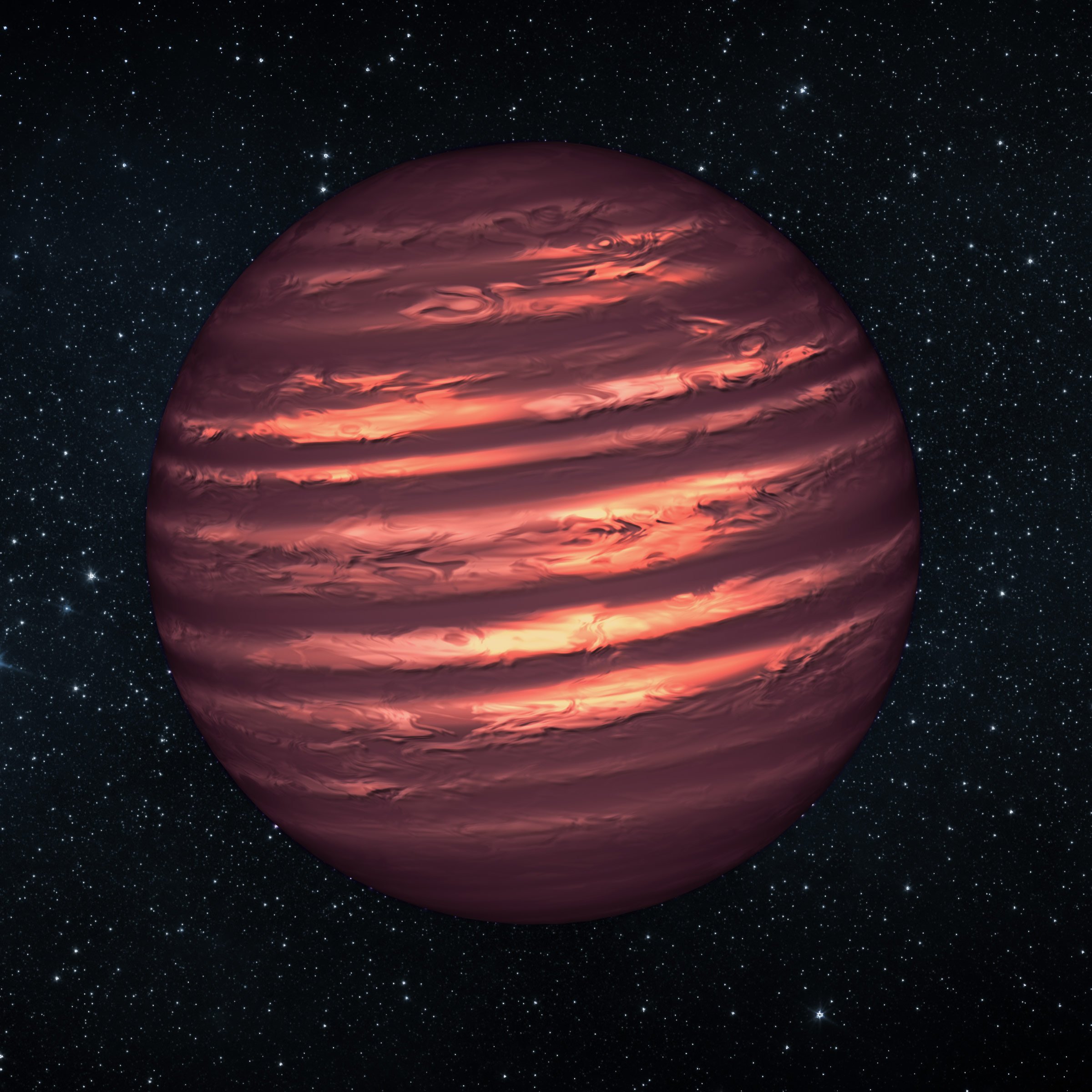
    This artist’s conception illustrates the brown dwarf named 2MASSJ22282889-431026. NASA’s Hubble and Spitzer space telescopes observed the object to learn more about its turbulent atmosphere. Brown dwarfs are more massive and hotter than planets but lack the mass required to become sizzling stars. Their atmospheres can be similar to the giant planet Jupiter’s. Spitzer and Hubble simultaneously observed the object as it rotated every 1.4 hours. The results suggest wind-driven, planet-size clouds. Credit: NASA/JPL-Caltech

    By using the Hubble Space Telescope and Spitzer Space Telescope to simultaneously view the brown dwarf planet 2MASSJ22282889-431026, a team of astronomers has created a detailed “weather map” and a technique to better understand the atmospheres of planets beyond our solar system.

    Astronomers using NASA’s Spitzer and Hubble space telescopes have probed the stormy atmosphere of a brown dwarf, creating the most detailed “weather map” yet for this class of cool, star-like orbs. The forecast shows wind-driven, planet-sized clouds enshrouding these strange worlds.

    Brown dwarfs form out of condensing gas, as stars do, but lack the mass to fuse hydrogen atoms and produce energy. Instead, these objects, which some call failed stars, are more similar to gas planets with their complex, varied atmospheres. The new research is a stepping-stone toward a better understanding not only of brown dwarfs, but also of the atmospheres of planets beyond our solar system.
    graph-shows-the-brightness-variations-of-the-brown-dwarf-named-2MASSJ22282889-431026
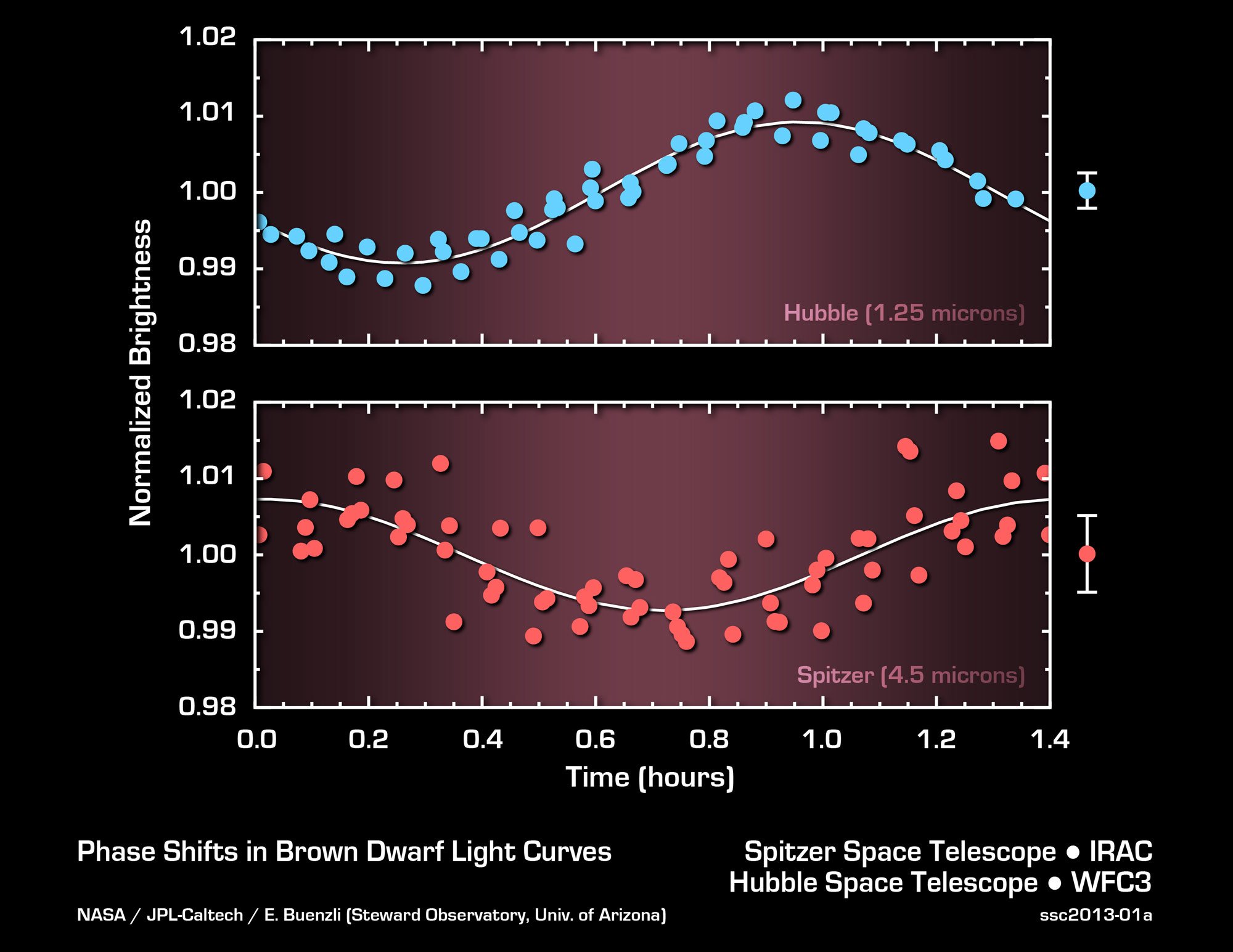
    This graph shows the brightness variations of the brown dwarf named 2MASSJ22282889-431026 measured simultaneously by both NASA’s Hubble and Spitzer space telescopes. As the object rotates every 1.4 hours, its emitted light periodically brightens and dims. Surprisingly, the timing, or phase, of the variations in brightness changes when measured at different wavelengths of infrared light. Spitzer and Hubble’s wavelengths probe different layers in the atmosphere of the brown dwarf. The phase shifts indicate complex clouds or weather patterns that change with altitude. Credit: NASA/JPL-Caltech/University of Arizona

    “With Hubble and Spitzer, we were able to look at different atmospheric layers of a brown dwarf, similar to the way doctors use medical imaging techniques to study the different tissues in your body,” said Daniel Apai, the principal investigator of the research at the University of Arizona in Tucson, who presented the results at the American Astronomical Society meeting Tuesday in Long Beach, California.

    A study describing the results, led by Esther Buenzli, also of the University of Arizona, is published in the Astrophysical Journal Letters.

    The researchers turned Hubble and Spitzer simultaneously toward a brown dwarf with the long name of 2MASSJ22282889-431026. They found that its light varied in time, brightening and dimming about every 90 minutes as the body rotated. But more surprising, the team also found the timing of this change in brightness depended on whether they looked using different wavelengths of infrared light.
    artist's-illustration-shows-the-atmosphere-of-a-brown-dwarf-called-2MASSJ22282889-431026
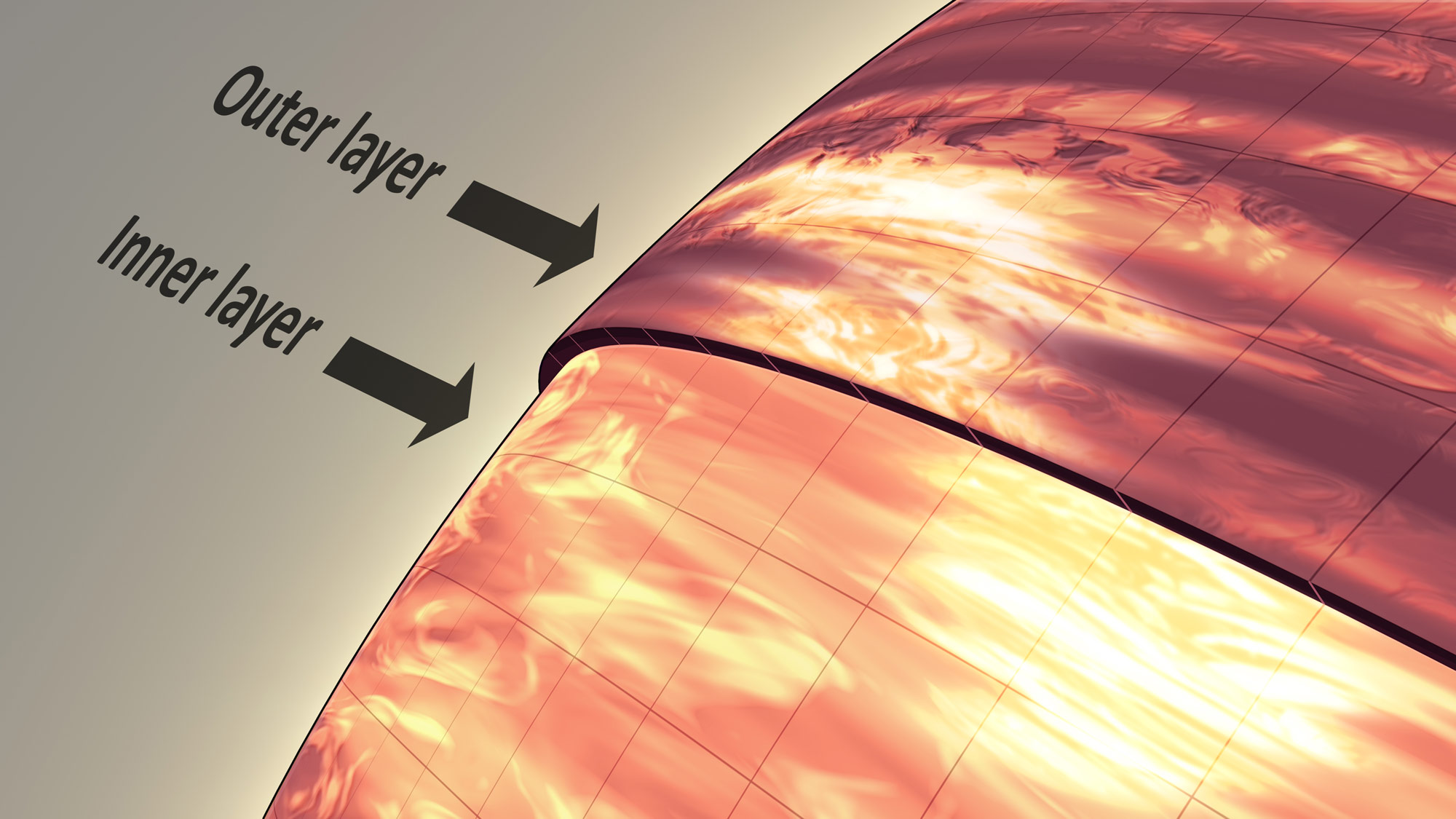
    This artist’s illustration shows the atmosphere of a brown dwarf called 2MASSJ22282889-431026, which was observed simultaneously by NASA’s Spitzer and Hubble space telescopes. Credit: NASA/JPL-Caltech

    These variations are the result of different layers or patches of material swirling around the brown dwarf in windy storms as large as Earth itself. Spitzer and Hubble see different atmospheric layers because certain infrared wavelengths are blocked by vapors of water and methane high up, while other infrared wavelengths emerge from much deeper layers.

    “Unlike the water clouds of Earth or the ammonia clouds of Jupiter, clouds on brown dwarfs are composed of hot grains of sand, liquid drops of iron, and other exotic compounds,” said Mark Marley, research scientist at NASA’s Ames Research Center in Moffett Field, California, and co-author of the paper. “So this large atmospheric disturbance found by Spitzer and Hubble gives a new meaning to the concept of extreme weather.”

    Buenzli says this is the first time researchers can probe variability at several different altitudes at the same time in the atmosphere of a brown dwarf. “Although brown dwarfs are cool relative to other stars, they are actually hot by earthly standards. This particular object is about 1,100 to 1,300 degrees Fahrenheit (600 to 700 degrees Celsius),” Buenzli said.

    “What we see here is evidence for massive, organized cloud systems, perhaps akin to giant versions of the Great Red Spot on Jupiter,” said Adam Showman, a theorist at the University of Arizona involved in the research. “These out-of-sync light variations provide a fingerprint of how the brown dwarf’s weather systems stack up vertically. The data suggest regions on the brown dwarf where the weather is cloudy and rich in silicate vapor deep in the atmosphere coincide with balmier, drier conditions at higher altitudes — and vice versa.”

    Researchers plan to look at the atmospheres of dozens of additional nearby brown dwarfs using Spitzer and Hubble.

    “From studies such as this we will learn much about this important class of objects, whose mass falls between that of stars and Jupiter-sized planets,” said Glenn Wahlgren, Spitzer program scientist at NASA Headquarters in Washington. “This technique will see extensive use when we are able to image individual exoplanets.”

    Reference: “Vertical Atmospheric Structure in a Variable Brown Dwarf: Pressure-Dependent Phase Shifts in Simultaneous Hubble Space Telescope–Spitzer Light Curves” by Esther Buenzli, Dániel Apai, Caroline V. Morley, Davin Flateau, Adam P. Showman, Adam Burrows, Mark S. Marley, Nikole K. Lewis and I. Neill Reid, 8 November 2012, The Astrophysical Journal Letters.
    DOI: 10.1088/2041-8205/760/2/L31

    Never miss a breakthrough: Join the SciTechDaily newsletter.
    Follow us on Google and Google News.

    Astronomy Hubble Space Telescope JPL NASA Popular Spitzer Space Telescope
    Share. Facebook Twitter Pinterest LinkedIn Email Reddit

    Related Articles

    NASA Discovers Pair of Super-Earths With 1,000-Mile-Deep Oceans

    Godzilla Nebula: A “Monster” Star-Forming Region Spied by NASA’s Spitzer Space Telescope

    Hidden Supernova: Stars Are Exploding in Dusty Galaxies – We Just Can’t Always See Them

    NASA’s Spitzer Spies a Massive Star Factory – 2 Quadrillion Miles Across

    New Study Revives Doubted Exoplanet Fomalhaut b

    Measuring the Expansion of Universe – A Newly Refined Value for the Hubble Constant

    New Image of the Helix Nebula Unraveling Into Space

    NASA Telescopes Spot Ultra-Distant Galaxy, MACS 1149-JD

    Searching for “Bubbles” in the Milky Way

    Leave A Reply Cancel Reply

    • Facebook
    • Twitter
    • Pinterest
    • YouTube

    Don't Miss a Discovery

    Subscribe for the Latest in Science & Tech!

    Trending News

    Breakthrough Bowel Cancer Trial Leaves Patients Cancer-Free for Nearly 3 Years

    Natural Compound Shows Powerful Potential Against Rheumatoid Arthritis

    100,000-Year-Old Neanderthal Fossils in Poland Reveal Unexpected Genetic Connections

    Simple “Gut Reset” May Prevent Weight Gain After Ozempic or Wegovy

    2.8 Days to Disaster: Scientists Warn Low Earth Orbit Could Suddenly Collapse

    Common Food Compound Shows Surprising Power Against Superbugs

    5 Simple Ways To Remember More and Forget Less

    The Atomic Gap That Could Cost the Semiconductor Industry Billions

    Follow SciTechDaily
    • Facebook
    • Twitter
    • YouTube
    • Pinterest
    • Newsletter
    • RSS
    SciTech News
    • Biology News
    • Chemistry News
    • Earth News
    • Health News
    • Physics News
    • Science News
    • Space News
    • Technology News
    Recent Posts
    • Scientists Warn That This Common Pet Fish Can Wreck Entire Ecosystems
    • Scientists Just Made Carbon Capture Much Cheaper and Easier
    • Harvard Breakthrough Brings Powerful UV Light Sources Onto a Chip
    • This Strange Quantum “Dance” Could Rewrite Superconductivity
    • Scientists Make Breakthrough in Turning Plastic Trash Into Clean Fuel Using Sunlight
    Copyright © 1998 - 2026 SciTechDaily. All Rights Reserved.
    • Science News
    • About
    • Contact
    • Editorial Board
    • Privacy Policy
    • Terms of Use

    Type above and press Enter to search. Press Esc to cancel.