
Close Menu
    Facebook X (Twitter) Instagram
    SciTechDaily
    • Biology
    • Chemistry
    • Earth
    • Health
    • Physics
    • Science
    • Space
    • Technology
    Facebook X (Twitter) Pinterest YouTube RSS
    SciTechDaily
    Home»Space»Mars Rock Is a Close Match in Chemical Composition to Rocks Found on Earth
    Space

    Mars Rock Is a Close Match in Chemical Composition to Rocks Found on Earth

    By DC Agle / Guy Webster, Jet Propulsion LaboratoryOctober 12, 2012No Comments6 Mins Read
    Facebook Twitter Pinterest Telegram LinkedIn WhatsApp Email Reddit
    Share
    Facebook Twitter LinkedIn Pinterest Telegram Email Reddit
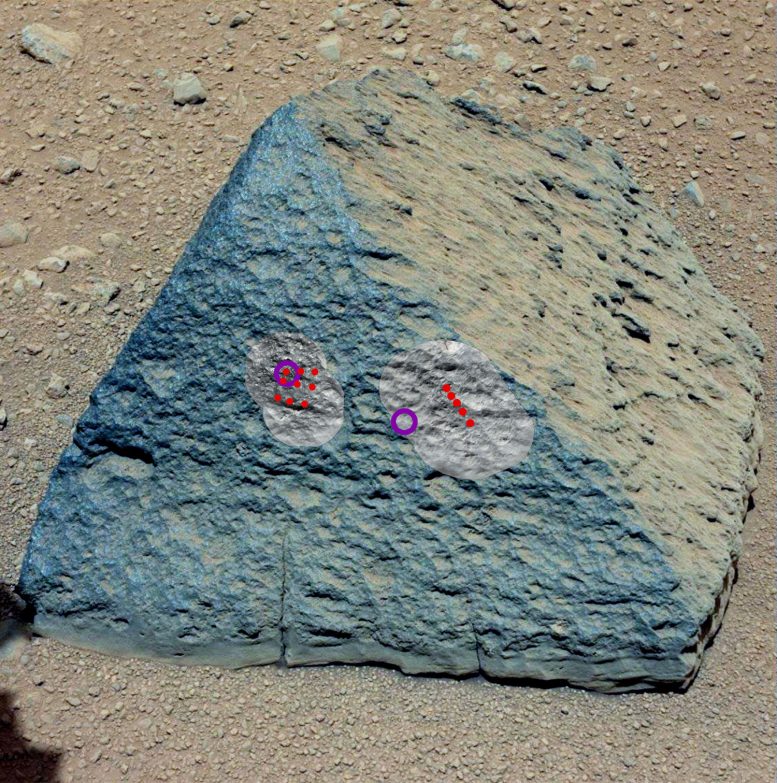
    Jake Matijevic
    This image shows where NASA’s Curiosity rover aimed two different instruments to study a rock known as “Jake Matijevic.” The red dots are where the Chemistry and Camera (ChemCam) instrument zapped it with its laser on September 21, 2012, and September 24, 2012, which were the 45th and 48th sol, or Martian day of operations. The circular black and white images were taken by ChemCam to look for the pits produced by the laser. The purple circles indicate where the Alpha Particle X-ray Spectrometer trained its view. Scientists white-balanced the color in this view to increase the inherent differences visible within the rock. Credit: NASA/JPL-Caltech/MSSS

    Using Curiosity’s arm-mounted Alpha Particle X-Ray Spectrometer (APXS) instrument and the Chemistry and Camera (ChemCam) instrument, scientists examined the chemical makeup of the football-size rock called “Jake Matijevic” on Mars, finding that the rock is a close match in chemical composition to a type of igneous rock found in many volcanic provinces on Earth.

    The first Martian rock NASA’s Curiosity rover has reached out to touch presents a more varied composition than expected from previous missions. The rock also resembles some unusual rocks from Earth’s interior.

    The rover team used two instruments on Curiosity to study the chemical makeup of the football-size rock called “Jake Matijevic” (matt-EE-oh-vick) The results support some surprising recent measurements and provide an example of why identifying rocks’ composition is such a major emphasis of the mission. Rock compositions tell stories about unseen environments and planetary processes.

    “This rock is a close match in chemical composition to an unusual but well-known type of igneous rock found in many volcanic provinces on Earth,” said Edward Stolper of the California Institute of Technology in Pasadena, who is a Curiosity co-investigator. “With only one Martian rock of this type, it is difficult to know whether the same processes were involved, but it is a reasonable place to start thinking about its origin.”

    On Earth, rocks with a composition like the Jake rock typically come from processes in the planet’s mantle beneath the crust, from crystallization of relatively water-rich magma at elevated pressure.

    Jake was the first rock analyzed by the rover’s arm-mounted Alpha Particle X-Ray Spectrometer (APXS) instrument and about the thirtieth rock examined by the Chemistry and Camera (ChemCam) instrument. Two penny-size spots on Jake were analyzed on September 22 by the rover’s improved and faster version of earlier APXS devices on all previous Mars rovers, which have examined hundreds of rocks. That information has provided scientists a library of comparisons for what Curiosity sees.

    “Jake is kind of an odd Martian rock,” said APXS Principal Investigator Ralf Gellert of the University of Guelph in Ontario, Canada. “It’s high in elements consistent with the mineral feldspar, and low in magnesium and iron.”
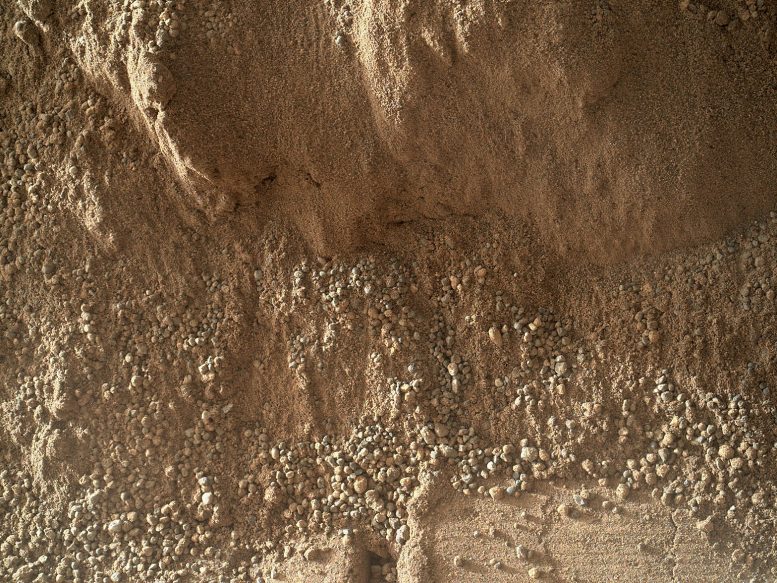
    High-Resolution View of Cross-Section Through a Mars Ripple
    This image shows the wall of a scuff mark NASA’s Curiosity made in a windblown ripple of Martian sand with its wheel. The upper half of the image shows a small portion of the side wall of the scuff and a little bit of the floor of the scuff (bottom of this image). The prominent depression with raised rims at the bottom center of the image was formed by one of the treads on Curiosity’s front right wheel. The largest grains in this image are about 0.04 to 0.08 inches (1 to 2 millimeters) in size. Those large grains were on top of the windblown ripple and fell down to this location when the scuff was made. The bulk of the sand in the ripple is smaller, in the range below 0.002 to 0.008 inches (50 to 200 microns). The full scuff mark is 20 inches (50 centimeters) wide, which is the width of Curiosity’s wheel. This image from the Mars Hand Lens Imager (MAHLI) is the product of merging eight images acquired at eight slightly different focus settings to bring out details on the wall, slopes, and floor of the wheel scuff. The merge was performed onboard the MAHLI instrument to reduce downlinked data volume. The image was acquired by MAHLI with the lens about 4.7 inches (12 centimeters) from the target. The pixel scale is about 0.002 inches (50 microns) per pixel. The image covers an area, roughly 3 by 2 inches (8 by 6 centimeters). The image was obtained on October 4, 2012, or sol 58, the 58th Martian day of operations on the surface. Credit: NASA/JPL-Caltech/MSSS

    ChemCam found unique compositions at each of 14 target points on the rock, hitting different mineral grains within it.

    “ChemCam had been seeing compositions suggestive of feldspar since August, and we’re getting closer to confirming that now with APXS data, although there are additional tests to be done,” said ChemCam Principal Investigator Roger Wiens (WEENS) of Los Alamos National Laboratory in New Mexico.

    Examination of Jake included the first comparison on Mars between APXS results and results from checking the same rock with ChemCam, which shoots laser pulses from the top of the rover’s mast.

    The wealth of information from the two instruments checking chemical elements in the same rock is just a preview. Curiosity also carries analytical laboratories inside the rover to provide other composition information about powder samples from rocks and soil. The mission is progressing toward getting the first soil sample into those analytical instruments during a “sol,” or Martian day.

    “Yestersol, we used Curiosity’s first perfectly scooped sample for cleaning the interior surfaces of our 150-micron sample-processing chambers. It’s our version of a Martian carwash,” said Chris Roumeliotis (room-eel-ee-OH-tiss), lead turret rover planner at NASA’s Jet Propulsion Laboratory in Pasadena, California.

    Before proceeding, the team carefully studied the material for scooping at a sandy patch called “Rocknest,” where Curiosity is spending about three weeks.

    “That first sample was perfect, just the right particle-size distribution,” said JPL’s Luther Beegle, Curiosity sampling-system scientist. “We had a lot of steps to be sure it was safe to go through with the scooping and cleaning.”

    Following the work at Rocknest, the rover team plans to drive Curiosity about 100 yards eastward and select a rock in that area as the first target for using the drill.

    During a two-year prime mission, researchers will use Curiosity’s 10 instruments to assess whether the study area ever has offered environmental conditions favorable for microbial life. JPL, a division of Caltech, manages the project and built Curiosity.

    Never miss a breakthrough: Join the SciTechDaily newsletter.
    Follow us on Google and Google News.

    Curiosity Rover JPL Mars NASA Planetary Science
    Share. Facebook Twitter Pinterest LinkedIn Email Reddit

    Related Articles

    Curiosity Rover Photographs Diverse Rocks

    Curiosity Prepares to Take Its First Scoop of Soil for Analysis

    Curiosity Finds Ancient Streambed on Mars

    NASA’s Curiosity Prepares for Use of Its Arm and Tools

    Curiosity Sends Back Radioed Words and New Telephoto View of Mars

    NASA’s Curiosity Readies for First Drive on Mars

    Color HiRISE Image of Curiosity Rover on Mars

    First 360-Degree Color Panorama From NASA’s Curiosity Mars Rover

    First Full-Resolution Images From Curiosity’s Navigation Cameras

    Leave A Reply Cancel Reply

    • Facebook
    • Twitter
    • Pinterest
    • YouTube

    Don't Miss a Discovery

    Subscribe for the Latest in Science & Tech!

    Trending News

    Breakthrough Bowel Cancer Trial Leaves Patients Cancer-Free for Nearly 3 Years

    Natural Compound Shows Powerful Potential Against Rheumatoid Arthritis

    100,000-Year-Old Neanderthal Fossils in Poland Reveal Unexpected Genetic Connections

    Simple “Gut Reset” May Prevent Weight Gain After Ozempic or Wegovy

    2.8 Days to Disaster: Scientists Warn Low Earth Orbit Could Suddenly Collapse

    Common Food Compound Shows Surprising Power Against Superbugs

    5 Simple Ways To Remember More and Forget Less

    The Atomic Gap That Could Cost the Semiconductor Industry Billions

    Follow SciTechDaily
    • Facebook
    • Twitter
    • YouTube
    • Pinterest
    • Newsletter
    • RSS
    SciTech News
    • Biology News
    • Chemistry News
    • Earth News
    • Health News
    • Physics News
    • Science News
    • Space News
    • Technology News
    Recent Posts
    • After 37 Years, the World’s Longest-Running Soil Warming Experiment Uncovers a Startling Climate Secret
    • NASA Satellite Captures First-Ever High-Res View of Massive Pacific Tsunami
    • ADHD Isn’t Just a Deficit: Study Reveals Powerful Hidden Strengths
    • Scientists Uncover “Astonishing” Hidden Property of Light
    • Scientists Discover Stem Cells That Could Regrow Teeth and Bone
    Copyright © 1998 - 2026 SciTechDaily. All Rights Reserved.
    • Science News
    • About
    • Contact
    • Editorial Board
    • Privacy Policy
    • Terms of Use

    Type above and press Enter to search. Press Esc to cancel.