
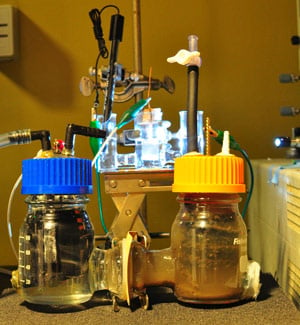
By combining a microbial fuel cell and a type of solar cell called a photoelectrochemical cell, researchers from UC Santa Cruz have developed a hybrid device that produces hydrogen gas from wastewater and sunlight.
A novel device that uses only sunlight and wastewater to produce hydrogen gas could provide a sustainable energy source while improving the efficiency of wastewater treatment.
A research team led by Yat Li, associate professor of chemistry at the University of California, Santa Cruz, developed the solar-microbial device and reported their results in a paper published in the American Chemical Society journal ACS Nano. The hybrid device combines a microbial fuel cell (MFC) and a type of solar cell called a photoelectrochemical cell (PEC). In the MFC component, bacteria degrade organic matter in the wastewater, generating electricity in the process. The biologically generated electricity is delivered to the PEC component to assist the solar-powered splitting of water (electrolysis) that generates hydrogen and oxygen.
Either a PEC or MFC device can be used alone to produce hydrogen gas. Both, however, require a small additional voltage (an “external bias”) to overcome the thermodynamic energy barrier for proton reduction into hydrogen gas. The need to incorporate an additional electric power element adds significantly to the cost and complication of these types of energy conversion devices, especially at large scales. In comparison, Li’s hybrid solar-microbial device is self-driven and self-sustained, because the combined energy from the organic matter (harvested by the MFC) and sunlight (captured by the PEC) is sufficient to drive electrolysis of water.
In effect, the MFC component can be regarded as a self-sustained “bio-battery” that provides extra voltage and energy to the PEC for hydrogen gas generation. “The only energy sources are wastewater and sunlight,” Li said. “The successful demonstration of such a self-biased, sustainable microbial device for hydrogen generation could provide a new solution that can simultaneously address the need for wastewater treatment and the increasing demand for clean energy.”
Microbial fuel cells rely on unusual bacteria, known as electrogenic bacteria, that are able to generate electricity by transferring metabolically-generated electrons across their cell membranes to an external electrode. Li’s group collaborated with researchers at Lawrence Livermore National Laboratory (LLNL) who have been studying electrogenic bacteria and working to enhance MFC performance. Initial “proof-of-concept” tests of the solar-microbial (PEC-MFC) device used a well-studied strain of electrogenic bacteria grown in the lab on artificial growth medium. Subsequent tests used untreated municipal wastewater from the Livermore Water Reclamation Plant. The wastewater contained both rich organic nutrients and a diverse mix of microbes that feed on those nutrients, including naturally occurring strains of electrogenic bacteria.
When fed with wastewater and illuminated in a solar simulator, the PEC-MFC device showed continuous production of hydrogen gas at an average rate of 0.05 m3/day, according to LLNL researcher and coauthor Fang Qian. At the same time, the turbid black wastewater became clearer. The soluble chemical oxygen demand–a measure of the amount of organic compounds in water, widely used as a water quality test–declined by 67 percent over 48 hours.
The researchers also noted that hydrogen generation declined over time as the bacteria used up the organic matter in the wastewater. Replenishment of the wastewater in each feeding cycle led to the complete restoration of electric current generation and hydrogen gas production.
Qian said the researchers are optimistic about the commercial potential for their invention. Currently, they are planning to scale up the small laboratory device to make a larger 40-liter prototype continuously fed with municipal wastewater. If results from the 40-liter prototype are promising, they will test the device on site at the wastewater treatment plant.
“The MFC will be integrated with the existing pipelines of the plant for continuous wastewater feeding, and the PEC will be set up outdoors to receive natural solar illumination,” Qian said.
“Fortunately, the Golden State is blessed with abundant sunlight that can be used for the field test,” Li added.
Qian and Hanyu Wang, a graduate student in Li’s lab at UC Santa Cruz, are co-first authors of the ACS Nano paper. The other coauthors include UCSC graduate student Gongming Wang; LLNL researcher Yongqin Jiao; and Zhen He of Virginia Polytechnic Institute & State University. This research was supported by the National Science Foundation and Department of Energy.
Reference: “Self-Biased Solar-Microbial Device for Sustainable Hydrogen Generation” by Hanyu Wang, Fang Qian, Gongming Wang, Yongqin Jiao, Zhen He and Yat Li, 16 September 2013, ACS Nano.
DOI: 10.1021/nn403082m
Never miss a breakthrough: Join the SciTechDaily newsletter.
Follow us on Google and Google News.
4 Comments
What happens to the MFC when it is no longer able to produce electricity? Is there a risk of bacteria infestations if it gets out of the containers? Can the waste product from the waste product side be used for further energy creation or possibly fertilizer? I have a gross but interesting idea for that.
There may be a practical way to use solar power and even make money.
1. Build a bunch of solar cells in the desert.
2. Use electricity to make H2 gas on the spot.
3. Bring in some low grade cheap crude oil.
4. Hydrogenate the crude and get shorter chain more valuable
hydrocarbons such as hexane and octane ( gasoline ).
5. Once you have built it, the cost to run should be low.
Sorry if this is not AGW politically correct.
Solar powered preparation is basically a really easy method, and a fun project for the youngsters. This makes a wonderful science fair project.
Use electricity to make H2 gas on the spot.