
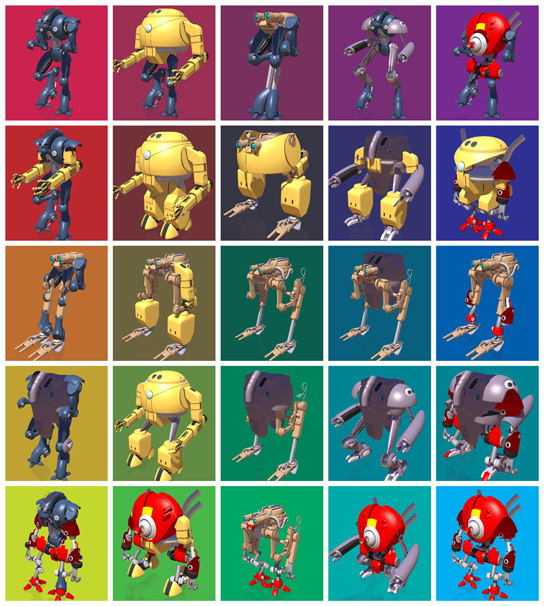
New software for creating advanced 3D characters like those seen in blockbuster films will allow inexperienced users a chance to create their own movie magic. Developed by researchers at the Max Planck Institute for Informatics, this software significantly shortens and simplifies the creation process of 3D movie characters.
3D movies like “Toy Story” or “Transformers” are based on everyday objects that are able to move like humans. Such 3D characters are created by skilled experts in time-consuming manual work. Computer scientists at the Max Planck Institute for Informatics have now developed two computer programs that can accomplish the same process in mere seconds and can easily be handled even by inexperienced users. The researchers present their unique software for the first time at F34 in Hall 26 at the Cebit from March 6-10, 2012.
In the 3D movie “Toy Story,” the astronaut “Space Ranger Buzz Lightyear” elicits great laughs from the audience. In “Transformers,” cars and trucks amaze viewers by turning into robots and then fighting each other, agile like professional boxers. Their spectacular on-screen movements are hand-crafted and take a lot of time to produce, regardless of the hardware involved.
After creating a static digital representation of the character, the ability to move is achieved by “rigging” of the character, i.e. a motion skeleton is manually defined and attached to the character’s individual components.
Max Planck researchers are now the first worldwide to have developed two novel approaches not only significantly shortening these two important steps of the creation process, but also considerably simplifying them. “It has never been easier to create and animate a custom 3D character than today,” explains Thorsten Thormählen from the MPI for Informatics, head of the research group “Image-based Analysis of 3D Scenes” with a view to ambitious amateur movie makers and game developers.
Thormählen’s software uses databases like Dosch Design, Turbosquid, or Google Warehouse, which, either free or for a small fee, offer data sets defining the shape of a character or an object. That way the users do not need to create their own 3D model, but cannot yet customize them either.
This is where the first of the two novel algorithms comes in. It cleverly splits the 3D models in the database into components and remembers how they were connected. Users can then select two of the processed models that they want to combine into a new and unique model. An amateur designer can thus, for example, assemble his or her own ultimate robot for a video game. By using a slider, the designer can make a real-time decision as to how much of component A or B to use and is always able to view the resulting combination. To make sure that only fitting components can be exchanged, e.g. the arms of A with the arms of B, the program uses segmentation based on identified symmetries. “This even works if you want to create a James Bond vehicle out of a motor boat and a plane”, says Thormälen.
Finally, the newly created model can be animated with another algorithm. All that is needed is a defined movement sequence and a target skeleton. These are also freely available on the internet, for example, at the Mocap Database, maintained by Carnegie Mellon University. The software developed by Thormählen’s research group applies the movement and the skeleton to the 3D model. This is done by a clever algorithm that is able to identify a similar skeleton, including the appropriate joints in the target model. The movement will be then transferred to the skeleton animating the model. Like this, the clunky astronaut figure of Toy Story star “Buzz Lightyear” can move on the screen like Kung Fu legend Bruce Lee within mere seconds.
Never miss a breakthrough: Join the SciTechDaily newsletter.
Follow us on Google and Google News.
1 Comment
The 3D Animation is the advance technology of portraying characters and put ideas in a well-mannered way, these kind of blogs are interesting and have so many information for a common user.