
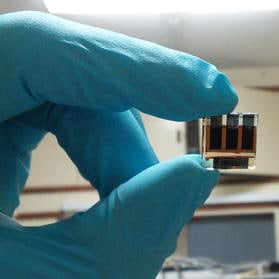
By working to improve perovskite cell efficiency, scientists at Oxford University are creating simpler and cheaper solar cells.
Over the last four years, solar cells made from materials called perovskites have reached efficiencies that other technologies took decades to achieve, but until recently no-one quite knew why.
Since perovskite was first used in 2009 to produce 3% efficient photovoltaic (PV) cells, scientists have rapidly developed the technology to achieve efficiencies of over 15%, overtaking other emerging solar technologies which have yet to break the 14% barrier.
Scientists at Oxford University, reporting in Science, have revealed that the secret to perovskites’ success lies in a property known as the diffusion length, and worked out a way to make it ten times better.
‘The diffusion length gives us an indication of how thick the photovoltaic (PV) film can be,’ explains Sam Stranks, who led the discovery in Henry Snaith’s group at Oxford University’s Department of Physics. ‘If the diffusion length is too low, you can only use thin films so the cell can’t absorb much sunlight.’
So why is the diffusion length so important?
PV cells are made from two types of material, called p-type and n-type semiconductors. P-type materials mainly contain positively-charged ‘holes’ and n-type materials mainly contain negatively-charged electrons. They meet at a ‘p–n junction’, where the difference in charge creates an electric field.
The cells generate electricity when light particles (photons) collide with electrons, creating ‘excited’ electrons and holes. The electric field of the p–n junction guides excited electrons towards the n-side and holes towards the p-side. They are picked up by metal contacts, electrodes, which enable them to flow around the circuit to create an electric current.
‘The diffusion length tells you the average distance that charge-carriers (electrons and holes) can travel before they recombine,’ explains Sam. ‘Recombination happens when excited electrons and holes meet, leaving behind a low-energy electron which has lost the energy it gained from the sunlight.
‘If the diffusion length is less than the thickness of the material, most charge-carriers will recombine before they reach the electrodes so you only get low currents. You want a diffusion length that is two to three times as long as the thickness to collect almost all of the charges.’
The thickness of a solar cell is always a compromise – if they’re too thin they won’t absorb much light, but if they’re too thick the charge carriers inside won’t be able to travel through. Longer diffusion lengths allow for more efficient cells overall, as they can be made thicker without losing as many charge carriers. Scientists can get around this by arranging cells into complex structures called ‘mesostructures’, but this is a time-consuming and complicated process which has yet to be proven commercially.
Previously, researchers were able to get mesostructured perovskite cells to 15% efficiency, using a perovskite compound with a diffusion length of around 100 nanometers (nm). But by adding chloride ions to the mix, Henry’s group achieved diffusion lengths over 1000nm. These improved cells can reach 15% efficiency without the need for complex structures, making them cheaper and easier to produce.
‘Being able to make 15% efficient cells in simple, flat structures makes a huge difference. We’ve made hundreds just for research purposes, it’s such an easy process. I expect we’ll be seeing perovskite cells in commercial use within the next few years. They’re incredibly cheap to make, have proven high efficiencies, and are also semi-transparent. We can tune the color too, so you could install them in aesthetically-pleasing ways in office windows.’
That perovskite cells are showing commercial potential after such a short time is a testament to their fantastic properties. We could well be seeing perovskite cells with efficiencies of 20-30% within the next few years, offering the same power as standard silicon-based cells at a fraction of the cost.
‘Now is a truly exciting time to be working in the field,’ says Sam. ‘It’s such a rapidly-emerging field, I expect to see it evolve even further over the next couple of years. What’s incredible is that all of these advances have been made in academic environments so far, but it won’t be long before industrial manufacturers start looking at perovskite cells as serious contenders.’
Reference: “Electron-Hole Diffusion Lengths Exceeding 1 Micrometer in an Organometal Trihalide Perovskite Absorber” by Samuel D. Stranks, Giles E. Eperon, Giulia Grancini, Christopher Menelaou, Marcelo J. P. Alcocer, Tomas Leijtens, Laura M. Herz, Annamaria Petrozza and Henry J. Snaith, 18 October 2013, Science.
DOI: 10.1126/science.1243982
Never miss a breakthrough: Join the SciTechDaily newsletter.
Follow us on Google and Google News.