
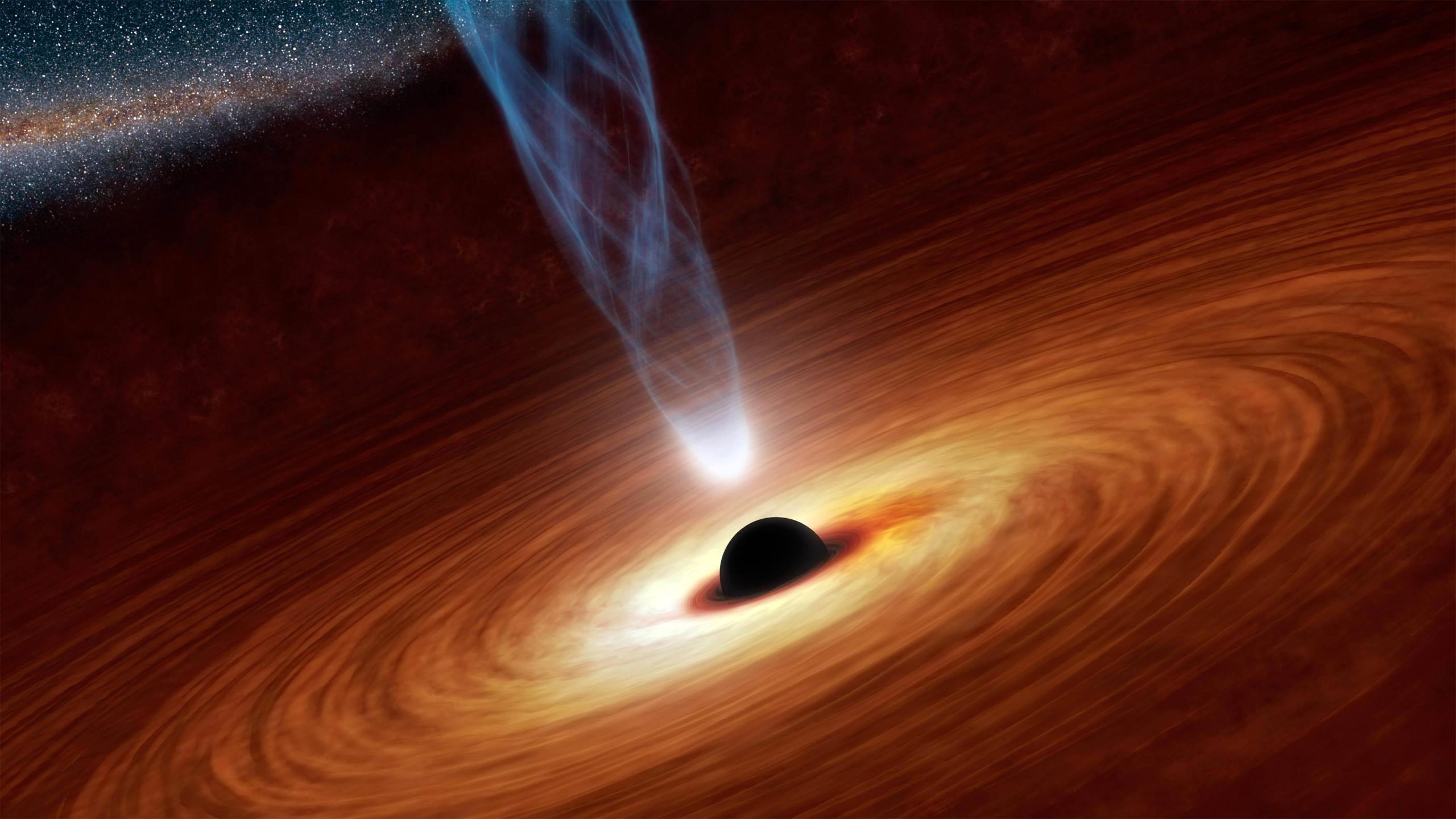
Using the NuSTAR and XMM-Newton telescopes, researchers traced matter as it swirled into a black hole, resolving a long-standing debate about black holes and gaining a better understanding of how black holes and galaxies evolve.
Two X-ray space observatories, NASA’s Nuclear Spectroscopic Telescope Array (NuSTAR) and the European Space Agency’s XMM-Newton, have teamed up to measure definitively, for the first time, the spin rate of a black hole with a mass 2 million times that of our sun.
The supermassive black hole lies at the dust- and gas-filled heart of a galaxy called NGC 1365, and it is spinning almost as fast as Einstein’s theory of gravity will allow. The findings, which appear in a new study in the journal Nature, resolve a long-standing debate about similar measurements in other black holes and will lead to a better understanding of how black holes and galaxies evolve.
“This is hugely important to the field of black hole science,” said Lou Kaluzienski, a NuSTAR program scientist at NASA Headquarters in Washington.
The observations also are a powerful test of Einstein’s theory of general relativity, which says gravity can bend space-time, the fabric that shapes our universe, and the light that travels through it.
“We can trace matter as it swirls into a black hole using X-rays emitted from regions very close to the black hole,” said the coauthor of a new study, NuSTAR principal investigator Fiona Harrison of the California Institute of Technology in Pasadena. “The radiation we see is warped and distorted by the motions of particles and the black hole’s incredibly strong gravity.”
NuSTAR, an Explorer-class mission launched in June 2012, is designed to detect the highest-energy X-ray light in great detail. It complements telescopes that observe lower-energy X-ray light, such as XMM-Newton and NASA’s Chandra X-ray Observatory. Scientists use these and other telescopes to estimate the rates at which black holes spin.
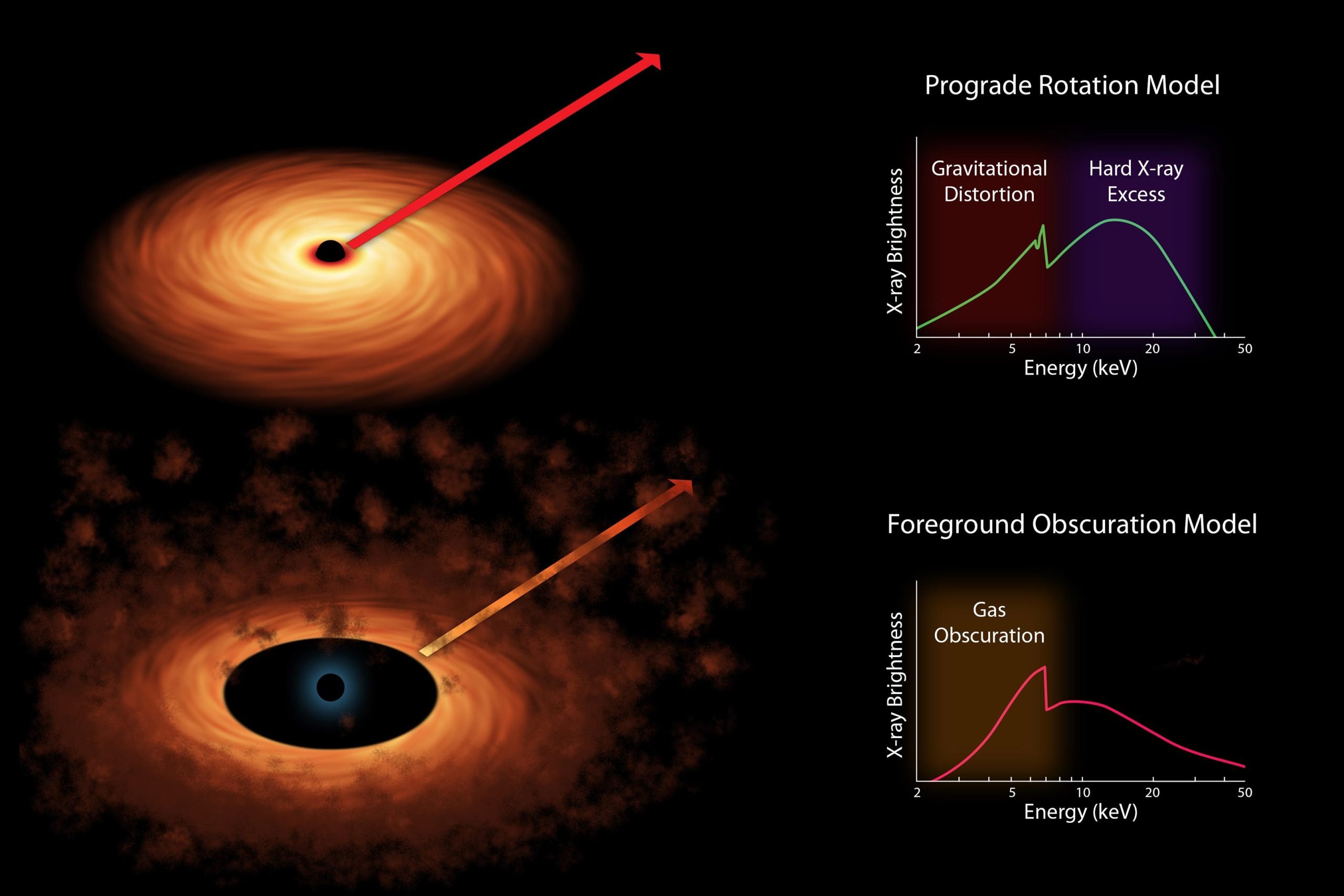
Until now, these measurements were not certain because clouds of gas could have been obscuring the black holes and confusing the results. With help from XMM-Newton, NuSTAR was able to see a broader range of X-ray energies and penetrate deeper into the region around the black hole. The new data demonstrate that X-rays are not being warped by the clouds, but by the tremendous gravity of the black hole. This proves that spin rates of supermassive black holes can be determined conclusively.
“If I could have added one instrument to XMM-Newton, it would have been a telescope like NuSTAR,” said Norbert Schartel, XMM-Newton Project Scientist at the European Space Astronomy Center in Madrid. “The high-energy X-rays provided an essential missing puzzle piece for solving this problem.”
Measuring the spin of a supermassive black hole is fundamental to understanding its past history and that of its host galaxy.
“These monsters, with masses from millions to billions of times that of the sun, are formed as small seeds in the early universe and grow by swallowing stars and gas in their host galaxies, merging with other giant black holes when galaxies collide, or both,” said the study’s lead author, Guido Risaliti of the Harvard-Smithsonian Center for Astrophysics in Cambridge, Mass., and the Italian National Institute for Astrophysics.
Supermassive black holes are surrounded by pancake-like accretion disks, formed as their gravity pulls matter inward. Einstein’s theory predicts the faster a black hole spins, the closer the accretion disk lies to the black hole. The closer the accretion disk is, the more gravity from the black hole will warp X-ray light streaming off the disk.
Astronomers look for these warping effects by analyzing X-ray light emitted by iron circulating in the accretion disk. In the new study, they used both XMM-Newton and NuSTAR to simultaneously observe the black hole in NGC 1365. While XMM-Newton revealed that light from the iron was being warped, NuSTAR proved that this distortion was coming from the gravity of the black hole and not gas clouds in the vicinity. NuSTAR’s higher-energy X-ray data showed that the iron was so close to the black hole that its gravity must be causing the warping effects.
With the possibility of obscuring clouds ruled out, scientists can now use the distortions in the iron signature to measure the black hole’s spin rate. The findings apply to several other black holes as well, removing the uncertainty in the previously measured spin rates.
Reference: “A rapidly spinning supermassive black hole at the centre of NGC 1365” by G. Risaliti, F. A. Harrison, K. K. Madsen, D. J. Walton, S. E. Boggs, F. E. Christensen, W. W. Craig, B. W. Grefenstette, C. J. Hailey, E. Nardini, Daniel Stern and W. W. Zhang, 27 February 2013, Nature.
DOI: 10.1038/nature11938
The California Institute of Technology in Pasadena manages JPL for NASA.
Never miss a breakthrough: Join the SciTechDaily newsletter.
Follow us on Google and Google News.
12 Comments
So how fast is the black hole spinning?
Research states, NGC 1365 is spinning about 84 percent as fast as Einstein’s general theory of relativity allows it to, so about 84% the speed of light.
Does the accretion rate of a black hole accelerate as the black hole grows and its gravity increases? Does the accretion acceleration rate increase respectively? Assuming an unlimited supply of matter to accrete, is there a maximum accretion rate?
There is a maximum accretion rate known as the Eddington limit.
Presumably matter cannot fall toward the black hole any faster than the speed of light but is there a limit to how much matter can fall together at that speed?
Hi, Nelson Simonson! Got some great news for you! You don’t have to worry about ‘Matter/Mass’ falling into a, ‘Black Hole/Point of Infinite Density’ because, there is no such thing… There! Don’t you feel a lot better now that you’ve been enlightened? By the way, light travels at the speed it it is being emitted from the parent body until it encounters something that can create an influence on it.
The signature of Iron spectrum both partially ionized and fully ionized is mapped in the X-ray spectrum to find the spin rate of the Super massive black hole NGC 1365 with a mass of 2000000 suns. This iron spectrum is coming from the accretion disc of the black hole and not from any spongy gaseous envelope, thereby fixing the spin of the black hole which should be gravitationally locked to the nearby accretion disc just as our Sun locks the closest planet mercury with its spin rate of 24 days. Moreover we know very well that atoms of Iron, Silicon and even organic molecules are formed only in the inter-stellar dust which later on consolidate on the Proto-planets to be formed later. The Fraunhofer spectrum of the sun,s photosphere the signatures of gases like Hydrogen, Helium, etc in addition to the other elements formed on it in optical spectroscopy. By the by the spin does not mean that it reaches 80% of the velocity of light but only the maximum velocity given by the formula F=G*m1*m2/d². For such huge mass it should be very great however.
The signature of Iron spectrum both partially ionized and fully ionized is mapped in the X-ray spectrum to find the spin rate of the Super massive black hole NGC 1365 with a mass of 2000000 suns. This iron spectrum is coming from the accretion disc of the black hole and not from any spongy gaseous envelope, thereby fixing the spin of the black hole which should be gravitationally locked to the nearby accretion disc just as our Sun locks the closest planet mercury with its spin rate of 24 days. Moreover we know very well that atoms of Iron, Silicon and even organic molecules are formed only in the inter-stellar dust which later on consolidate on the Proto-planets to be formed later. The Fraunhofer spectrum of the sun,s photosphere contains the signatures of gases like Hydrogen, Helium, etc in addition to the other elements formed on it in optical spectroscopy. By the by the spin does not mean that it reaches 80% of the velocity of light but only the maximum velocity given by the formula F=G*m1*m2/d². For such huge mass it should be very great however.
Hi, Madanagopal.V.C. Still spouting the Dogma with the greatest of verve I see. Come on, Admit it! ‘Infinite Density’ ‘Black Holes’ only existed in, ‘SCIENCE FICTION’ before, Stephen Hawking started messing around with the concept.. I find it absolutely amazing that supposedly ‘Learned’ ‘Intelligent’ Scientists can be so gullible as to be, taken-In by a bit of ‘Math’… Wake up and smell the, ‘Roses of Reality’! ‘You’ve been Conned and Stephen has turned himself into a millionaire via that con…. ‘Or is it that, Scientists are going to persist with the concept because if they don’t, they are all going to appear ‘Right Plonkers’ to the General Public? Mmmmmm?
I met one guy the other day who claimed with the same fervor that the earth is flat. No amount of obvious evidence will sway him – everything is a conspiracy to just prove him wrong.
You’re like that. If you can disprove the existence of black holes, this would be a good opportunity to publish a paper in a referred journal and become famous. Otherwise you sound like the flat earth guy.
Hi !
I might be wrong, but it seems like this guy was denying infinite density, maybe not denying black holes in general. Anyway, I do think that it’s possible that multiple black holes merge and eventually reach a weight limit, where they explode and become a big bang 🙂
84% the speed of light, is the speed of the last data receivable, not the max speed. The max speed, is the speed of light, at the point of infinite density. The result of Einstein’s equations should be infinite, while you have interpreted the results as nonsense, they are correct.