
Close Menu
    Facebook X (Twitter) Instagram
    SciTechDaily
    • Biology
    • Chemistry
    • Earth
    • Health
    • Physics
    • Science
    • Space
    • Technology
    Facebook X (Twitter) Pinterest YouTube RSS
    SciTechDaily
    Home»Technology»UCLA Engineers Develop Cell Phone Attachment for Detection of E. coli
    Technology

    UCLA Engineers Develop Cell Phone Attachment for Detection of E. coli

    By Wileen Wong Kromhout, University of California - Los AngelesFebruary 25, 20121 Comment3 Mins Read
    Facebook Twitter Pinterest Telegram LinkedIn WhatsApp Email Reddit
    Share
    Facebook Twitter LinkedIn Pinterest Telegram Email Reddit
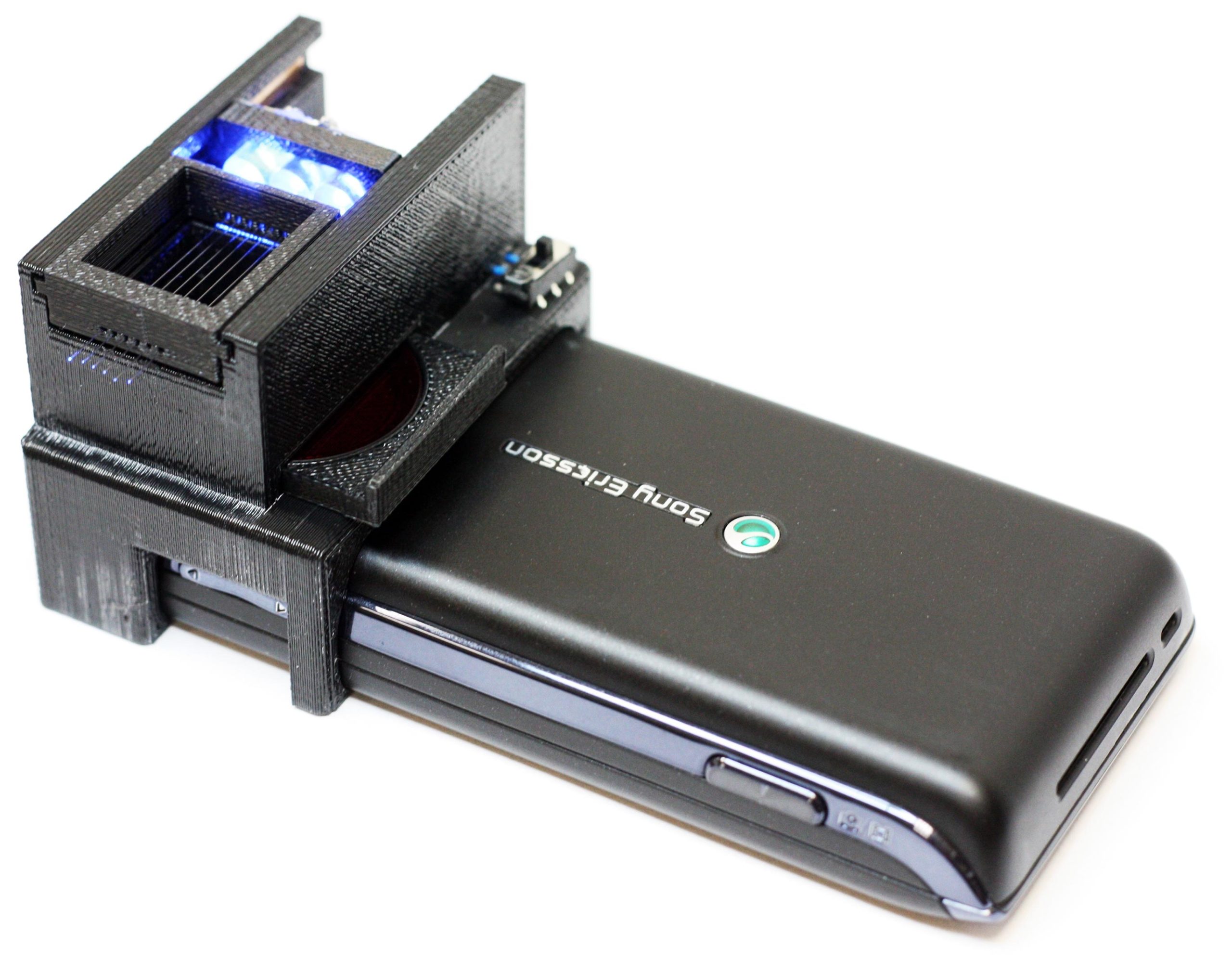
    Cell Phone-Based E. coli Detector
    Cell phone-based E. coli detector. Credit: Courtesy of UCLA Engineering

    Engineers at UCLA have developed a cost-effective cell-phone attachment that can detect the presence of the bacterium E. coli in food and water.

    FINDINGS:
    Researchers from the University of California, Los Angeles (UCLA) Henry Samueli School of Engineering and Applied Science have developed a new cell phone–based fluorescent imaging and sensing platform that can detect the presence of the bacterium Escherichia coli in food and water. The engineers combined antibody functionalized glass capillaries with quantum dots (semiconductors often used for medical imaging) as signal reporters to specifically detect E. coli particles in liquid samples using a lightweight, compact attachment to an existing cell-phone camera.

    Using battery-powered, inexpensive light-emitting diodes (LEDs), the researchers can excite/pump labeled E. coli particles captured on the capillary surface; there, emissions from the quantum dots can be imaged with the cell-phone camera, using an additional lens inserted between the capillary and the cell phone.

    The cost-effective cell-phone attachment acts as a florescent microscope, quantifying the emitted light from each capillary after the specific capture of E. coli particles within a sample. By quantifying the fluorescent light emission from each tube, the concentration of E. coli in the sample can be determined.

    IMPACT:
    E. coli can easily contaminate food and drinking water. It poses a significant threat to public health, even in highly developed parts of the world, and causes a large number of hospitalizations and deaths every year. As few as 10–100 E. coli particles can kill the cells of the intestinal lining, destroy the kidneys, and cause blood clots in the brain, as well as seizures, paralysis, and respiratory failure.

    This study illustrates the promising potential of a cell phone–enabled, field-portable, and cost-effective E. coli detection platform for the screening of both water and food samples.

    The research is published in the peer-reviewed journal The Royal Society of Chemistry.

    Reference: “Quantum dot enabled detection of Escherichia coli using a cell-phone” by Hongying Zhu, Uzair Sikora and Aydogan Ozcan, 13 February 2012, The Royal Society of Chemistry.
    DOI: 10.1039/C2AN35071H

    Authors of the research include UCLA electrical engineering postdoctoral scholar Hongying Zhu; UCLA electrical engineering undergraduate student Uzair Sikora; and UCLA associate professor of electrical engineering and bioengineering Aydogan Ozcan. Ozcan is also a member of the California NanoSystems Institute at UCLA. More on Ozcan’s research group can be found at http://innovate.ee.ucla.edu.

    The Ozcan Research Group is funded by the U.S. Office of Navel Research, the National Institutes of Health, the National Science Foundation, and the U.S. Army Research Office.

    Never miss a breakthrough: Join the SciTechDaily newsletter.
    Follow us on Google and Google News.

    Bacteria Cell Phone E. Coli Popular Quantum Dots UCLA
    Share. Facebook Twitter Pinterest LinkedIn Email Reddit

    Related Articles

    New Electromagnetic Wave Router Offers Unlimited Bandwidth

    New Efficiency Record for Quantum-Dot Photovoltaics

    New Approach for Mixing Nanoparticles to Produce Composite Materials

    Nanocapsules Battle Cancer without Harming Healthy Cells

    Smartphones Are Great for Sharing Bacteria

    Bacteria May be the Key to New Biofuel Technology

    Engineered Nanoparticles Deliver Antibiotics Directly to Bacteria

    RDT-Reader Attachment Works With Cell Phone

    Making Graphene-Based Supercapacitors With DVD Discs

    1 Comment

    1. Swetha M L on August 19, 2019 8:45 am

      I tried to develop a project in similar topic.”develop a mobile based sensor”

      Reply
    Leave A Reply Cancel Reply

    • Facebook
    • Twitter
    • Pinterest
    • YouTube

    Don't Miss a Discovery

    Subscribe for the Latest in Science & Tech!

    Trending News

    Breakthrough Bowel Cancer Trial Leaves Patients Cancer-Free for Nearly 3 Years

    Natural Compound Shows Powerful Potential Against Rheumatoid Arthritis

    100,000-Year-Old Neanderthal Fossils in Poland Reveal Unexpected Genetic Connections

    Simple “Gut Reset” May Prevent Weight Gain After Ozempic or Wegovy

    2.8 Days to Disaster: Scientists Warn Low Earth Orbit Could Suddenly Collapse

    Common Food Compound Shows Surprising Power Against Superbugs

    5 Simple Ways To Remember More and Forget Less

    The Atomic Gap That Could Cost the Semiconductor Industry Billions

    Follow SciTechDaily
    • Facebook
    • Twitter
    • YouTube
    • Pinterest
    • Newsletter
    • RSS
    SciTech News
    • Biology News
    • Chemistry News
    • Earth News
    • Health News
    • Physics News
    • Science News
    • Space News
    • Technology News
    Recent Posts
    • Scientists Print Artificial Neurons That Can Talk to the Brain
    • Bowel and Ovarian Cancers Are Dramatically Rising in Young Adults and Scientists Aren’t Sure Why
    • Alzheimer’s May Begin Decades Earlier Than You Think, New Mayo Clinic Study Finds
    • The Hidden Risk of Taking Breaks From Weight-Loss Drugs Like Ozempic
    • Total Solar Eclipse Made Cities Go Eerily Quiet Beneath the Surface
    Copyright © 1998 - 2026 SciTechDaily. All Rights Reserved.
    • Science News
    • About
    • Contact
    • Editorial Board
    • Privacy Policy
    • Terms of Use

    Type above and press Enter to search. Press Esc to cancel.