
Close Menu
    Facebook X (Twitter) Instagram
    SciTechDaily
    • Biology
    • Chemistry
    • Earth
    • Health
    • Physics
    • Science
    • Space
    • Technology
    Facebook X (Twitter) Pinterest YouTube RSS
    SciTechDaily
    Home»Space»VLT Reveals Alignment of Quasars Across Billions of Light-Years
    Space

    VLT Reveals Alignment of Quasars Across Billions of Light-Years

    By European Southern ObservatoryNovember 19, 20144 Comments4 Mins Read
    Facebook Twitter Pinterest Telegram LinkedIn WhatsApp Email Reddit
    Share
    Facebook Twitter LinkedIn Pinterest Telegram Email Reddit
    Mysterious Alignment of Quasar Rotation Axes
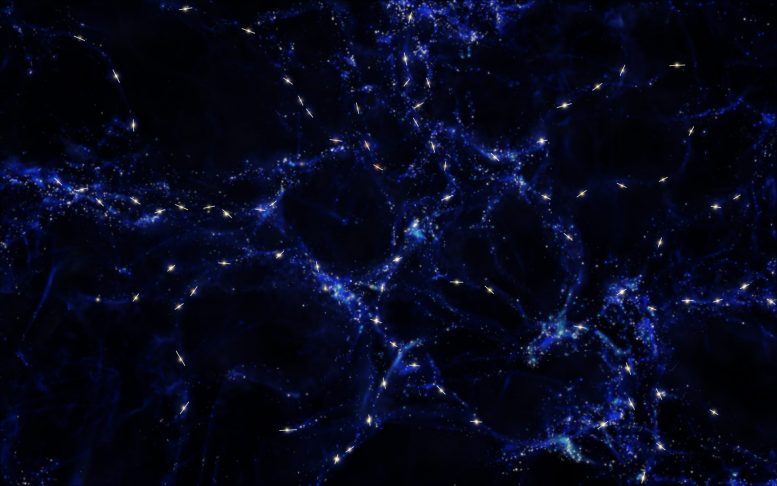
    This artist’s impression shows schematically the mysterious alignments between the spin axes of quasars and the large-scale structures that they inhabit that observations with ESO’s Very Large Telescope have revealed. These alignments are over billions of light-years and are the largest known in the Universe. The large-scale structure is shown in blue and quasars are marked in white with the rotation axes of their black holes indicated with a line. Credit: ESO/M. Kornmesser

    Using data from ESO’s Very Large Telescope, astronomers have discovered alignments between supermassive black hole axes separated by billions of light-years.

    New observations with ESO’s Very Large Telescope (VLT) in Chile have revealed alignments over the largest structures ever discovered in the Universe. A European research team has found that the rotation axes of the central supermassive black holes in a sample of quasars are parallel to each other over distances of billions of light-years. The team has also found that the rotation axes of these quasars tend to be aligned with the vast structures in the cosmic web in which they reside.

    Quasars are galaxies with very active supermassive black holes at their centers. These black holes are surrounded by spinning discs of extremely hot material that is often spewed out in long jets along their axes of rotation. Quasars can shine more brightly than all the stars in the rest of their host galaxies put together.

    A team led by Damien Hutsemékers from the University of Liège in Belgium used the FORS instrument on the VLT to study 93 quasars that were known to form huge groupings spread over billions of light-years, seen at a time when the Universe was about one-third of its current age.

    “The first odd thing we noticed was that some of the quasars’ rotation axes were aligned with each other — despite the fact that these quasars are separated by billions of light-years,” said Hutsemékers.

    Spooky Alignment of Quasars
    This very detailed simulation of large-scale structure was created as part of the Illustris simulation. The distribution of dark matter is shown in blue and the gas distribution in orange. This simulation is for the current state of the Universe and is centered on a massive galaxy cluster. The region shown is about 300 million light-years across. Credit: Illustris Collaboration

    The team then went further and looked to see if the rotation axes were linked, not just to each other, but also to the structure of the Universe on large scales at that time.

    When astronomers look at the distribution of galaxies on scales of billions of light-years they find that they are not evenly distributed. They form a cosmic web of filaments and clumps around huge voids where galaxies are scarce. This intriguing and beautiful arrangement of material is known as large-scale structure.

    The new VLT results indicate that the rotation axes of the quasars tend to be parallel to the large-scale structures in which they find themselves. So, if the quasars are in a long filament then the spins of the central black holes will point along the filament. The researchers estimate that the probability that these alignments are simply the result of chance is less than 1%.

    “A correlation between the orientation of quasars and the structure they belong to is an important prediction of numerical models of evolution of our Universe. Our data provide the first observational confirmation of this effect, on scales much larger than what had been observed to date for normal galaxies,” adds Dominique Sluse of the Argelander-Institut für Astronomie in Bonn, Germany and University of Liège.

    The team could not see the rotation axes or the jets of the quasars directly. Instead, they measured the polarization of the light from each quasar and, for 19 of them, found a significantly polarized signal. The direction of this polarization, combined with other information, could be used to deduce the angle of the accretion disc and hence the direction of the spin axis of the quasar.

    “The alignments in the new data, on scales even bigger than current predictions from simulations, maybe a hint that there is a missing ingredient in our current models of the cosmos,” concludes Dominique Sluse.


    This artist’s impression video sequence shows schematically the mysterious alignments between the spin axes of quasars and the large-scale structures that they inhabit that observations with ESO’s Very Large Telescope have revealed. These alignments are over billions of light-years and are the largest known in the Universe.

    Reference: “Alignment of quasar polarizations with large-scale structures” by D. Hutsemékers, L. Braibant, V. Pelgrims and D. Sluse, 19 November 2014, Astronomy & Astrophysics.
    DOI: 10.1051/0004-6361/201424631

    Never miss a breakthrough: Join the SciTechDaily newsletter.
    Follow us on Google and Google News.

    Astronomy Astrophysics European Southern Observatory Popular Quasars Very Large Telescope
    Share. Facebook Twitter Pinterest LinkedIn Email Reddit

    Related Articles

    Astronomers Have Discovered the Most Distant Source of Radio Emission Ever Known – 13 Billion Light-Years Away

    Astronomers Find Unexpected Giant Glowing Halos around Distant Quasars

    VLT Confirms G2 Survived Close Approach of Supermassive Black Hole

    Astronomers View Stardust Being Made in Real Time

    Astronomers Measure the Length of an Exoplanet Day

    VLT Views a Gas Cloud Being Ripped Apart by a Black Hole

    Scientists Discover the Most Powerful Quasar Outflow Ever

    Planetary Nebula Fleming 1 Likely Has Two White Dwarfs Circling Each Other at Its Center

    Scientists Detect Dark Galaxies for the First Time

    4 Comments

    1. Dave on November 19, 2014 4:40 pm

      The universe looks like the inside of a human brain when viewed with a microscope.

      Reply
      • Ian on November 21, 2014 7:57 am

        Is this an example of ‘as above, so below’? Is the Universe the hardware of a cosmic consciousness? some would say so…

        Reply
      • Tim on November 21, 2014 12:24 pm

        Dave, I was thinking that myself. The galaxy clusters look like neurons and the filaments the dendrites and axons.

        Reply
    2. Philip Russell on November 22, 2014 10:32 am

      Have we finally detected the chicken wire? I confirm that I’m definitely not a spammer, I just think I’m funny, though nobody else does yet.

      Reply
    Leave A Reply Cancel Reply

    • Facebook
    • Twitter
    • Pinterest
    • YouTube

    Don't Miss a Discovery

    Subscribe for the Latest in Science & Tech!

    Trending News

    Even Occasional Binge Drinking May Triple Liver Damage Risk

    Liftoff! NASA’s Artemis II Launch Sends Astronauts Around the Moon for First Time in 50 Years

    Scientists Discover New Way To Eliminate “Zombie Cells” Driving Aging

    This New Quantum Theory Could Change Everything We Know About the Big Bang

    This One Vitamin May Help Protect Your Brain From Dementia Years Later

    Stopping Weight-Loss Drugs Like Ozempic Can Quickly Erase Heart Benefits

    A 500-Million-Year-Old Surprise Is Forcing Scientists to Rethink Spider Evolution

    Coffee and Blood Pressure: What You Need To Know Before Your Next Cup

    Follow SciTechDaily
    • Facebook
    • Twitter
    • YouTube
    • Pinterest
    • Newsletter
    • RSS
    SciTech News
    • Biology News
    • Chemistry News
    • Earth News
    • Health News
    • Physics News
    • Science News
    • Space News
    • Technology News
    Recent Posts
    • NASA’s Artemis II: Humans Just Left Earth Orbit for the First Time Since 1972
    • What Causes Chronic Pain? Scientists Identify Key Culprit in the Brain
    • Semaglutide Shows Surprising Mental Health Benefits in Massive 100,000-Person Study
    • This Little-Known Japanese Fruit Could Help Stop Lung Cancer Before It Starts
    • Scientists Uncover Giant Lava Fields From an Active Underwater Volcano
    Copyright © 1998 - 2026 SciTechDaily. All Rights Reserved.
    • Science News
    • About
    • Contact
    • Editorial Board
    • Privacy Policy
    • Terms of Use

    Type above and press Enter to search. Press Esc to cancel.