
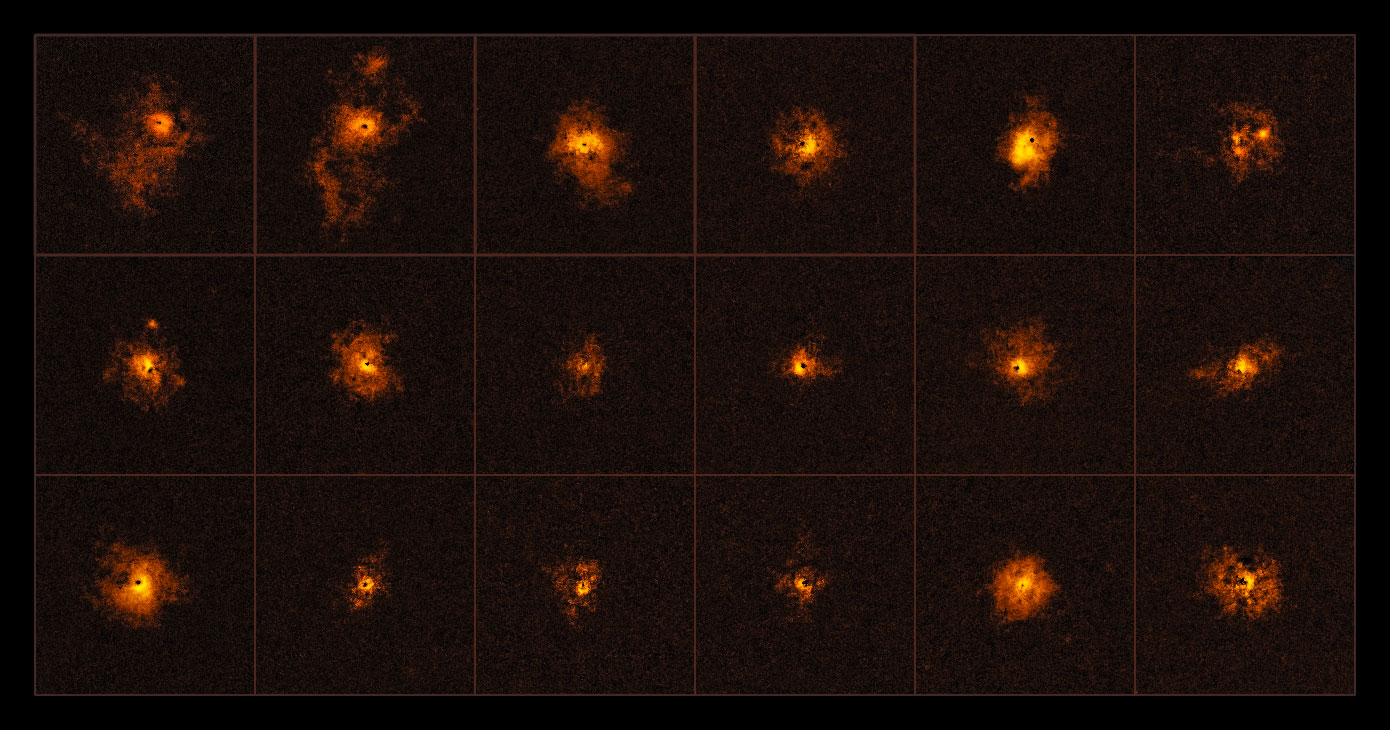
A new survey by the MUSE instrument on ESO’s Very Large Telescope indicates that halos around quasars are far more common than expected. The properties of the halos in this surprising find are also in striking disagreement with currently accepted theories of galaxy formation in the early Universe.
An international collaboration of astronomers, led by a group at the Swiss Federal Institute of Technology (ETH) in Zurich, Switzerland, has used the unrivaled observing power of MUSE on the Very Large Telescope (VLT) at ESO’s Paranal Observatory to study gas around distant active galaxies, less than two billion years after the Big Bang. These active galaxies, called quasars, contain supermassive black holes in their centers, which consume stars, gas, and other material at an extremely high rate. This, in turn, causes the galaxy center to emit huge amounts of radiation, making quasars the most luminous and active objects in the Universe.
The study involved 19 quasars, selected from among the brightest that are observable with MUSE. Previous studies have shown that around 10% of all quasars examined were surrounded by halos, made from gas known as the intergalactic medium. These halos extend up to 300,000 light-years away from the centers of the quasars. This new study, however, has thrown up a surprise, with the detection of large halos around all 19 quasars observed — far more than the two halos that were expected statistically. The team suspects this is due to the vast increase in the observing power of MUSE over previous similar instruments, but further observations are needed to determine whether this is the case.
“It is still too early to say if this is due to our new observational technique or if there is something peculiar about the quasars in our sample. So there is still a lot to learn; we are just at the beginning of a new era of discoveries,” says lead author Elena Borisova, from the ETH Zurich.
The MUSE instrument on ESO’s Very Large Telescope is able to collect three-dimensional data. Using this data cube, astronomers were able to create a 3D representation of the gas halos surrounding the distant quasars.
The original goal of the study was to analyze the gaseous components of the Universe on the largest scales; a structure sometimes referred to as the cosmic web, in which quasars form bright nodes. The gaseous components of this web are normally extremely difficult to detect, so the illuminated halos of gas surrounding the quasars deliver an almost unique opportunity to study the gas within this large-scale cosmic structure.
The 19 newly detected halos also revealed another surprise: they consist of relatively cold intergalactic gas — approximately 10,000 degrees Celsius (18,000 degrees Fahrenheit). This revelation is in strong disagreement with currently accepted models of the structure and formation of galaxies, which suggest that gas in such close proximity to galaxies should have temperatures upwards of a million degrees.
The discovery shows the potential of MUSE for observing this type of object. Co-author Sebastiano Cantalupo is very excited about the new instrument and the opportunities it provides: “We have exploited the unique capabilities of MUSE in this study, which will pave the way for future surveys. Combined with a new generation of theoretical and numerical models, this approach will continue to provide a new window on cosmic structure formation and galaxy evolution.”
Reference: “Ubiquitous giant Ly α nebulae around the brightest quasars at z∼3.5 revealed with MUSE revealed with MUSE” by Elena Borisova, Sebastiano Cantalupo, Simon J. Lilly, Raffaella A. Marino, Sofia G. Gallego, Roland Bacon, Jeremy Blaizot, Nicolas Bouché, Jarle Brinchmann, C. Marcella Carollo, Joseph Caruana, Hayley Finley, Edmund C. Herenz, Johan Richard, Joop Schaye, Lorrie A. Straka, Monica L. Turner, Tanya Urrutia, Anne Verhamme and Lutz Wisotzki, 26 October 2016, The Astrophysical Journal.
DOI: 10.3847/0004-637X/831/1/39
arXiv:1605.01422
Never miss a breakthrough: Join the SciTechDaily newsletter.
Follow us on Google and Google News.
2 Comments
The observed halos are plasma “glow mode” discharge phenomena. The halo size and luminosity is based upon the plasma energy density and EM environment. Recent observations of the Sloan Digital Sky Survey have seen a quasar dramatically diminishing energetic activities within a brief 12 year period to the point where “the quasar now looks like a normal galaxy”. Therefore the conclusion is that from a quasi-stellar object, a galaxy is formed.
Perhaps we should consider the work of one the greatest astronomers of the last century, Halton Arp who performed hundreds of observations at Mt. Wilson and Palomar Observatories. From his observations Arp concluded that quasars are born from galaxies, ejected in pairs from the galactic center in opposite directions along the galactic rotational axis. As newly ejected quasars are accelerated at near the speed of light, they gain mass and most importantly diminish their apparent red shift. Thus and most importantly, red shift appears to be an intrinsic property of matter that correlates not with distance, but rather with the age of the object.
Arp showed with dozens of examples that different red shifted objects like a galaxy and a quasar that appeared to be vastly distant from each other based on their red shifts, were actually connected by filamentary streams and other plasma bridge structures. The implications of this finding are truly revolutionary since they indicate that the universe may not be expanding, and as a result the big bang never happened, and no need for dark matter. I know that this is heretical to modern cosmology; however, the evidence is accumulating that this may very well be the case. These phenomena are supported in a plasma universe where there is charge separation resulting in EM phenomena that precede and dominate gravity. This simple yet eloquent model explains and predicts many of the anomalous observations that continue to surprise and baffle scientists that solely use the gravitational cosmological model.
Although Arp’s work was rejected by conventional science, his observations and conclusions are being vindicated by new observations and findings from advanced instrumentation.
For more precise clarification, please review this 7 minute short video:
https://www.youtube.com/watch?v=MmODEyIRUhg&index=1&list=PLwOAYhBuU3UeYFyfm2LilZldjJd48t6IY
Massive Black Holes.
Wouldn’t it be bizarre if these quasars didn’t have halos?